
By: Khushbu Ahlawat, Consulting Editor, GSDN
Introduction
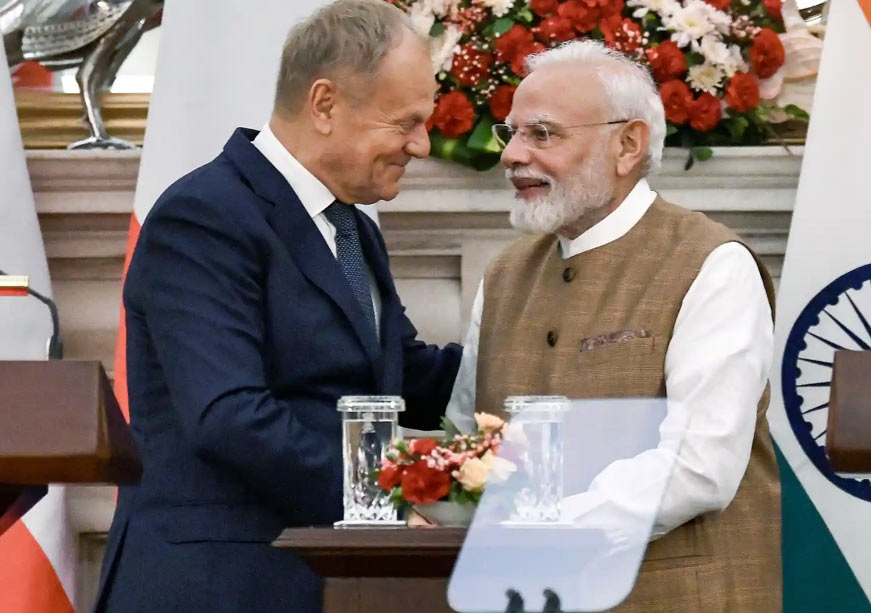
Warsaw spends more of its economy on defence than any other NATO member and cannot build fast enough. Delhi wants technology and a diversified supplier base. On paper, the match is almost too neat. The harder part is everything that has to happen after the joint statement. When a Polish prime minister lands in New Delhi with roughly a hundred chief executives in tow, the visit is not about courtesy. Donald Tusk’s three-day trip to India from 21 to 23 October 2026 was his first as prime minister since 2010, and it came with a very specific purpose: to turn a strategic partnership declared two years earlier into something that shows up on factory floors and in order books. Speaking to Indian business leaders, Tusk said as much, telling the audience that the time had come to convert declarations into joint ventures. For a relationship that has spent decades in the shadow of larger ones, that is a notable change in tone.
The groundwork was laid in August 2024, when Narendra Modi became the first Indian prime minister to visit Poland in 45 years, and the two governments elevated their ties to a strategic partnership. What the October visit added was a harder edge. Defence sat at the front of the agenda and in the joint statement alongside space, nuclear energy and technology, with both sides agreeing to set up a Defence Industry Dialogue covering technology partnerships, co-development and co-production, and expressing the hope of finalising an agreement on protecting classified information soon. They also set a goal of doubling bilateral trade, currently around €6 billion, by 2030.
Whether any of this becomes more than a good photograph depends on whether two very different defence ecosystems can find enough common ground to build things together. It is a more interesting question than it first appears.
An Old Relationship, Rediscovered
The India-Poland defence connection is older than most people assume. During the Cold War, Poland supplied military equipment to India and built industrial links that outlasted the Soviet system. In the late 1990s and early 2000s, India acquired WZT-3 armoured recovery vehicles, which support its T-72 tank fleet, and DRAWA-T fire-control systems, with Poland’s Bumar working alongside India’s BEML. The two countries signed a defence cooperation agreement in 2003 and set up a joint working group the following year. Then, for the better part of two decades, the relationship drifted. Poland turned its attention to NATO and the European Union; India’s defence ties stayed anchored in Moscow and, increasingly, in Washington, Paris and Tel Aviv.
What revived it was geopolitics. Russia’s full-scale invasion of Ukraine in 2022 turned Poland into one of the most consequential states in European security, a frontline NATO member on the eastern flank and the main logistical hub for Western support to Ukraine. Warsaw now spends 4.8 percent of its GDP on defence, the highest share in NATO, and is replacing its ageing Soviet-era inventory with modern Western systems. When Poland held the rotating presidency of the Council of the EU in 2025, it put security at the centre of the agenda, and Europe’s wider rearmament push, including the ReArm Europe initiative, the €150 billion SAFE lending instrument and the Readiness 2030 White Paper, gave it a bigger stage.
India, for its part, has been quietly rebalancing. Russia’s share of its defence imports fell from roughly 70 percent in 2011-15 to about 40 percent in 2021-25, as Delhi added suppliers and pushed hard on domestic production. The broader EU-India relationship, which gathered pace this year with the Security and Defence Partnership signed in January 2026 and the conclusion of the long-delayed EU-India free trade agreement, provides the diplomatic scaffolding. Poland sits inside European manufacturing networks, which makes it a plausible gateway for Indian firms looking to enter Central and Eastern Europe.
Why the Two Sides Need Each Other
The logic of the partnership rests on complementarity, and it is worth spelling out. Poland has money, urgency and a growing technology base, but limited production capacity. A large national defence budget does not automatically translate into factories, trained workers and supply chains, and Polish defence firms are stretched. India has the opposite profile: manufacturing scale, a large engineering workforce, a growing private defence sector and a government that has spent years pushing indigenous production, but a continuing need for advanced technology and for suppliers that are not tied to any single bloc. Joint manufacturing and research would let each side fill the other’s gap.
This is not just theory. The most concrete example already exists in Uttar Pradesh. WB Group, Poland’s largest privately owned defence technology company, operates in India through WB Electronics India and already supplies its Warmate loitering munition to the Indian Army. The company is developing a production line in the Uttar Pradesh Defence Industrial Corridor, with a planned facility at Jhansi, and its co-owner Adam Bartosiewicz told Indian media during Tusk’s visit that WB drones would be manufactured in India as early as next year. His stated ambition was to build WB India into a substantial local presence rather than just assemble products for export. WB Group’s unmanned systems have seen heavy use in Ukraine, which gives it a decade of operational experience that Indian planners, watching modern drone warfare closely, have good reason to value.
There is a pointed footnote to the story. Indian officials have noted that Polish-made drones were put to use during India’s Operation Sindoor in 2025, when Indian forces struck terrorist infrastructure inside Pakistan. For a country that has been rewriting its doctrine around unmanned systems, loitering munitions, counter-drone defence and electronic warfare, that is exactly the sort of battlefield-tested capability worth co-producing locally.
Where the Real Opportunities Lie
Sustaining Soviet-origin equipment is the obvious starting point. India still operates large numbers of T-72 tanks and other legacy platforms, and Polish expertise in armoured vehicles and military engineering could help keep them serviceable and modernised. That is useful but not transformative.
The more consequential opportunities lie in contemporary warfare. Unmanned aerial systems, counter-drone technology, electronic warfare and secure battlefield communications are areas where Poland has been investing under wartime pressure and where India has urgent needs. Cyber defence, including protecting critical networks and building secure communications infrastructure, is another natural fit. Naval cooperation could focus on sensors, radar integration and specialised ship components, while space-based imaging and satellite data offer further scope. On the Indian side, strengths in electronics, ammunition, aerospace components, shipbuilding and autonomous systems could give Polish manufacturers a capable and cost-competitive partner.
The mistake to avoid is trying to do everything at once. The sensible approach is an initial portfolio of projects that are commercially credible and technically achievable, with startups and research institutions connected to established manufacturers to identify the right fits. The institutional plumbing is already in place. The Joint Working Group on Defence held its eighth meeting in Warsaw in September 2026. India reopened its defence wing in Warsaw in 2024. The new Defence Industry Dialogue is meant to link technology firms, manufacturers and officials. And the India-Poland business forums in New Delhi and Bengaluru brought together nearly a hundred Polish companies, defence firms among them. The question is whether these mechanisms produce contracts or merely meetings.
The Frictions Nobody Should Ignore
It would be a mistake to treat the partnership as frictionless, and the strongest analyses of it do not.
The deepest divergence is in threat perception. Warsaw regards Russia as its primary and immediate danger, and many Polish officials see India’s continued purchases of Russian oil as helping to finance Moscow’s war. Delhi, meanwhile, maintains a relationship with Russia built on decades of defence dependence and on its own concern about China, and it does not see Moscow the way Warsaw does. India also has its own sensitivities, notably over Poland’s engagement with Pakistan, which became visible after Polish Foreign Minister Radosław Sikorski visited Islamabad in 2025, only months after Operation Sindoor.
Tusk’s statement that the two countries have no conflicts of interest is a promising starting point, and Warsaw has shown a willingness to separate the Ukraine question from wider security cooperation with India, a pragmatic recognition of Delhi’s constraints. Tusk has also welcomed India’s recent engagement with both Moscow and Kyiv and its proposed peace plan, which Kyiv has described as the most comprehensive so far. Still, trust of the kind needed for real technology transfer is not built by joint statements. It has to be built deliberately, through repeated, reliable cooperation.
That brings up the most practical obstacle. The two countries have yet to finalise an agreement on the mutual protection and exchange of classified information, and without it, deeper defence-technology cooperation cannot really begin. Poland’s industry will want credible safeguards against unauthorised transfers and enforceable end-use conditions. India will want assurance that sensitive technology it receives will not be restricted or withdrawn when politics shifts. A sensible way through is to separate projects that need heightened protections from those that do not, so that sensitive negotiations do not hold up cooperation that is possible in the short term.
What Success Would Look Like
The measure of this partnership will not be the number of memoranda signed. It will be whether, in two or three years, there are Indian factories producing Polish-designed systems under licence or in joint ventures, Indian components in Polish products, and engineers from both countries working on shared designs. That would move the relationship beyond the traditional buyer-seller pattern, in which one side sells equipment and the other uses it, to something closer to co-development, where both sides have a stake in the outcome.
There are good reasons to think it can work. India’s target of expanding defence exports and building a more resilient domestic industrial base lines up with Poland’s need for production capacity and for partners outside the usual circle. The EU-India free trade agreement, expected to be ratified by the end of the year, could help lower barriers in related sectors. The EU-India Security and Defence Partnership gives both sides a framework to work within. And Europe’s rearmament drive means Polish firms will have the order books to justify investing in a new partner.
Conclusion
India and Poland are an unlikely pair in some respects, a large Asian power with a complicated relationship with Russia and a mid-sized European frontline state that sees Russia as an existential threat. Their convergence is a sign of how the global defence landscape is being reorganised, as Europe rearms, India diversifies and both discover that their industrial needs overlap more than their political histories would suggest.
The October visit supplied the political momentum and a clear agenda. What it did not supply, and could not, is the contracts, capital and trust that actually build a defence industrial relationship. Those will come, if they come, from the slower work that follows: finalising the classified-information agreement, launching a handful of realistic joint projects, and proving through steady delivery that each side is a reliable partner. If Delhi and Warsaw manage that, the partnership could become one of the more durable links between India and Europe, anchored in shared interests rather than ceremonial visits. If they do not, it will join the long list of promising declarations that never left the conference room. The next year or two will show which it is.


