
By: Khushbu Ahlawat, Consulting Editor, GSDN
INTRODUCTION
The EU-India Security and Defence Partnership, signed in January 2026, did not come out of nowhere. It is the end point of a run of shocks, from the Himalayas to Ukraine, that pushed two cautious partners towards each other.
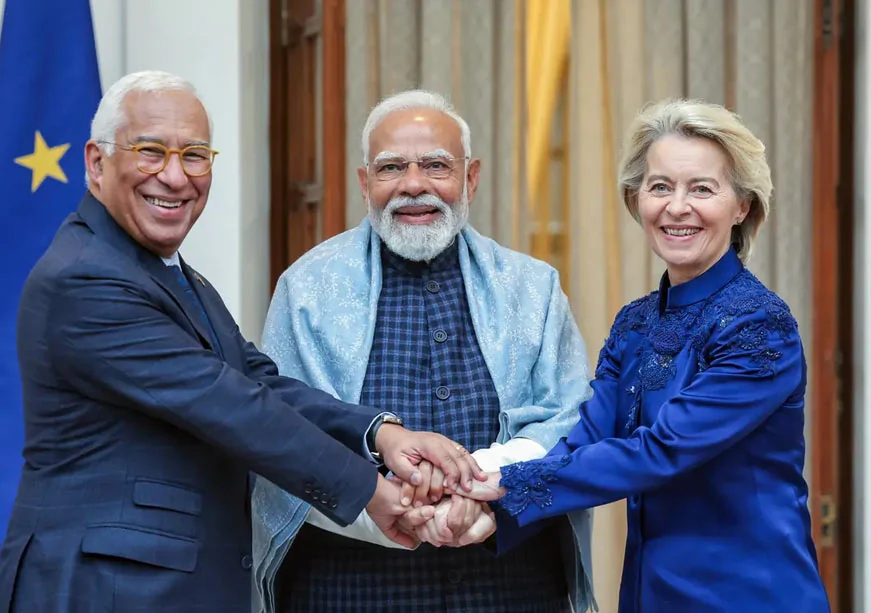
When India and the European Union signed their Security and Defence Partnership (SDP) at the 16th EU-India Summit in New Delhi in January 2026, most of the headlines went elsewhere. The summit had also produced the long-awaited free trade agreement, and trade is an easier story to tell. Tariff lines, market access and who gets cheaper cars make for better copy than a framework document on defence cooperation. But the SDP is the more unusual achievement. It is the first time Brussels and New Delhi have built a dedicated structure for security and defence, covering maritime security, the defence industry, cyber and hybrid threats, counterterrorism, space, emerging technologies and organised crime. A relationship that for decades was about trade, development money and summit communiqués now has a security chapter.
To understand why it happened now, it helps to follow the sequence rather than the signature. Six years ago, a former EU ambassador to India has remarked, nobody would have thought this possible. What changed was not one event but a series of them, each of which nudged Europe and India to look at the other differently. This article walks through that sequence in order, then looks at what the partnership offers, where it is likely to stall, and what comes next.
2020 to 2021: the first cracks in old assumptions
The starting point is June 2020, when Indian and Chinese troops clashed in the Galwan valley. For India, Galwan ended a long period in which the border dispute with China could be managed quietly. China became, in the plainest sense, the long-term security problem.
Europe’s response was measured. The EU said it supported a peaceful solution and left it there. Delhi noticed. The even-handed language, set against Europe’s sharper reaction to other disputes, left an impression that has not entirely faded, and Indian analysts still bring it up when they discuss how far European and Indian threat perceptions really overlap.
The following year, 2021, the two sides launched the EU-India Connectivity Partnership. It was a useful signal that the relationship was widening beyond trade, but it is also a cautionary tale. Its implementation has remained limited, and the people now working on the SDP know that a grand framework without follow-through is exactly the fate they need to avoid.
In those years the relationship was cordial and thin. Europe saw India as a large market and a democratic partner. India saw Europe as an investor and a source of technology, but not as a security actor. Neither side was pushing for more.
2022: Ukraine, and a European awakening
The turning point on the European side came in February 2022, when Russia launched its full-scale invasion of Ukraine. The war, now running for nearly five years, changed the way Europe thinks about itself. A continent that had spent decades enjoying a peace dividend found itself with depleted stockpiles, fragmented defence industries and an adversary at its border.
A month after the invasion, in March 2022, the EU approved its Strategic Compass, an action plan setting out a common vision and concrete goals for European security and defence up to 2030. One of its practical outcomes was a new kind of instrument: the Security and Defence Partnership. These are non-binding frameworks that let the EU deepen ties with like-minded countries without the heavy machinery of a formal alliance.
The EU has since signed twelve of them, and they are not all alike. Norway, the United Kingdom and Canada, as NATO allies, built on ties that already existed. Albania, Moldova and North Macedonia are part of an effort to counter Russian influence. Ghana’s focuses on counterterrorism and capacity building in West Africa. India’s belongs to a third group, with Japan, South Korea and Australia, where the aim is stability in the Indo-Pacific and cooperation in defence industry and capability development.
For India, Ukraine did something different. It exposed how exposed Indian forces were to a supplier tied down in a war. Russia’s share of India’s arms imports had already been falling, from 69 percent in 2012 to 2016 to 36 percent in 2019 to 2023, according to SIPRI, but the war made the delays visible. Deliveries of the S-400 air defence system and Admiral Grigorovich-class frigates slipped. Moscow’s growing reliance on Beijing for components, including some used in the S-400, added to the unease. Some 60 to 70 percent of India’s inventory is still of Russian or Soviet origin, so this was not a problem that could be solved overnight.
2023 to 2024: quiet groundwork
The next two years were less dramatic but they mattered. In 2023 the EU appointed a military attaché to New Delhi, a small but telling step. Diplomats do not post defence officers to capitals where they expect nothing to happen. India has yet to reciprocate in Brussels, which the ORF brief points out as something worth fixing.
Meanwhile, the practical business of defence cooperation went on through bilateral channels, which is where the real substance has always sat. France continued to be India’s most trusted European partner, with the Scorpène submarines being built in India using French technology. Spain’s Airbus and Tata Advanced Systems began manufacturing C-295 transport aircraft in Gujarat. Italy’s Leonardo worked with Adani Defence and Aerospace on helicopters. Sweden’s Saab set up a facility in Haryana to produce the Carl-Gustaf M4 weapon system.
Note what these projects have in common. They are about co-development, local production and technology sharing, not simple purchases. By the middle of the decade, Indian procurement had firmly attached itself to domestic manufacturing, and the European firms that did well were those willing to build in India.
In March 2024 the European Commission published its first European Defence Industrial Strategy. It was a frank document. It described a sector marked by chronic underinvestment, fragmented production lines and short-term procurement cycles. Read alongside India’s own reform drive, it hinted at a fit that nobody had yet spelled out: Europe needed capacity, and India was building it.
2025: pressure from every direction
If 2022 started the shift, 2025 sped it up. Several things happened close together.
In Europe, the return of Donald Trump to the White House raised hard questions about American security guarantees. Washington’s increasingly transactional approach to NATO, including pressure on allies to spend 5 percent of GDP on defence, strengthened the case for strategic autonomy. In March the Commission unveiled ReArm Europe, a plan worth 800 billion euro. Within it came the Security Action for Europe instrument, known as SAFE, which offers 150 billion euro in loans for defence production, joint procurement and industrial capacity.
In India, the picture was just as unsettled. American tariffs and Washington’s evolving engagement with Pakistan acted as what the ORF brief calls a reality check on a relationship once billed as the defining partnership of the century. In May 2025, during Operation Sindoor, Chinese arms supplied to Pakistan played a visible role, driving home how closely Beijing and Islamabad had converged. Indian planners saw the China-Pakistan axis confirmed as the country’s principal security challenge. Delays to the GE-HAL F414 fighter engine programme and the loss of momentum in the Quad did not help American credibility, even as India renewed a ten-year defence framework with the United States in the autumn.
The result was a kind of mirror image. Europe was worried about being left alone. India was worried about relying on too few suppliers. Four structural shocks, as the brief lists them, had come together: the war in Ukraine, Chinese assertiveness in the Indo-Pacific, doubts about the United States, and tension between India and Pakistan. Their threat perceptions were not identical, but they overlapped enough on maritime security, on a free and open Indo-Pacific, on reducing dependencies in critical sectors, and on diversifying arms procurement away from the United States and Russia.
Indian firms had, in fact, already begun to supply Europe. Defence exports to the continent grew from about 2.8 million US dollars before the Ukraine war to 67.4 million in 2023-24 and 135.6 million in the first nine months of 2024-25. Indian 155 mm artillery shells, much cheaper than Western equivalents, won a 68 million dollar order from Germany’s Rheinmetall to Reliance Defence. The trade was no longer one-way.
January 2026: the signing
This is the context in which the SDP was signed on 27 January 2026. It came alongside the new EU-India Strategic Agenda and the conclusion of the free trade agreement. Indian Defence Minister Rajnath Singh said as it was signed that Indian industry could play a meaningful role in the EU’s rearmament effort.
The agreement is not a treaty and does not promise help in a crisis. The EU’s SDPs are non-binding and each contains a review clause, which suits India’s long dislike of alliances. What the SDP offers instead is machinery: an annual Security and Defence Dialogue, a dedicated EU-India Defence Industry Forum, and negotiations towards a Security of Information Agreement. That last item is the one to watch. Without a framework for exchanging classified information, sensitive cooperation and technology transfer cannot go far. The EU’s ambassador has described the SDP as a political enabler and the information agreement as the legislative enabler.
The SDP also commits both sides to exploring Indian participation in relevant EU defence initiatives. Whatever comes of it will depend on legal frameworks and political approval, but it is the first formal opening for India to become part of Europe’s emerging defence architecture. The brief reads it as a bid to move beyond the buyer and seller model.
The same month the European foreign policy chief, Kaja Kallas, visited New Delhi and said Europe would increasingly source defence capabilities from outside the bloc. It was a notable shift from a Union that, not long ago, wanted its money spent at home.
2026: what has happened since, and what could
The months since the signing have been about turning intent into plans, and this is where the harder questions begin.
On the opportunity side, the logic is neat. India can offer scale, lower costs, a large skilled workforce and growing capacity in ammunition, loitering munitions, drones, missiles, artillery, electronics and shipbuilding. Europe has what India lacks. A 2024 estimate puts research and development intensity at 1.2 percent of revenue for Indian defence firms against 3.4 percent for their global counterparts. Europe leads in defence R&D and advanced military technology, which could help Indian firms move up the value chain.
India’s own targets show why this matters. New Delhi wants defence exports to rise from about 2.8 billion dollars in 2025 to 5.8 billion by 2029, and production from 17.4 billion dollars in 2024-25 to around 34.7 billion. The 2026-27 defence budget is about 90.8 billion dollars, roughly 2 percent of GDP. Deeper integration into European supply chains could help meet those goals while bringing in technology and investment.
Existing projects give some idea of the scale. Germany’s ThyssenKrupp Marine Systems and Mazagon Dock are working on six advanced diesel-electric submarines with air-independent propulsion, a deal that may include a degree of technology transfer in one of the most jealously guarded areas of defence. In February 2026 the Defence Acquisition Council cleared a record package that included 114 more Rafale fighters, adding to the 26 naval variants already approved. The Rafale relationship now includes engines and long-term maintenance, work Europe itself needs.
Threat perceptions differ. The EU regards Russia as an existential danger. India regards China as its long-term challenge and still depends on Moscow for maintenance and legacy platforms. India watches how Europe handles China, noting that member states keep substantial economic links to Beijing. It also notes the EU’s continued engagement with Pakistan, including preferential market access under the GSP+ scheme. A diplomatic spat with Poland in January 2026 over its foreign minister’s Pakistan visit, and India’s participation in the Zapad exercises with Russia and Belarus, show the gap. These differences may confine cooperation to low-risk areas such as humanitarian relief and anti-piracy.
Rules point in opposite directions. SAFE requires at least 65 percent of component costs to originate in the EU, Ukraine or the European Economic Area. India’s Defence Acquisition Procedure favours indigenous content, with at least 50 percent for the Buy Indian-IDDM category. Squaring the two is difficult, and it weakens the case for co-production. The SDP is only the first step towards SAFE access; a separate agreement is needed before India can receive any financing. That is not a given. Canada is only the third country with access, and talks for the United Kingdom collapsed in November 2025.
Europe is divided. Export controls and licensing regimes differ across member states, and defence decisions remain largely national. Cooperation is therefore likely to stay anchored in bilateral ties, and there is a risk that EU-wide procurement rules could complicate India’s relationships with individual capitals.
The model is slow. Government-to-government deals centred on major platforms do not suit fast-moving technology. Design, intellectual property and high-value work remain with European firms, leaving Indian companies mostly in components, assembly and support.
There is a trust problem underneath. European companies worry about intellectual property leaking. Indian officials worry about being kept in the lower rungs of the supply chain. Until the information agreement is signed and tested, each side will hedge.
What comes next
The brief proposes a set of steps that follow naturally from this history, and they are worth restating in order of urgency.
First, the Security of Information Agreement should come first, because it opens the door to Indian participation in selected projects under the EU’s Permanent Structured Cooperation framework and other initiatives. Second, the Defence Industry Forum should be run as a matchmaking hub, finding specific platforms where Indian manufacturing and European research fit together and encouraging joint ventures. Joint projects can be designed to meet content requirements while qualifying for SAFE funding.
Third, an innovation track could be added. India’s iDEX programme, which involves more than 650 startups and over 10,000 small firms, could be linked to the European Defence Fund, which has backed 224 projects worth 4 billion euro since 2021. India might also consider joining the EU Defence Innovation Scheme. That would take cooperation beyond state-to-state contracts.
Fourth, the EU-India Trade and Technology Council can help from the side. Semiconductors, artificial intelligence, quantum technologies, space and secure supply chains are all dual-use, so progress there supports defence cooperation without anyone having to discuss arms deals. Finally, India should send a military attaché to Brussels to match the European one in Delhi, a cheap step that would keep dialogue going. On the harder question of Russia, the brief argues for pragmatism rather than pressure. France has shown that a strong, independent partnership with India is possible despite different positions on Moscow. As India diversifies, its reliance on Russian kit may fade of its own accord.
A framework still waiting to be filled
Looked at in sequence, the SDP is less a sudden breakthrough than the result of six years of accumulated pressure. Galwan showed India that its neighbourhood was not going to calm down. Ukraine showed Europe that peace could not be assumed. Washington’s unpredictability gave both a reason to look for other partners. Operation Sindoor and Europe’s rearmament drive gave them something concrete to talk about.
But agreements that ignore history tend to repeat it. The EU-India Connectivity Partnership was launched with fanfare in 2021 and has delivered little. The SDP is, in the end, a statement of political willingness. It does not itself create a binding industrial arrangement, and its worth will be measured by whether joint projects actually get built.
The honest assessment is that the partnership does not need the two sides to agree on everything. It needs them to cooperate where interests meet and leave the rest alone. If they manage that, with patience and a willingness to bend some rules, the arrangement could become a lasting pillar of security in both the Indo-Pacific and Europe. If not, it will join the long list of well-meant frameworks that never quite left the page.


