
By: Khushbu Ahlawat, Consulting Editor, GSDN
Introduction
On 12 December, thirty years of water diplomacy between India and Bangladesh runs out. The real danger is not that talks fail, but that they succeed at the wrong thing. On 12 December 1996, Prime Minister H.D. Deve Gowda and Prime Minister Sheikh Hasina sat down in New Delhi and signed what both governments hailed as the end of a dispute that had festered for decades. The Ganges Water Sharing Treaty was to run for thirty years, long enough for a Bangladeshi child born that week to grow up, have children of her own, and watch the treaty approach its own expiry. That date is now close. The agreement lapses on 12 December 2026, barely four weeks from today, and as of this writing there is no announced renewal, extension or replacement.
The politics around the expiry are as tangled as the hydrology. In Dhaka, a BNP-led government whose party has criticised the treaty for years has little room to accept less than it has publicly demanded. Bangladesh’s Water Resources Minister, Shahiduddin Chowdhury Anee, has said his country wants a new treaty rather than a simple renewal, with a guarantee clause to secure its dry-season share. In New Delhi, the Ministry of External Affairs has said renewal will be handled through the existing Joint Rivers Commission, and in February 2026 the government told Parliament that renewal discussions had not yet begun. In July, a parliamentary standing committee on external affairs urged the government to open talks “without further delay.” Layered on top is the matter of Sheikh Hasina herself, sentenced to death in absentia by a Bangladeshi tribunal and living in India, a fact that makes every bilateral negotiation harder to insulate from wider grievance.
All of this has pushed the debate into a familiar groove: how many cusecs, released when, at which barrage. That groove is worn deep. It is worth asking whether it is still the right one.
What the 1996 Treaty Actually Does
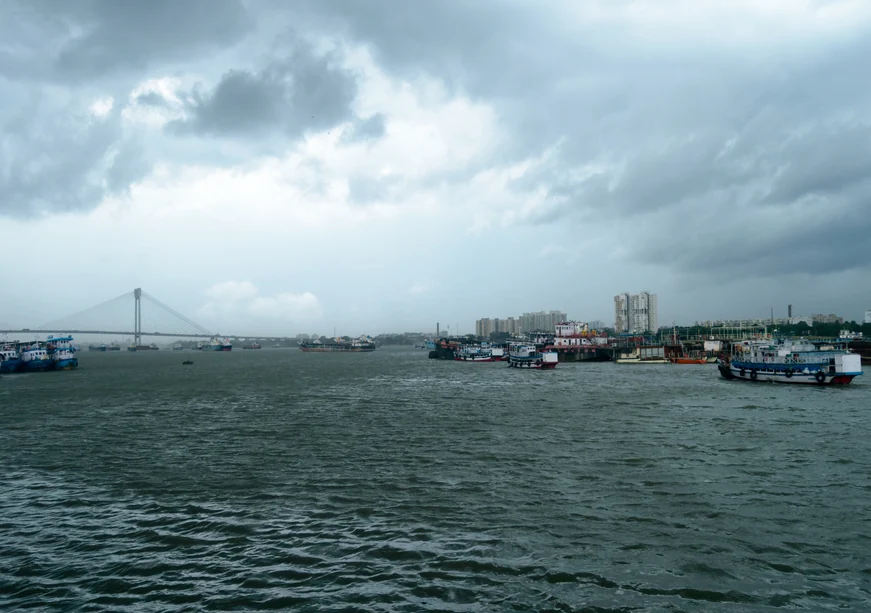
It helps to be precise about the instrument being debated. The treaty governs one thing: the sharing of Ganges flows at the Farakka Barrage in West Bengal during the lean season, from 1 January to 31 May, assessed in ten-day periods. Farakka sits roughly 18 kilometres upstream of the Bangladesh border and was built in the 1970s to divert water down the Bhagirathi-Hooghly channel so that Kolkata’s port could stay navigable. That diversion was exactly what made it a grievance downstream from the day it began operating.
The treaty’s formula is a sliding scale. When flow at Farakka is 70,000 cusecs or less, the two countries split it equally. Above that, a fixed volume goes to each side depending on the band the flow falls into. Article III caps India’s “reasonable use” withdrawals between Farakka and the Bangladesh border at 200 cusecs. A Joint Committee collects and examines data on the ground, and the India-Bangladesh Joint Rivers Commission, set up in 1972, provides the wider institutional frame.
By the standards of transboundary river agreements in South Asia, it has done respectable work. Of the 54 rivers the two countries share, the Ganges is the only one governed by a durable bilateral water-sharing treaty. The Teesta agreement, proposed more than a decade ago, remains unsigned. The Kushiyara agreement of 2022 and the Feni memorandum of 2019 are narrower in scope. So the 1996 treaty is not merely one agreement among many; it is the main load-bearing structure in a very thin architecture.
But it was built for the Ganges of the mid-1990s, and it has two structural weaknesses that nearly every serious reading identifies. First, it has no guarantee clause. The 1977 agreement that preceded it had one, giving Bangladesh a floor in dry years. The 1996 text replaced it with a softer commitment: when flow at Farakka falls below 50,000 cusecs in any ten-day period, the two governments are only to enter immediate consultations. That is a promise to talk, not a promise of water. Second, it measures only volume at a single point. It says nothing of sediment, of ecological flows, of groundwater, of what happens in the delta, or of anything beyond the barrage.
The Argument for Going Beyond the Cusec
This is where the better thinking on the treaty’s future departs from the arithmetic. Water scholars, among them Nilanjan Ghosh of the Observer Research Foundation, have argued that the 1996 framework treats the river as a quantity to be divided, when it is actually a system to be managed. The distinction matters for three reasons.
The first is climate. A treaty with fixed bands was calibrated against a hydrological record that is now a weaker guide to the future. Glacier melt in the Himalaya, shifting monsoon patterns and changing groundwater recharge all alter how much water arrives at Farakka and when. The Ganges basin supports about 655 million people, making it one of the most densely populated river systems on earth, and any allocation formula that assumes stable flows is built on sand. A more adaptive agreement would define what counts as normal, moderately scarce and severely scarce conditions, and write transparent procedures for adjusting shares as conditions move between them.
The second is ecology and the delta. A river carries more than water. It carries sediment, and sediment builds and maintains the land at its mouth. The Sundarbans, the world’s largest mangrove forest, which straddles the border, depends both on the freshwater that dilutes salinity and on the silt that lets the delta keep pace with rising seas. When barrages, embankments and diversions interfere with either, the damage shows up not at Farakka but hundreds of kilometres downstream, in salt-intruded farmland and a shrinking forest. The 2011 India-Bangladesh memorandum on conserving the Sundarbans is a start, but its conservation focus cannot on its own address freshwater availability, sediment connectivity or livelihoods. A revised treaty should treat environmental flows as a binding component, assessed across seasons and ecological zones, not a footnote.
The third reason is that the “upstream India versus downstream Bangladesh” frame, while politically useful, is analytically thin. Both countries have internal tensions that the treaty ignores.
The Domestic Fault Lines Nobody Wants to Discuss
On the Indian side, West Bengal is not a bystander. The Bhagirathi-Hooghly channel supplies the Kolkata urban-industrial region and underpins the Kolkata-Haldia port complex, and the Farakka feeder canal has historically sustained its lean-season flows. Dismantling or radically re-operating Farakka, as some critics in Bangladesh demand, would carry real costs for West Bengal’s water security. Yet the same barrage has been blamed for upstream sedimentation, bank erosion and flooding in Bihar and parts of West Bengal itself. Bihar’s position illustrates the point. Reports indicate that Bihar wants the Centre to hold off on renewal, while its coalition partner JD(U) has pressed for fresh talks. A structure that benefits one Indian state is perceived to impose costs on another. That is hydropolitics at sub-national scale, and it means India’s negotiating position is not a single voice but several.
On the Bangladeshi side, the story is also more complicated than the upstream-downstream binary allows. The country’s southwest suffers real freshwater scarcity, salinity intrusion and stress on dry-season agriculture. Bangladeshi officials have called Farakka a “death trap” and have pointed to the roughly 900 embankments India built along the Ganges after the barrage. These are serious grievances. But water security in Bangladesh also depends on things beyond the volume released at the border: the health of its own distributary channels, groundwater use, sedimentation and agricultural choices. Dry-season irrigated rice is among the most water-intensive crops one can grow in the lean months, precisely when the river is at its lowest. India has been nudging farmers toward less thirsty crops, using higher minimum support prices for millets and value-chain incentives, while Bangladesh’s rice-centred agriculture remains a heavy dry-season draw. None of this negates Dhaka’s developmental needs. It does suggest that demand management on both sides belongs in any honest negotiation, and that every additional requirement should not simply translate into a demand for more water at Farakka.
What Other Rivers Can Teach This One
South Asia is not short of cautionary tales about what happens when river diplomacy is treated as a purely political bargain. The Indus Waters Treaty of 1960, long cited as one of the world’s most resilient water agreements, survived wars between India and Pakistan for decades. In April 2025, after the Pahalgam terror attack, India placed it in abeyance, a reminder that even the sturdiest treaty rests on political goodwill that can vanish quickly. The lesson for the Ganges is not that treaties are fragile by nature, but that an agreement which gives neither side an institutional reason to keep talking when relations sour will not survive the souring.
Other basins offer more constructive models. The Colorado River, shared between the United States and Mexico, has been managed through a series of “Minutes” appended to the 1944 treaty. Minute 319, agreed in 2012 and implemented in 2014, allowed a deliberate “pulse flow” of water to be released to restore the river’s long-dry delta in Mexico. Minute 323, in 2017, set out how the two countries would share shortages and surpluses in a drought, in effect writing an adaptive mechanism into the agreement. The point is not that the Ganges should copy the Colorado, since the two systems differ enormously, but that treaties can be built to flex with conditions, to protect ecosystems explicitly, and to share the pain of scarcity by rule rather than by dispute. These are the very features the 1996 treaty lacks.
There is also a geographic omission worth flagging. Nepal supplies a large share of the Ganges’s dry-season volume through its rivers, yet it is absent from the treaty framework. The 1996 Mahakali Treaty between India and Nepal envisioned a shared storage project at Pancheshwar, but it has languished for decades. Any basin-wide thinking about the post-2026 era eventually has to find a way to bring Kathmandu into the conversation, however long that takes.
From Dividing Water to Sharing Benefits
If the treaty is to be rebuilt, what might it look like? The most promising idea is a shift from allocation to benefit sharing. The question stops being “how many cusecs does each side get?” and becomes “how do we sustain and distribute the total economic and ecological value this river system generates?”
That reframing has practical consequences. It would distinguish consumptive uses, like irrigation withdrawals, from non-consumptive or partly consumptive ones, like navigation, hydropower and many ecosystem services, instead of lumping all demands into one undifferentiated quantity. Treating them as equivalent produces misleading pictures of scarcity. It would assess each sector’s claims through marginal benefits, opportunity costs and distributional effects. And it would set certain floors that economics cannot trade away: basic human water needs and critical ecosystem functions should be treated as constraints within which competing uses are weighed, not as additional claims in an unrestricted optimisation. That matters most in the Sundarbans, where the loss of ecosystem services may be both irreversible and invisible to conventional project appraisal.
Institutionally, a more adaptive framework would rest on a few building blocks. A jointly maintained hydrological knowledge base covering changing flows, upstream withdrawals and groundwater interactions. Explicit environmental-flow requirements. Joint monitoring of sediment generation, transport and deposition. A structured consultation channel for affected states, particularly West Bengal and Bihar, and for comparable regions in Bangladesh. An agreed method for costing alternative allocations. And a stronger Joint Rivers Commission, with transparent data and independent scientific review, so that disputes over what the river is actually doing are settled by shared evidence instead of competing narratives.
The Politics Will Not Wait for the Hydrology
None of this is easy. An unconditional minimum guarantee, the clause Dhaka wants restored, is hard to square with basin sustainability in a drying, climate-stressed river; a flat promise of water in every dry year is a promise nature may not allow either government to keep. But India should also recognise that refusing a guarantee without offering an alternative leaves Bangladesh’s concern unanswered. The better answer to the guarantee demand is a well-designed adaptive mechanism that shares hydrological risk fairly across wet and dry years, rather than a fixed number that breaks the first time the river fails to deliver.
The geopolitical backdrop makes that harder. The 1996 treaty was signed when Delhi enjoyed a friendly government in Dhaka. That is no longer the case. There is a real risk that water, a matter of human need, becomes a vehicle for wider grievance, with one side framing every shortfall as injustice and the other treating every demand as a political manoeuvre. Few outcomes would be worse for the millions on both banks who depend on the river regardless of who governs either capital.
Conclusion
The Ganges Treaty’s thirtieth anniversary arrives with a deadline attached, and the temptation will be to treat it as a drafting problem: extend the old text, tweak a number, announce a technical committee, and move on. That would be the path of least resistance, and it would probably keep the peace for a while. But it would also leave untouched the things that now matter most: a changing climate, a deteriorating delta, and a thicket of domestic interests on both sides that the original treaty never had to confront.
The better path, harder and slower, is to accept that the river has outgrown the instrument built to divide it. A twenty-first-century Ganges agreement would share risk, not just volume; protect sediment and ecological flows, not just discharge at a barrage; bring West Bengal, Bihar and Bangladesh’s affected regions into the room; and rest on evidence both governments trust. Whether Delhi and Dhaka have the political bandwidth for that in the next four weeks is doubtful. Whether they can begin the work, with an interim extension and a firm timetable, is a more modest and more realistic test. The river will keep flowing, or not flowing, whatever they decide. The question is whether the next treaty is written for the river that exists today, or for the one that was there in 1996.


