
By: Khushbu Ahlawat, Consulting Editor, GSDN
INTRODUCTION
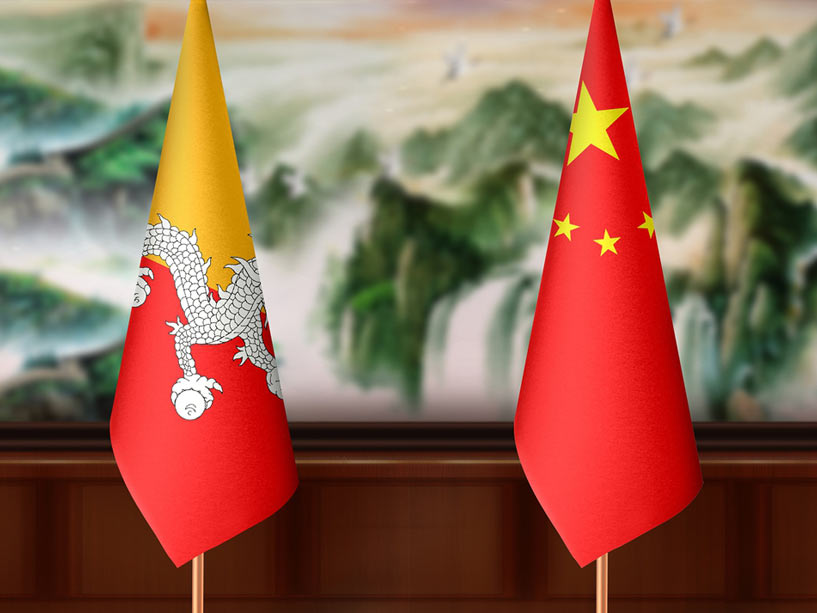
Bhutan and China have never exchanged ambassadors. Yet tourists, students, traders and delegations keep crossing the gap, mostly by indirect routes. How did a relationship with no formal ties come to carry so much traffic?
On the map, Bhutan is a small kingdom wedged between two giants. In diplomatic terms it is still. Thimphu has no formal relations with any of the five permanent members of the UN Security Council, and China, the neighbour it shares a long and unsettled border with, is no exception. The two countries do not have embassies in each other’s capitals.
And yet something is plainly going on. Chinese tourists are returning to Bhutan in large numbers. Bhutanese students are enrolling in Chinese universities. Chinese electric vehicles, phones and telecom equipment are showing up in Bhutanese shops and offices. Delegations travel, workshops are held, and a Chinese-organised New Year celebration drew Bhutanese ministers and members of the royal family to a function in their own country.
China calls this practical cooperation. The label is useful because it describes the relationship accurately: it is a collection of working arrangements, built up piece by piece, without waiting for a political settlement. This article traces how that arrangement came about, and in the order it happened.
The 1950s: a border drawn by an invasion
The story begins in Tibet. For centuries Bhutan’s religion, culture and politics had been bound up with its northern neighbour. Monasteries, trade routes and teachers moved back and forth across the mountains, and Bhutan’s dominant Buddhist tradition has strong Tibetan roots.
Then, in the 1950s, the People’s Republic of China took control of Tibet. For Bhutan, the consequences were immediate and severe. Tibetan heritage was destroyed on a large scale, refugees came south, and Beijing began making claims on territory that Bhutan regarded as its own. Early on, Communist China appears to have misread the old Tibet-Bhutan relationship, treating Bhutan as a vassal and laying claim to it in full.
Thimphu’s reaction was to cut its links with the north. It sealed the frontier, ended its traditional trade with Tibet and turned towards India. This was not an arbitrary choice. The 1949 Treaty of Perpetual Peace and Friendship had already tied the two countries together, and India’s own interest in keeping Chinese influence out of the Himalayan kingdom was strong. The result was a relationship in which India guided Bhutan’s foreign policy, a point that matters a great deal for everything that follows.
The 1960s and 1970s: narrowing claims, and a seat at the table
By the 1960s China had scaled back its ambitions. It no longer claimed all of Bhutan, only certain contested areas along the frontier. During this period Beijing reportedly offered aid and direct boundary talks. Bhutan turned both down.
The reasons are worth listing, because they still shape policy. First, India’s role. Delhi was uneasy about any Chinese presence in Bhutan and, under the 1949 treaty, helped shape its neighbour’s external relations. Second, Thimphu did not want to reward Chinese intrusions and pressure by negotiating under duress. Third, Bhutan preferred to stay out of great-power politics, which meant avoiding diplomatic relations with the permanent members of the Security Council. That last concern grew sharper after 1971, when the People’s Republic took China’s seat at the UN.
India tried more than once, at Bhutan’s request, to raise the boundary issue with Beijing. China refused. It would speak to Thimphu directly, it said, or not at all. Still, the 1970s brought a thaw of sorts. Contacts improved through bilateral gestures and international forums. Better relations between India and China, and the lack of progress on Bhutan’s boundary question, helped create room for something new.
1984: the first direct talks
That something arrived in 1984, when Bhutan and China held their first round of boundary talks. Until then the two governments had no direct channel of communication at all. More than 25 rounds have been held since. They have not produced a final settlement, but they have done something else that matters just as much: they gave each side a regular opportunity to learn what the other wants and can live with. The talks became the backbone of the relationship, a place where border questions and wider cooperation could be discussed in the same room.
The two sides have never agreed on sequence. China has pressed for diplomatic relations alongside the talks. Bhutan wants the boundary settled first. There is a logic to Thimphu’s position. By holding off on formal ties, it avoids handing Beijing new leverage during negotiations, and it avoids setting off alarm in Delhi about growing Chinese influence. As long as the border stays open, so does Bhutan’s bargaining position.
1998: a promise to keep the peace
In 1998 the two governments signed an agreement to maintain peace and tranquillity along the border and to refrain from unilateral action to change the status quo. It was a modest document, but it gave Bhutan a reference point it still uses when Chinese activity near the frontier raises concern. The difficulty is that agreements of this kind depend on both parties acting in good faith, and China has continued to use border intrusions to build pressure on Bhutan. In other words, cooperation and coercion have run on parallel tracks for decades. Beijing talks about friendship while maintaining a presence on the ground that Bhutan has little power to resist.
2008: tourists arrive, and a wedding helps
The next step came from an unexpected place. In 2008 Bhutan held its first parliamentary elections, completing the transition from absolute monarchy to constitutional democracy. That same year, a celebrity couple from Hong Kong married in the country, and the publicity opened Chinese eyes to the place. Chinese tourist numbers have risen since. Visitors have been drawn by what Bhutan is known for: its focus on happiness, its Buddhist culture, its clean environment and its calm. Travel was disrupted by the pandemic, but arrivals are now recovering towards earlier levels.
Bhutan benefits in a direct way. Chinese tourists pay the high Sustainable Development Fee that the country charges visitors, and they bring in US dollars, which Bhutan needs. That has created goodwill. More Chinese-speaking guides are being trained, in some cases with government support, and the government has helped the Tourism Council promote Bhutan in China.
2017: Doklam, and a harder edge
None of this softened the border dispute. In 2017, Chinese road building near the Doklam plateau, an area claimed by Bhutan and close to the strategically sensitive Siliguri corridor, led to a standoff between Indian and Chinese troops that lasted more than two months. Bhutan lodged a protest with China, while India’s troops stood on territory that Thimphu considers its own.
Doklam showed everyone how closely Bhutan’s border is tied to Indian security. It also strengthened Bhutan’s wish to avoid being seen as a pawn, either of Delhi or of Beijing. Thimphu has since taken care to speak for itself, reiterating its neutrality and its interest in resolving the boundary on its own terms.
2020 and 2021: a pandemic and a roadmap
Bhutan has traditionally avoided accepting Chinese development aid. The COVID-19 pandemic changed that, at least at the margins. Thimphu asked for help, and China, which normally gives aid only to countries it has diplomatic relations with, sent relief supplies anyway. It was a small exception, and an instructive one.
In mid-2020, China also raised a new claim at an international environmental forum, objecting to funding for a wildlife sanctuary in eastern Bhutan and asserting that the area was disputed. Bhutan rejected the claim, but it showed that Beijing was prepared to widen the border dispute beyond its earlier boundaries.
The next year, in October 2021, the two sides signed a memorandum on a three-step roadmap to speed up the boundary talks. Details have been limited, but it indicated that both governments wanted to move the process forward.
2023 to 2025: exchange grows, quietly
The past three years have seen the relationship deepen in ways that are easy to miss.
In 2023, China hosted a training course and workshop on traditional medicine tailored to Bhutanese participants. China’s Himalaya Forum drew participants from Bhutan at secretary level. In 2025, as noted earlier, China organised a New Year celebration in Bhutan, attended by ministers and members of the royal family. None of these events is large, but together they represent a pattern of official engagement that would have been hard to imagine a generation ago.
Trade has grown faster than anyone expected. China is now one of Bhutan’s top five sources of imports, while Bhutan’s exports to China remain small and uneven. Imports have climbed sharply since 2021. The list is revealing: data-processing machines, electrical and telecommunications equipment, electric vehicles, smartphones, machinery, furniture, prefabricated buildings and mobile base stations. Many of these match Bhutan’s own goals, such as a green transition, a digital economy, new infrastructure and construction. In 2025, imports from China reached their highest value yet, at INR 21,045 million.
The flagship Gelephu Mindfulness City project, a large planned development in the south of the country, is likely to add to this demand.
There is also a human side. Bhutanese travel to China and Tibet has increased. Tibet remains culturally and religiously important to many Bhutanese, and the number studying in China has risen. The younger generation, who did not grow up in the shadow of the 1950s, tend to see China with curiosity rather than fear, and as a place of opportunity.
How it works without a door
The striking feature of all this is how it is done. With no embassies, no direct trade mechanism and a closed frontier, most of the contact is informal, and it travels through other places.
One route is digital. Bhutanese and Chinese companies and agents now use platforms such as WeChat to promote tourism. Education consultancies advertise Chinese universities and scholarships open to all foreign nationals, and enrolments among Bhutanese students have gone up as a result.
The other is geographic. Nepal has become the main bridge. It is close to both countries, has cultural ties with each and keeps stable relations with both. Bhutanese going to Tibet usually enter via the Gyirong port on the Nepali border. Many Chinese visitors to Bhutan pass through Nepal or combine the two countries in a single trip. Nepali travel agents often act as go-betweens, since direct dealings are scarce and costly. Routes through Southeast Asia have opened up as alternatives, but Nepal is still the practical favourite.
Trade has to work around the same limits. There is no infrastructure for direct commerce with China, and Bhutan’s land routes for trade run only through India. That adds time and cost to every shipment, yet imports from China have kept rising. Some evidence, much of it anecdotal, suggests that Chinese vehicles and goods also arrive through re-exports from other South and Southeast Asian countries. The takeaway is that Bhutan’s economic dependence on Chinese goods is real and growing, whether or not the paperwork says so.
2026: what each side wants
Where does that leave things now? Each side has its reasons for continuing.
For China, cooperation and eventual diplomatic ties help keep relations with Bhutan stable and weaken what has long been India’s uncontested influence there. They also build leverage for settling the border on terms that suit Beijing and add to its security position in Tibet. Beijing’s approach looks patient. It has not pushed to open an embassy, and it has chosen to show Bhutan what it can offer. It says it understands Bhutan’s hesitation, expresses contentment with slow progress, and calls Bhutan a traditional friend. It also accuses India of bullying its neighbour, a line that Thimphu does not echo.
For Bhutan, the aims are different. It wants to reassure China of its neutrality, close the border issue without damaging its own interests or India’s security concerns, and avoid being seen as a threat, whether as a launch pad via India or as a gateway for Tibetan activity. At the same time, Bhutan’s economy has real needs, and China’s weight in global supply chains makes it hard to ignore.
Delhi, for its part, seems to have read the situation sensibly. It has not objected to the growth in trade and tourism and has offered alternatives where it can. That restraint is smart. Public opposition would be likely to push Bhutan away, while quiet competition keeps India in the picture.
Bhutanese Prime Minister Tshering Tobgay has put the central question in a way many in Thimphu appear to accept: the issue is no longer whether Bhutan should establish diplomatic relations with China, but when and how.
The road ahead
The likeliest scenario is more of the same, for a while. Bhutan is unlikely to agree to formal ties until the boundary is settled, and the boundary remains unsettled. Progress on diplomatic relations is therefore likely to be slow, perhaps very slow.
But the shape of the relationship has already changed. A route that once ran only through Tibet’s monasteries and trade caravans is being rebuilt through apps, travel agents in Kathmandu and container trucks passing through India. Every year of growth makes the eventual opening of embassies look a little less like a concession and a little more like a formality.
Three things to watch. First, whether the boundary talks produce anything concrete, particularly on the central and western sectors where Bhutan’s interests are most tied to Indian security. Second, how Gelephu develops and who invests in it. Third, whether Chinese imports keep climbing, because a country that buys more from a neighbour than it can sell to it tends, over time, to lose some independence of judgement.
The lesson for India is not that it should panic. It is that influence in the neighbourhood is built through attention and alternatives, not through insistence. For Bhutan, the lesson may be older: that a small state sandwiched between powers survives by keeping its options open for as long as possible. Seventy years after Tibet fell, it is still doing exactly that.


