
By : Shaurya Pandey, Research Analyst, GSDN
Introduction
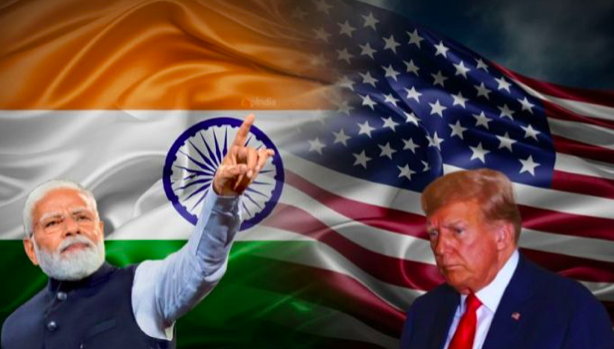
When Donald Trump returned to the White House in January 2025, New Delhi was among the capitals that welcomed his victory with the greatest enthusiasm. Prime Minister Narendra Modi publicly congratulated his friend on social media, and External Affairs Minister Subrahmanyam Jaishankar told reporters that, unlike many other nations, India was not nervous about a second Trump presidency. The optimism rested on the perceived personal chemistry between Modi and Trump, visible in the Howdy Modi rally in Houston on September 22, 2019, and the Namaste Trump event in Ahmedabad on February 24, 2020, as well as on the belief that a shared strongman political style and a shared wariness of China would keep the relationship on an upward trajectory. Barely a year later, optimism has evaporated. The United States has imposed the highest tariffs of any major trading partner on Indian goods, the two leaders reportedly went months without speaking to each other, and Washington has simultaneously courted Pakistan’s civilian and military leadership in ways that have unsettled New Delhi. This article examines why the second Trump administration has turned unexpectedly cold towards India, tracing the interplay of trade disputes, the fallout from the India-Pakistan military conflict of May 2025, Washington’s tilt towards Islamabad, disagreements over Russian oil purchases, a weakening strategic consensus on China, and the personality-driven nature of Trump’s diplomacy.
A Reset That Never Materialized
Modi travelled to Washington on February 12, 2025, only weeks after Trump’s inauguration, hoping to lock in early momentum. The visit began awkwardly, overshadowed by images of shackled Indian deportees being flown home on a United States (US) military aircraft just before the summit. In the Oval Office meeting held on February 13, 2025, Modi offered to expand purchases of American weapons, oil and natural gas while pressing Trump to spare India from punitive tariffs. The two sides did launch an ambitious-sounding initiative, the US-India Catalyzing Opportunities for Military Partnership, Accelerated Commerce and Technology (COMPACT) framework, intended to deepen defence manufacturing, artificial intelligence cooperation and energy trade. Yet Modi did not secure the one assurance he wanted most: protection from tariffs. Within weeks, Washington signaled that Indian exports would face a 27 percent reciprocal tariff unless a better arrangement could be negotiated, a rate notably higher than the 10 percent initially applied to Chinese goods. The gap between the warmth on display at the podium and the harshness of the trade signals emerging almost simultaneously set the tone for the year that followed.
The Tariff Shock and Trade Discord
Trade quickly became the most visible irritant in the relationship. After a ninety-day pause on Trump’s broader Liberation Day tariff programme, Washington confirmed a 25 percent tariff on Indian goods in early August 2025, only to double it to 50 percent by the end of August 2025, explicitly as a penalty for India’s continued purchase of discounted Russian crude oil. Jaishankar publicly described the increase as unfair and unreasonable. Commerce officials in the administration, notably trade advisor Peter Navarro and Commerce Secretary Howard Lutnick, framed India as an economy resistant to opening its markets, with Lutnick pointedly questioning why a nation of 1.4 billion people would not import even modest quantities of American agricultural produce. Modi, in turn, declared that India would never compromise on the interests of its farmers, signaling that agriculture and dairy, sectors employing more than 40 percent of India’s workforce, would not be sacrificed for a trade deal. Trump escalated the rhetoric further by describing the Indian and Russian economies as dead in a social media post, prompting anger in New Delhi. Five rounds of bilateral trade negotiations through mid-2025 failed to produce an agreement, even as both governments continued to signal, by the final quarter of the year, that a deal worth potentially several billion US dollars in annual trade remained within reach.
Operation Sindoor and the Ceasefire Controversy
The single most consequential rupture came from South Asia’s security landscape rather than economics. On April 22, 2025, terrorists killed twenty-six people, most of them Hindu tourists, in Indian-administered Kashmir. India responded on May 7, 2025, with strikes on what it described as militant camps in Pakistan and Pakistan-administered Kashmir, under an operation New Delhi named Operation Sindoor. Four days of drone and missile exchanges followed before both sides stepped back from further escalation. Before either New Delhi or Islamabad issued an official statement, Trump announced on social media that the two countries had agreed to a full and immediate ceasefire, credited his own administration with brokering it, and suggested he would help mediate the underlying Kashmir dispute. Pakistan welcomed the claim; India rejected it outright. New Delhi’s position, held consistently for more than two decades and previously respected by successive US administrations, is that any dispute with Pakistan must be resolved bilaterally, without third-party mediation. The Modi government’s official language described the pause in hostilities as an understanding reached directly between the two militaries, not an agreement brokered by Washington. Trump’s insistence on taking credit, and his repeated references to it in subsequent months, is widely seen as having personally offended Modi, who reportedly avoided taking calls from the American president for more than two months afterwards. Because the episode touched Modi’s domestic image as a decisive, strong leader, analysts have argued that this personal affront did more lasting damage to the relationship than the tariff dispute itself.
Washington’s Pivot towards Islamabad
Compounding New Delhi’s unease has been a marked warming in US ties with Pakistan. Trump hosted Pakistan’s army chief, Field Marshal Asim Munir, for a lunch at the White House in June 2025, the first time a sitting US president had hosted a Pakistani military chief without accompanying civilian leadership. Munir was received again within two months, seated prominently at a change-of-command ceremony hosted by the US Central Command in Florida. On September 25, 2025, Trump welcomed both Munir and Pakistani Prime Minister Shehbaz Sharif to the White House together, formalizing what commentators described as a significant recalibration of Washington’s South Asia policy. Islamabad secured the lowest tariff rate of any major market it trades with, Washington designated the Balochistan Liberation Army a foreign terrorist organisation, a long-dormant joint counter-terrorism dialogue was revived, and American officials signalled fresh interest in Pakistani critical minerals and hydrocarbon reserves. For a bilateral relationship long defined by mutual suspicion and periodic drift, the pace of engagement in 2025 was striking, and it arrived just as ties with India were fraying. Whether this warmth endures is uncertain, since the same pattern of transactional, minerals-driven American interest in Pakistan has waxed and waned before, but it’s timing left New Delhi with the uncomfortable sense that its strategic value in Washington was being taken for granted.
The Russian Oil Question
India’s continued purchase of discounted Russian crude oil, a practice that expanded significantly after Western sanctions followed Russia’s invasion of Ukraine, became a central flashpoint. The Trump administration, having shifted its own posture on the Ukraine war, applied direct pressure on New Delhi to curtail these purchases, framing India’s position as effectively subsidizing the Russian war effort. Officials close to Trump argued that India had become a conduit for laundering discounted Russian oil into global markets, though other major economies, including China and Türkiye, also continue to purchase significant volumes of Russian crude without facing comparable tariff penalties, a double standard New Delhi has pointed to repeatedly. By October 23, 2025, reports suggested Indian refiners were moving to reduce their dependence on Russian crude towards near-zero levels, partly under sanctions pressure and partly as a goodwill gesture ahead of a possible trade agreement. The episode illustrated how a foreign policy dispute rooted in a conflict thousands of miles away, in Ukraine, was allowed to spill directly into the core of the US-India economic relationship, with the US trade deficit with India, then estimated at close to US$ 46 billion, adding further pressure on negotiators.
A Fading China Convergence
For two decades, shared concern over the rise of China provided the strategic glue binding Washington and New Delhi together, sustaining the relationship through disagreements over trade, human rights and Russia policy. That convergence has weakened under the second Trump administration. Trump has expressed a clear personal preference for a broader deal with Chinese President Xi Jinping, and a draft of the United States’ National Defense Strategy under consideration in September 2025 reportedly contemplated a version of great-power accommodation with Beijing in the Asia-Pacific region. Simultaneously, Trump reversed an earlier ban on selling advanced computer chips to Chinese firms, actions that led many observers to question the depth of his administration’s commitment to countering Chinese influence in Asia. For India, whose own outreach to China has included Modi’s visit to Tianjin on August 31, 2025, to attend the Shanghai Cooperation Organization (SCO) summit and his first visit to China in seven years, the erosion of a shared American resolve on China removes one of the strongest incentives Washington previously had to manage disagreements with New Delhi carefully.
Personality, Ego and Domestic Politics
Several analysts argue that the deterioration cannot be explained by policy disagreements alone and instead reflects the personality-driven nature of Trump’s diplomacy. His repeated, unsolicited claims of having ended the India-Pakistan conflict, and his apparent frustration at New Delhi’s refusal to credit him publicly, appear to have coloured his broader approach towards India through much of 2025. Unlike the previous administration of former President Joe Biden, which was comparatively attentive to Modi’s domestic political sensitivities on issues such as the Group of Twenty (G20) presidency and allegations of extrajudicial activity, the Trump White House has shown little inclination to coordinate messaging with New Delhi or soften its public statements for the sake of the relationship. This has created a genuine domestic vulnerability for Modi, since years of messaging in India’s pro-government media have promoted the idea of an exceptionally close personal bond between the two leaders and depicted India as a rising global power. Trump’s blunt public statements, including his description of India’s economy as dead, have made that narrative difficult to sustain.
Structural Strains and India’s Strategic Autonomy
Beyond the immediate disputes, the relationship’s difficulties expose deeper structural questions. India’s foreign policy has long rested on a principle of strategic autonomy, avoiding firm alignment with any single power. Under ordinary circumstances, Washington’s traditional willingness to tolerate friction with valued partners, sometimes described by scholars as an act of long-term strategic altruism towards India, allowed New Delhi considerable room to pursue independent policies on Russia, Iran and elsewhere without serious consequence. A more transactional and short-term-oriented Trump administration appears less willing to extend that patience. Analysts at institutions including Chatham House have noted that despite ongoing defence and technology cooperation, through frameworks such as the Transforming the Relationship Utilizing Strategic Technology (TRUST) initiative and the India-US Defence Acceleration Ecosystem (INDUS-X), and despite both countries refreshing their ten-year defence framework agreement on October 31, 2025, the underlying pillars of the relationship, namely shared democratic identity, shared concern over China, and India’s role as a manufacturing alternative to China, have all weakened simultaneously. The result, some argue, is that India’s long-standing preference for equidistance between major powers, while consistent with its principles, risks being read in Washington as disengagement rather than genuine strategic value.
Signs of Recalibration
Despite the acrimony, neither side has moved to inflict deeper damage on the relationship. Modi’s government chose not to retaliate against American tariffs or public criticism, and by September 2025 both leaders had exchanged more conciliatory public statements, suggesting an interest in repairing ties. Reports through the final months of 2025 indicated that negotiators were close to a bilateral trade agreement that would lower tariffs on Indian goods in exchange for reduced Indian purchases of Russian oil, though a comprehensive deal had not been finalized by the year’s end. Visits by senior American officials in 2026, including Secretary of State Marco Rubio’s trip to India on May 21, 2026, described by observers as a mission of repair, point to a deliberate, if gradual, effort on both sides to stabilise the partnership even as the underlying sources of friction remain unresolved.
Conclusion
The coldness that has characterized Trump’s approach to India during his second term is best understood not as the product of any single dispute but as the convergence of several distinct pressures arriving together. A punishing tariff regime driven by trade imbalances and Russian oil purchases, an unresolved and deeply personal disagreement over credit for the India-Pakistan ceasefire, a surprising American tilt towards Pakistan’s military establishment, and a weakening of the shared China-focused strategic logic that once underpinned the entire relationship have combined to produce the most difficult period in US-India ties in roughly a quarter of a century. Whether the relationship recovers its earlier trajectory will depend heavily on whether both governments can separate transactional irritants, namely tariffs, oil purchases and trade imbalances, from the deeper strategic partnership that both sides still describe as indispensable. For India, the episode has reinforced the value of its long-standing commitment to strategic autonomy, while also exposing the risks of relying too heavily on personal rapport between leaders rather than durable institutional ties.



