
By : Nandika Dusi, Research Analyst, GSDN
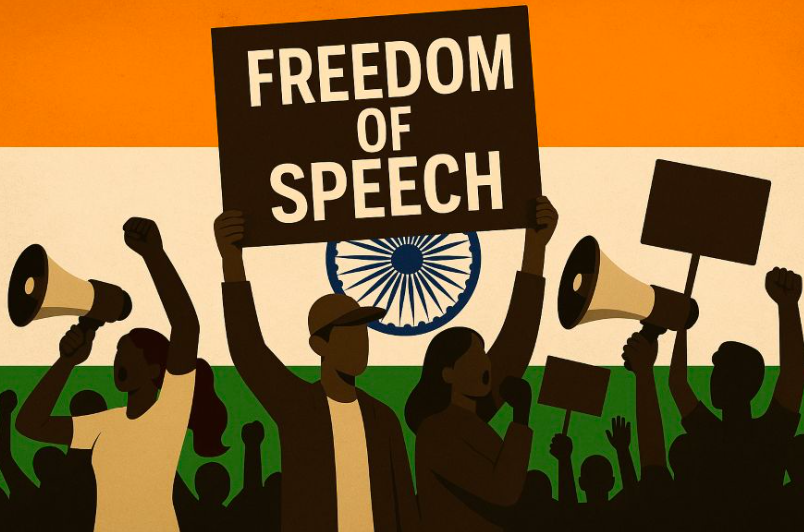
Article 19 of the Constitution of India is the basis of democratic liberty. It guarantees citizens six fundamental freedoms: the right to freedom of speech and expression; to assemble peacefully and without arms; to form associations, unions, or cooperative societies; to move freely throughout the territory of India; to reside and settle in any part of the country and to practice any profession, or carry on any occupation, trade, or business. Broadly summarized under the banner of ‘Freedom of Speech and Expression,’ the true scope of these rights has been continuously refined by the Supreme Court of India through landmark case laws that addresses state overreach and legislative vagueness.
Origin of the Law
The concept was adopted from concepts Free Speech and Democratic Liberties from Democratic Frameworks from the United States Constitution, while shaping to fit the sociopolitical demographic of India.
Members like K.M Munshi and B.R Ambedkar put forward provisions safeguarding freedom of speech, expressions, associations, movements, and trade, it was an initial draft of Article 13 across multiple seasons of December 1948 and October 1949. Soon through judicial review constant amendments were made to fit the people and evolving times.
Freedom of Press, Information, and Silence
The judiciary has consistently expanded “speech and expression” far beyond spoken words. In Romesh Thappar v. State of Madras (1950), the Supreme Court established that freedom of the press is a fundamental part of Article 19(1)(a), defining it as the right to print and publish without state interference, emphasizing that freedom lies in both circulation and content. Building on this, the Court in State of U.P. v. Raj Narain (1975) ruled that the “right to know” derives directly from freedom of speech, entitling citizens to know about public acts performed by public bodies.
This freedom also includes its other side, in Bijoe Emmanuel v. State of Kerala (1986), the Court held that forcing individuals to sing the National Anthem against genuine religious beliefs violates their rights, establishing that the right to speak includes the right to remain silent. In the modern era, this protective shield was extended to digital spaces in Shreya Singhal v. Union of India (2015), where the Supreme Court struck down Section 66A of the Information Technology Act, 2000, declaring it unconstitutionally vague and prone to misuse.
Freedom to Assemble, Associate, and Move Freely
Collective rights form the backbone of public engagement. In Himmat Lal v. Police Commissioner, Bombay (1972), the Supreme Court struck down rules empowering police commissioners to impose bans on public meetings, ruling that state regulations must aid rather than extinguish the right to assemble peacefully. Regarding collective identity, Damyanti v. Union of India (1971) upheld the right of association members to preserve their voluntary composition without forced state alteration. Furthermore, in Chambara Soy v. Union of India (2007), the Court emphasized state accountability, holding the administration responsible to compensate citizens for losses caused by state inaction in clearing illegal blockades that restrict free movement.
Freedom of Residence, Profession, Trade, and Business
The economic and personal liberties guaranteed under Article 19 ensure dignity in daily life. In U.P. Avas Evam Vikas Parishad v. Friends Co-op. Housing Society Ltd. (1995), the Supreme Court expanded the right to reside in the right to shelter and construct housing. Economic freedoms were defended early on in Chintaman Rao v. State of M.P. (1951), where a total ban on manufacturing bidis during agricultural seasons was struck down as an arbitrary and unreasonable restriction on trade.
Finally, human dignity at work was codified in Vishaka v. State of Rajasthan (1997), where the Supreme Court recognized that sexual harassment at the workplace directly violates a woman’s fundamental right. This historic judgment laid down binding guidelines that led to the Sexual Harassment of Women at Workplace (Prevention, Prohibition and Redressal) Act, 2013.
Recent Protests
The recent student protests are protected under this very article, and it has a constitutional foundation in it but also can serve as a basis for police restrictions and regulations due to the highly interpretative nature of the article.
The State cannot outright ban any protests, but the authorities can impose “reasonable restrictions” like maintaining traffic and public safety and order. It was said that a lot of the responses (using arms like pellet guns and tear gases) were simply “exceptional circumstances”.
Although the use of weaponry was illegal during the protests, the Supreme Court instantly stepped in, where the court ordered the strict preservation of all CCTV footage, issued notices to the government, and ordered an independent inquiry to determine if the deployment of such weaponry violated the students’ fundamental right to life and liberty.
Interference in IT Act, 2000.
The Constitution guarantees freedom of speech and expression, but the Supreme Court has now extended onto the digital lives of students where this right faces interference through the Informational Technology Act, 2000.
The landmark case of Shreya Singhal vs Union of India highlighted this dissonance in the Act and Article, where in Article 19 1(a) I guarantees freedom of speech, publishing, and exchange through online, subject to “reasonable restrictions” outlined under Article 19(2).
There’s ignorance among the people, which is their widespread lack of public awareness, which makes this act even more serious. We all believe in our six Fundamental Rights which includes Article 19, but it has its reasonable restrictions and guardrails with the help of Article 19(2), Information Technology Act, 2000, and the newly replaced Indian Penal Code with Bharatiya Nyaya Sanhita.
This lack of digital literacy means millions of users are unaware that one post, repost, or a comment can lead to an FIR (first information report), phone seizure, and immediate arrest.
Conclusion
Freedom of speech is often treated as an unrestrained privilege, yet through constitutional amendments and judicial review, it continuously evolves alongside the state and society. As expression shifts from physical streets to digital screens, legal ambiguity has only increased the threat of suppression. Article 19 stays in a living doctrine, defined by those who dare to speak, assemble, and question. The core struggle stays unchanged: balancing legitimate public order against state overreach. True freedom of speech requires more than constitutional text; it demands a public that recognizes where state authority ends, and fundamental liberty begins. Because this right stays prone to misuse by both the executive and the public, the judiciary must step in as an independent body to safeguard democratic freedom. Ultimately, Fundamental Rights are not just on paper but rather a day-to-day moral with restrictions every citizen of a nation must understand, interpret, and use wisely.


