
By: Khushbu Ahlawat, Consulting Editor, GSDN
Introduction
When Prime Minister Narendra Modi addressed the run-up to the AI Impact Summit in New Delhi in February 2026, he put the country’s ambition in a single sentence: the whole world’s data was invited to reside in India. It was a confident pitch, and it fits a global mood. Since 2013, more than US$1.3 trillion has been invested in artificial intelligence. In 2025, the United States announced the Stargate project, pledging up to US$500 billion for AI data centres and computing infrastructure. Consultancies promise that AI could add trillions to the global economy by 2030.
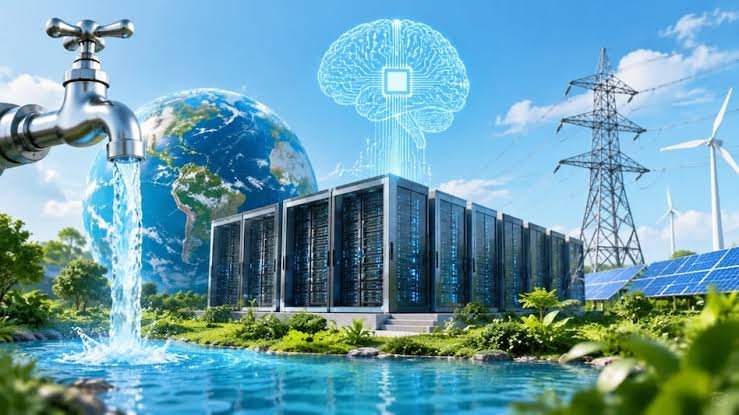
What gets less attention is the physical side of the story. The language around AI, “the cloud”, “the model”, “the algorithm”, suggests something weightless. It is the opposite. Every query travels to a building packed with servers, each fitted with power-hungry chips, drawing electricity around the clock and shedding heat that has to be carried away, usually with water. When the hardware becomes obsolete, which in this industry means within a few years, it has to go somewhere. Energy, water and waste: these are the three bills that come with the AI boom, and they are starting to arrive in places that never expected to pay them.
The Power Problem
Start with electricity, where the numbers are large but need careful reading. The International Energy Agency estimates that data centres used about 415 terawatt-hours in 2024, roughly 1.5 percent of global electricity consumption. Its projections have since been revised upward: data-centre demand is expected to roughly double from around 485 terawatt-hours in 2025 to about 950 by 2030, close to 3 percent of global demand, with electricity use at AI-focused facilities tripling over the same period. For comparison, 945 terawatt-hours is slightly more than the whole of Japan consumes today.
Two caveats are worth stating, because an honest account of AI’s footprint has to include them. First, even at those levels, data centres account for less than a tenth of the growth in global electricity demand between 2024 and 2030. Air conditioners, electric vehicles and industry matter more in aggregate. Second, the IEA notes that if every conventional internet search were replaced by a simple AI text query, the total would still be small relative to data-centre consumption today. The worrying bits are not everyday text prompts so much as the training of enormous models, video and image generation, and the constant, automatic embedding of AI features into products whether users want them or not.
The problem is not the global average but where and how the demand lands. A conventional data centre draws 10 to 25 megawatts. A hyperscale AI facility can draw 100 megawatts or more, as much as 100,000 households. These sites are highly concentrated: nearly half of US data-centre capacity sits in five regional clusters, where it takes up a big share of the local electricity market. Nearly 80 percent of the growth to 2030 is expected in the United States and China.
The climate consequences depend on what generates the power. Most of a data centre’s carbon footprint comes from the electricity it buys, and where grids still run on coal and gas, new demand means new emissions. The IEA expects natural gas to supply roughly 175 additional terawatt-hours for data centres by 2030, particularly in the US. Technology firms have pledged that their emissions will flatten and then fall, but those remain projections, not outcomes. Meanwhile, the indirect emissions of major players such as Alphabet, Amazon and Microsoft have risen by as much as 150 percent over the past three years, according to recent analysis.
A Thirsty Industry
Water is the less visible cost. Servers generate heat, and the cheapest way to remove it is often evaporative cooling, in which water absorbs heat and is released as steam. Closed-loop systems recirculate water and use far less, but they cost more and are not universal. A medium-sized data centre can use up to 110 million gallons a year, about as much as 1,000 households. Google has reported using over 6 billion gallons across its data-centre operations in a single year. In Northern Virginia, the world’s densest data-centre hub, facilities consumed close to two billion gallons in 2023.
The IEA estimates that a 100-megawatt facility could use roughly 2 million litres of water a day. That translates into a startling figure for the projects now being proposed in India. A planned 1-gigawatt data centre in Hyderabad, a city with limited water and no surplus power, could need around 20 million litres a day, or roughly 7.3 billion litres a year, on that basis. Estimates of the water used by a single chatbot query vary enormously depending on assumptions, and some circulating figures are almost certainly inflated, so it is wiser to focus on aggregate numbers than on viral per-prompt claims. At scale, though, the water footprint is real: a United Nations University study warns the sector’s water footprint could equal the minimum annual domestic needs of 1.3 billion people in Sub-Saharan Africa.
Where facilities are built matters as much as how much they use. Siting has historically followed cost, political convenience and proximity to other data centres, not water security. As a result, many operate in already stressed regions, such as Arizona and Nevada in the United States. In India, the cluster in Mumbai, Bengaluru and Greater Noida sits in or near areas with falling groundwater levels. Bengaluru, as one consultant noted, faces daily water shortfalls while hosting 16 data centres with a combined capacity of 205.6 megawatts.
This creates an uncomfortable opportunity cost. Every litre used to cool servers is a litre not available for irrigation, sanitation or drinking, and in a drought the priorities should not be in doubt. Water disclosure by technology firms is patchy, and in some jurisdictions large operators receive water at heavily discounted rates that do not reflect its scarcity. Evaporation and the discharge of warm water can also disturb local ecosystems, and some research suggests large AI facilities can raise land surface temperatures over a radius of several kilometres.
The Waste Nobody Plans For
The third cost is the least discussed. AI hardware ages fast. The graphics processors and servers at the heart of data centres are typically replaced every one to five years, because each new generation makes the last commercially obsolete. The world already generates huge volumes of electronic waste: the UN’s Global E-waste Monitor counted 62 million tonnes in 2022, containing an estimated US$91 billion worth of metals including copper, gold and silver. Less than a quarter was formally recycled. Recovered material met only about 1 percent of global demand for rare earths. Research suggests generative AI alone could add up to five million tonnes of accumulated e-waste by 2030.
The consequences depend on how waste is handled. Much of it ends up in landfills or is burned. Lithium batteries can ignite in landfills, causing fires that are hard to extinguish, and open burning releases heavy metals and dioxins. In India, the problem lands on an already strained system. Studies at informal recycling sites in Delhi’s Mandoli industrial area have found heavy-metal concentrations in groundwater above both Indian standards and the World Health Organization’s limits for drinking water. A 2026 assessment by the Central Pollution Control Board found 17 states and union territories with no registered recycling facilities at all. What the formal system cannot absorb flows to informal workers who dismantle and burn components with little protection, which is how pollution reaches communities that already live with coal-fired power plants and over-extracted aquifers.
There is a deeper point about materials. The same copper, gold and critical minerals that go into short-lived AI hardware are needed for solar panels, batteries and grid upgrades. Diverting them into a fast replacement cycle has an opportunity cost for the energy transition. Better recycling helps only so much, because electronics are rarely designed to be taken apart and the economics of recovery are poor.
India: Opening the Door Without Setting the Terms
India is a particularly important test case, because it wants the investment and is moving quickly. Installed data-centre capacity grew from about 375 megawatts in 2020 to nearly 1.5 gigawatts in 2025, making India the second-largest market in Asia-Pacific by some counts. Industry forecasts see operational capacity rising more than fivefold, to around 12 gigawatts, by 2030, with AI-dedicated capacity growing from a few hundred megawatts to several thousand. The government has told Parliament that AI data centres could add 26.3 gigawatts of electricity demand by 2031-32, while the Central Electricity Authority expects peak national demand to rise from 289 gigawatts in FY27 to 388 gigawatts by FY32.
The logic behind the rush is not frivolous. Emerging economies other than China account for about half the world’s internet users but less than a tenth of global data-centre capacity, while the United States alone hosts roughly 44 percent of global data-centre power capacity. Wanting a larger share of the infrastructure that processes your citizens’ data is a legitimate aim, and data sovereignty is a real concern.
But the terms matter. The 2026 Union Budget proposed a tax holiday running to 2047 for foreign companies providing cloud services through Indian data centres. Critics argue that this hands away fiscal leverage at precisely the moment the government should be attaching conditions, such as extended producer responsibility under the E-Waste Management Rules 2022, verified recycling arrangements and a requirement to help close the gap in recycling capacity across states. If concessions are not tied to environmental performance, India risks importing the industry’s pollution along with its workloads. Building the digital infrastructure of the Global South on the extractive model of the first wave would not deliver sovereignty; it would deliver the same problems, with fewer resources to deal with them.
Big Tech’s Green Promises
How have the companies themselves responded? Mostly with commitments, reports, clean-energy purchases and offsets. A review cited in recent research found that only 26 percent of climate claims made by major technology firms were backed by cited research, while 36 percent lacked substantiation and the rest rested on questionable estimates. Many claims about AI’s climate benefits rest on older, narrower forms of machine learning, such as grid optimisation or weather forecasting, which are comparatively light on resources. The consumer-facing products that absorb most of the investment, chatbots and image and video generators, offer no comparable climate payoff.
None of this means AI cannot help with climate. Machine learning is useful in precision agriculture, climate modelling and managing electricity grids. The difficulty is bundling the two: pointing to the real benefits of targeted applications while using fossil-fuelled data centres to power an expansion focused largely on low-value uses. Matching the marketing to the evidence would be a start.
The burden should not fall on individual users, either. Asking people to use AI less is reasonable advice, and unnecessary or trivial uses, especially image and video generation for fleeting trends, do carry a cost. But platforms increasingly build generative features into core products without opt-outs, and much of the ecological impact occurs before a user ever types a prompt, in the energy and water consumed to train each new model, often rushed to market without clear demand.
What Regulators Can Do
Regulators are behind, but they are not starting from scratch. The European Union’s AI Act, in force since August 2024, sets a baseline of transparency and accountability, although it does not impose direct limits on carbon, water or e-waste. In March 2026, a bill in the US Senate proposed a moratorium on new data centres until environmental concerns were addressed. A full moratorium is unlikely to pass, but the proposal signals where debate is heading.
A practical agenda is available. Governments can require lifecycle disclosure of training and inference energy, embodied carbon and water use as a condition for public procurement. They can make approval for large facilities conditional on sustainable cooling and on renewable energy that is genuinely additional rather than relabelled. They can introduce tiered water pricing, with surcharges in water-stressed catchments and the revenue earmarked for watershed restoration. They can adopt siting frameworks that weigh renewable availability, water scarcity and grid decarbonisation, and rule out new greenfield sites in high-stress areas. They can require community benefit agreements covering land, grid strain and water, with real consultation before siting decisions. And they can set standards for closed-loop, air-based or geothermal cooling.
Conclusion
The case against AI’s physical footprint is easy to overstate, and a serious argument should resist doing so. Data centres are not the largest source of electricity demand growth, and some of what AI can do, in science, medicine, energy systems and agriculture, is valuable. The case for scrutiny rests on something narrower and harder to dismiss: that a rapidly growing industry is concentrating large resource demands in specific places, that it discloses less than it should, that its environmental claims are often thin, and that the costs fall disproportionately on communities with the least say.
For India, the stakes are particular. The country is short of water in many of its tech hubs, still building out its power grid and struggling to manage the waste it already produces. It also has a real chance to set the terms on which the next wave of digital infrastructure is built. Welcoming data centres is not the mistake. Welcoming them without conditions, transparency or a plan for the water, power and waste they will generate would be. The cloud is a building, and it is time the rules caught up with that.


