
By : Glory Saikia, Research Analyst, GSDN
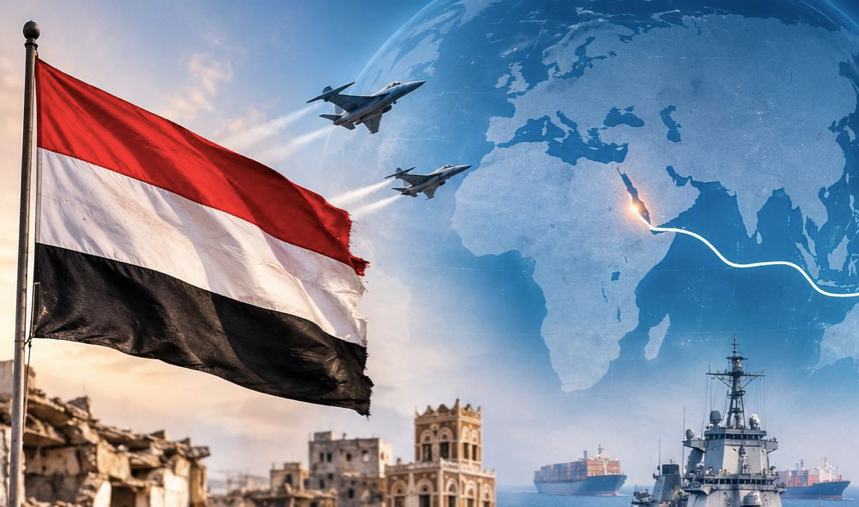
The turmoil in Yemen extends beyond civil war, with many describing it as a failed state exemplified by its weak institutions, economic decay, poor infrastructure and a high level of drug addiction. The absence of economic opportunities and the erosion of basic services have added to public frustration, pushing some desperate Yemenis towards extremist and terrorist organisations. The strategic location of Yemen along the Red Sea and its proximity to Saudi Arabia have made it a theatre of regional power struggle. The conflict can be understood through the lens of the New War paradigm due to its multilayered dimension and involvement of diverse actors.
Historical Roots of the Turmoil
Several interconnected factors act as the root of the crisis in Yemen, which include the Houthi insurgency, economic grievances, divisions within the armed forces, and foreign military intervention. The marginalization of Zaydis provides one of the most important historical causes of turmoil. The Zaydi monarchy was overthrown in 1962, and it was then replaced by a republic after a civil war. Ali Abdullah Saleh came to power in 1978, and his government supported the expansion of Salafi and Wahhabi influence in traditionally Zaydi northern areas. Saudi Arabia backed the spread of these movements to expand its influence.
The rise of the Houthi movement is another major cause, and it emerged from the Sa’ada region in northern Yemen. The Houthis are associated with Zaydi Shia Islam, and they experienced political marginalization and economic neglect in the Sa’ada region. The Houthi movement initially focused on protecting Zaydi identity and addressing local grievances, which then escalated into armed conflict with tensions between the Houthis and the government. The government of former President Ali Abdullah Saleh fought six wars between 2004 and 2010 against the Houthis, which strengthened the movement in military terms while intensifying hostility towards the Yemeni state.
In terms of economic grievances, the Hadi government removed fuel subsidies as part of its economic policies, resulting in higher fuel prices and increased public dissatisfaction. The Houthis also got the chance to mobilize people against the government and criticize the UN transition process and organized mass protests demanding lower fuel prices as well as a new government. Hadi’s supporters. Moreover, the split in the armed forces is another cause of the civil war in Yemen, as the military units loyal to Saleh, the former president, aligned themselves with the Houthis, which contributed to their success on the battlefield. The other militias mobilized against the Houthi-Saleh forces, aligning with the military of the government of Hadi. After Hadi fled to Saudi Arabia, the Saudi-led coalition launched a military campaign to restore Hadi’s government and reverse Houthi advances. However, the situation in Yemen became worse after the launch of the military attack, and the rivalry between these groups continued to intensify, with Houthis in North Yemen and Al-Qaida and ISIS in South Yemen.
The conflict is also described as a Sunni–Shia sectarian conflict because the Houthis are associated with Zaydi Shia Islam. The Sunni and Zaydi communities in Yemen historically coexisted with limited sectarian conflict, but their religious differences were politicized by domestic and regional powers such as Saudi Arabia and Iran to strengthen their influence.
Yemen is viewed as the theatre for regional power struggles by external actors. The Saudi and Yemeni governments portrayed the Houthis as Iranian proxies to undermine their legitimacy. Saudi Arabia feared the emergence of an Iran-friendly government in Sana’a as the Houthis gained power. Its policies towards Iran traditionally focused on maintaining a weak and stable neighbor by providing financial support to the Yemeni government and political elites. It also supported the spread of Salafism and feared that the state collapse would strengthen al-Qaeda in the Arabian Peninsula. Saudi Arabia intervened militarily in 2015 due to its increasing concerns about Iran’s regional influence. The Shia-Sunni division, in conjunction with economic repression, resulted in an unstable political climate in Yemen.
The US involvement in the Yemen conflict has been shaped largely by its war on terror. Yemen has offered AQAP an ideal training base and haven that constitutes a considerable challenge to American interests. During the tenure of Obama, his counter-terrorism advisors placed Yemen at the top of the priority list in combating Al Qaeda. The US conducted a military operation against AQAP in 2011 with the approval of former President Saleh. The US also helped train Yemen’s military forces and provided them with military capabilities. Apart from AQAP, the activities of the Islamic State operating in Yemen have caused concerns in Washington. The enduring political instability and chaos in Yemen have led the United States to intensify its strikes in the Southern parts of the country. To support the Saudi-led coalition and its operation, the US provided military, logistical, and intelligence help, and deployed American warships in the Gulf of Aden and Red Sea to deter Iran from any direct involvement in the conflict. The US and Saudi Arabia have formed a long -lasting alliance driven by the problematic relations between Saudi Arabia and Iran on one hand and the US and Iran on the other hand. The sales of arms to Saudi Arabia have been viewed by the American policymakers as a good strategy to support its campaign against terrorist groups in Yemen and counter Iran’s influence in the region.
The Arab Spring and the Failed Transition of Power in Yemen
The uprisings inspired the Arab Spring that reached Yemen in 2011, following the uprisings in Tunisia and Egypt. The uprisings unfolded in a divided political system and were shaped by tribal alliances, competing elites and regional grievances. There was rapid population growth, high unemployment, and inadequate healthcare and education. Economic growth was not translated into better living standards for young people. Additionally, the corruption and patronage networks weakened public confidence in government. There was political authoritarianism as Saleh consolidated power and attempted to strengthen presidential authority with the possibility of passing power to his son. This raised fears of dynastic rule among the people, and regional aspirations led to mass demonstrations in Tunisia and Egypt, broadcast by outlets like Al Jazeera and Al Arabiya. By late January and early February, the protesters in Sana’a, Taiz, and Aden started demanding Saleh’s resignation. Their demands were fueled by anti-corruption sentiment. The protests expanded as thousands joined the “Day of Rage” on the third of February. Under pressure from the Gulf Cooperation Council (GCC), Saleh signed an agreement to transfer power, after which, in February 2012, Vice-President Abdrabbuh Mansur Hadi became president after an election. However, the transition failed as the patronage networks and military divisions were not dismantled. The Houthis kept challenging the order, and the southern separatists were not satisfied. The transitional government faced limited authority over the armed groups, along with economic hardships.
The Humanitarian Cost of the War
Even after a decade of armed conflict starting in 2015, Yemen remains one of the world’s most severe humanitarian crises. The war between the Houthis and the Yemeni government has ravaged the infrastructure of the country, along with economic collapse and structural vulnerabilities. According to UNHCR, over 18.2 million people require urgent humanitarian assistance and protection services, and 4.5 million people are internally displaced. Women and children account for over 80 per cent of all internally displaced persons (IDPs). Moreover, women and girls are forced to sustain their families while facing economic inequality and limited access to basic services. There is a lack of livelihood opportunities and rampant inflation that leaves many families unable to afford even basic meals. Consequently, the women and the girls face gender-based violence, exploitation, and early child marriage. The UNICEF report also states that 1 in 2 children under the age of five suffer from malnutrition. Many IDPs in Yemen live in flood-prone areas or dangerous locations, characterized by widespread food insecurity and lack of water, healthcare and sanitation services.
The UNHCR delivers lifesaving aid across all 20 conflict-affected governorates in Yemen, supporting internally displaced Yemenis as well as around 61,240 refugees and asylum seekers primarily from Somalia and Ethiopia. They supply shelter, kits, mats, and plastic sheets to help families repair their damaged homes, along with emergency shelters. Additionally, they provide direct cash assistance to displaced households so the families can cover their urgent needs.
The recent clash between the Yemeni government and the Houthi fighters has intensified across regions such as Taiz, Lahij, al-Jawf, and Marib. The drone strikes; air raids and artillery fire have further resulted in casualties and instability in the country. Violence has also worsened the humanitarian crisis. More than 233,000 people have been displaced since the escalation of the conflict, according to the International Organization for Migration. The World Health Organization has warned about the shortages of fuel, medicines, and surgical supplies in Aiz’s hospitals, as approximately 121,000 people have been displaced there. Furthermore, the crisis has forced many refugees to seek safety in neighboring countries, highlighting the wider consequences.
Rethinking the War through the Paradigms of New Wars
The Yemeni civil war highlights the main features of the New Wars Paradigm as the conflict involves many actors operating beyond the traditional state-centric framework. The non-state armed groups, along with the government and its military, have become central players, including the Houthi movement, the Southern Transitional Council (STC), AQAP, and various tribal militias. The motivations for the war have diversified along with the diversification of the actors. The overlapping identities, pollical and economic grievances have become the main driving forces of the turmoil. The ambitions of the Houthis are based on the revival of Zaydi identity combined with their socio-economic exclusion and the historical marginalization.
The complexity of the conflict is reflected in the spatial and operational dynamics of the war. The multilayered identity and economic dimension fit the new character of contemporary wars where material and cultural grievances replace the traditional geopolitical and ideological divides. Yemen’s turmoil challenges the usual boundary between the frontlines and civilian zones as it extends across the whole country from Saada in the north to the port of Aden in the south. The war spills across borders through missile attacks on Saudi Arabia, maritime confrontations in the Red Sea, and the proxy dynamics tied to the Middle Eastern rivalries. Consequently, the military capability is no longer concentrated in the regular army but reaches NSAGs through several arms trafficking networks. Civilians have become deliberate targets in this coercion, leading to mass displacement, famine, and disaster outbreaks such as cholera.
The war economy forms another aspect of this conflict, with warring factions financing their operations through extortion, smuggling, taxation, and control over natural resources. The external actors, with their funding and arms supplies, have further helped in globalizing the economy of violence. These multilayered factors shaping the Yemeni conflict have prompted scholars to rethink how war should be categorized and understood in contemporary times.
The conflict has also received relatively less attention from genocide scholars despite the widespread human toll it has caused. The 2021 report by Mwatana for Human Rights, Starvation Makers: The Use of Starvation by Warring Parties in Yemen as a Method of Warfare, underlines that the Yemeni farms were struck by airstrikes 348 times and hit by roughly 570 cases of ground shelling between January 2018 and September 2020. The intensity of the attacks highlights how they intended to destroy both the food sources and the future possibility of farming in the land, since restoring it would require a major financial investment.
Conclusion
The tragedy in Yemen cannot be reduced to a sectarian strife or a proxy war. It has its roots in long-standing grievances, a failed political transition, and international powers using the turmoil to push forward their own agendas. The cost of this tragedy must be borne by the civilians as a form of humanitarian crisis with displacement, hunger, and destruction of livelihoods. Restoring peace in this region would require transforming the structure by rebuilding institutions, addressing the long-standing historical grievances, trimming down the influence of external actors and giving the Yemeni people their right to live.


