
By: Khushbu Ahlawat, Consulting Editor, GSDN
Introduction
A naval base on Australia’s west coast is about to host American and British attack submarines. It is a Pacific-era alliance turning towards the Indian Ocean, and India has to decide how closely to stand beside it.
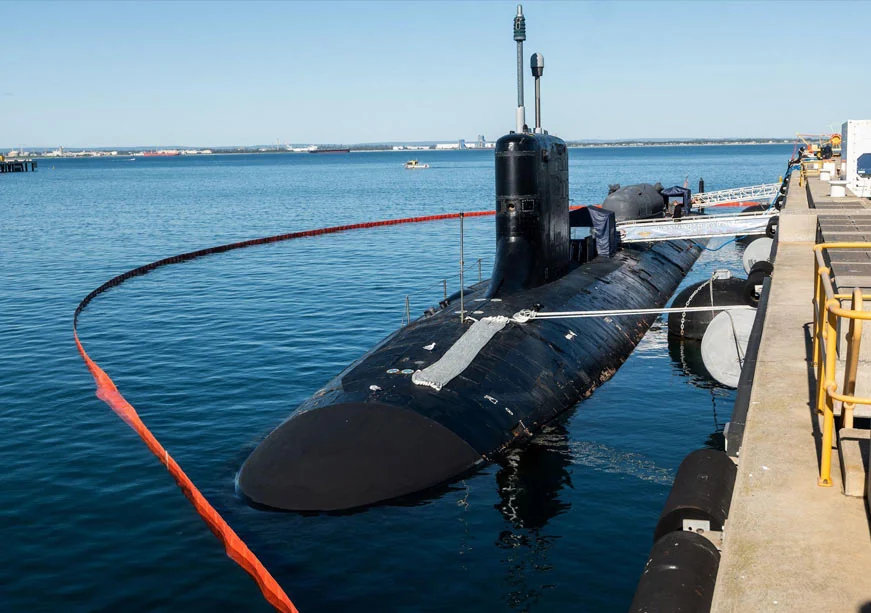
On 26 October 2026, the Pentagon named the first American submarine that will serve in a new rotational force based in Western Australia. The USS Colorado, a Virginia-class nuclear-powered attack submarine, will lead the Submarine Rotational Force-West, announced alongside British and Australian officials, with the force expected to reach initial operating capability in 2027. Within days, the vessel had already arrived at HMAS Stirling, the Royal Australian Navy’s principal west-coast base, about 50 kilometres south of Perth, for a planned maintenance period.
For most of the past five years, AUKUS, the security pact between Australia, the United Kingdom and the United States, has been discussed as a Pacific story: a way of strengthening Western submarine power against China in the waters around Taiwan and the South China Sea. Stirling changes that picture. The base faces the Indian Ocean, and when American and British attack boats start rotating through it in numbers, the alliance’s operational footprint will shift measurably westward, towards the ocean India regards as its own strategic backyard.
That raises a question worth asking carefully, without alarm or enthusiasm: is this good news for India, bad news, or something more complicated?
What Is Actually Being Built
It helps to be clear about the arrangement, because the vocabulary can mislead. AUKUS has two pillars. The first covers submarines. Australia is to acquire a fleet of conventionally armed, nuclear-powered attack submarines, beginning with the transfer of three secondhand American Virginia-class boats from the early 2030s, with an option to seek approval for up to two more. That will be followed by a new class, SSN-AUKUS, built in Australia to a British design incorporating American and Australian technology, with the first Australian-built boat expected in the early 2040s. In May 2026, the partners confirmed a streamlined approach to the Virginia purchase, with Australian Defence Minister Richard Marles saying it was driven by cost and a desire to simplify operations.
While that long construction programme matures, the second element comes into play: the rotational presence. Under SRF-West, HMAS Stirling will eventually host up to four US Virginia-class boats and one British Astute-class submarine. Australia is investing up to A8billionininfrastructureandlogisticsatthebase,andhasmadeinitialpaymentsofA3.9 billion to bolster the American submarine industrial base. The United States stood up a Naval Support Activity at Stirling in June 2026 and began re-establishing a submarine squadron to oversee the force. Washington started deploying personnel in the second half of 2026, and the base has already hosted maintenance periods for the USS Vermont in late 2025 and Britain’s HMS Anson in early 2026.
Officially, the force is “rotational,” meaning the submarines come and go rather than being permanently stationed. In practice, the substantial permanent infrastructure and defensive facilities it requires lead many analysts to describe it as a naval base in all but name.
The second pillar of AUKUS concerns advanced capabilities: uncrewed undersea vehicles, hypersonic and counter-hypersonic technology, cyber, electronic warfare, artificial intelligence and quantum technologies. It also includes the Deep Space Advanced Radar Capability, a space surveillance system whose first site, at Exmouth in Western Australia, was completed in December 2024. Taken together, these facilities make Western Australia an increasingly important node in Western military infrastructure, on the edge of the Indian Ocean.
India’s Naval Position: Strong but Stretched
To judge what this means for India, start with where its navy stands. India’s fleet is widely regarded as the largest resident naval power in the Indian Ocean region. It has a central geographic position, projecting power from its mainland coast and from the Andaman and Nicobar Islands, which sit near the approaches to the Strait of Malacca. From there, and from its western seaboard, it can watch the critical chokepoints: Malacca, Hormuz and the approaches to Bab-el-Mandeb.
The fleet includes two conventionally powered aircraft carriers, INS Vikramaditya and INS Vikrant, as well as destroyers, frigates and conventional submarines, plus a small force of nuclear-powered ballistic missile submarines for strategic deterrence. In October 2024, the Cabinet Committee on Security approved construction of two indigenous nuclear-powered attack submarines at an estimated cost of about ₹450 billion, roughly US$5.4 billion. The Navy expects the first to enter service around 2036-37 and the second about two years later.
These assets serve defined purposes: deterring Pakistan, monitoring Chinese naval activity and protecting the sea lanes on which India’s trade and energy supplies depend. India also sees itself as a net security provider and first responder in regional emergencies.
But the strategic environment is shifting. China’s navy is expanding rapidly, its network of port access arrangements is growing, and it is increasingly able to deploy nuclear-powered submarines in the Indian Ocean. India’s geographic advantage remains considerable, but geography is not a substitute for sustained investment. A navy that is regionally dominant today may find itself outnumbered tomorrow if the gap in building rates persists.
The Argument for Welcoming SRF-West
From this angle, the case for a larger Western submarine presence is easy to see. American and British attack submarines operating from Western Australia would add a further check on Chinese naval expansion in the eastern Indian Ocean. They could help protect sea lines of communication and the approaches to Southeast Asian chokepoints, including the Malacca Strait, through which a large share of China’s energy imports flow. They would also add to the number of quiet, capable platforms tracking Chinese movements, which helps India, given that submarines are among the hardest things to detect.
The strategic logic is reinforced by the state of other Western facilities in the region. The United States and Britain jointly operate Diego Garcia, a crucial logistics and operational hub, but Washington’s major regional bases, including the naval facility in Bahrain, home to the Fifth Fleet, have faced pressure. The Bahrain base was damaged in Iranian attacks during the 2026 conflict, and the Combined Maritime Forces headquartered there has been operating from dispersed locations since. A more resilient, geographically distributed presence in the Indian Ocean makes sense from Washington’s perspective, and Stirling fits that need.
India and the United States are also better placed to cooperate than at almost any previous point. They are tied together by four foundational defence agreements: the General Security of Military Information Agreement on protecting classified information; the Logistics Exchange Memorandum of Agreement, allowing reciprocal access to refuelling and replenishment; the Communications Compatibility and Security Agreement, facilitating secure communications; and the Basic Exchange and Cooperation Agreement for geospatial cooperation. Their navies train together in the Malabar exercises with Japan and Australia, and they work side by side in multilateral maritime security efforts. There is genuine convergence in how they view China’s growing maritime power: neither wants any single power to dominate the Indo-Pacific, and both want sea lanes to remain open.
The Argument for Caution
Yet convergence is not identity, and India has good reasons to avoid treating AUKUS as an extension of its own security arrangements.
The most basic reason is that India is not, and has never been, a member of the American alliance system. Most US partners in the Indo-Pacific, from Japan and South Korea to Australia, have security guarantees and treaty obligations. India pursues an independent foreign and defence policy and is not automatically committed to joining American-led military activities unless its own interests are involved. That independence is not a mere slogan; it shapes how India deals with Russia, Iran and others, and it is central to how New Delhi understands its place in the world.
The relationship has also had friction points. In April 2021, the USS John Paul Jones conducted a freedom-of-navigation operation roughly 130 nautical miles west of Lakshadweep, inside India’s exclusive economic zone, without seeking India’s prior consent. Washington argued that India’s requirement for prior consent for foreign military exercises in its EEZ is inconsistent with international law. New Delhi disagreed and said so through diplomatic channels. The episode showed that even close partners can differ on maritime law and on how to apply it.
Geography also shapes priorities. Washington’s principal concern is the prospect of a conflict over Taiwan and the western Pacific. India’s overriding worry is China’s growing naval and commercial presence in the Indian Ocean and its widening influence among South Asian neighbours. The two perspectives overlap, but they are not the same, and they could diverge in a crisis. A submarine rotation at Stirling is designed to serve alliance planning for a Pacific contingency as much as, or more than, to shore up India’s western flank.
Even the relationship with Australia carries historical wrinkles worth remembering. Many have forgotten an incident from the late 1990s when an Australian P-3C Orion maritime patrol aircraft dropped sonobuoys around the newly commissioned INS Delhi in the Bay of Bengal. It was a minor episode, but a telling one: friendly navies also watch each other.
What India Should Do
None of this suggests India should be hostile to AUKUS. It suggests India should be clear-eyed. Four points follow.
First, treat SRF-West as neither a threat nor a gift. A stronger Western naval presence can help constrain China, but it will operate under other countries’ command, priorities and political calendars. India should welcome the added awareness it provides while not depending on it.
Second, deepen practical cooperation without joining the structure. India can share information, conduct exercises, and use Australian and American facilities through its existing agreements and its own relationship with Canberra, which has grown considerably in recent years, without becoming part of AUKUS or accepting an alliance’s obligations. Quiet coordination on submarine tracking, maritime domain awareness and logistics is more useful than public declarations.
Third, invest in its own capabilities. The planned nuclear-powered attack submarines, due in the mid-2030s, are an important step, but timelines are long and delays are common. In the interim, India needs to keep expanding its surface fleet, its conventional submarine force, its underwater surveillance network and its access arrangements across the Indian Ocean, from the Andaman and Nicobar Islands to partners such as Mauritius, Seychelles, Oman and Indonesia. A strong Indian Navy is the best guarantee of India’s freedom of action.
Fourth, keep talking to everyone. India’s value to the United States, Australia and Britain lies partly in its independence, and its value to Southeast Asian and Indian Ocean littoral states lies in its role as a regional power that is not simply a Western proxy. A balanced approach, working with the AUKUS partners where interests align and speaking plainly where they do not, protects that standing.
Conclusion
The arrival of American and British attack submarines at HMAS Stirling marks a real shift in the geography of Western naval power. For years, the Indian Ocean was treated as a secondary theatre in the strategic contest with China. Now it is being built into the architecture of the main one. That has consequences for every country on the ocean’s rim, and for none more than India.
The right response is neither alarm nor applause. A stronger Western presence in the eastern Indian Ocean can help India by complicating Chinese naval planning and adding to maritime awareness. But it also creates a new strategic reality in which India’s interests may sometimes align with those of the AUKUS partners and sometimes diverge. What India needs is the capacity to cooperate with the United States, Britain and Australia without being absorbed into their alliance, and the naval strength to protect its own interests if the partnership frays or priorities change.
India and the United States are strategic partners today, as are India and Australia. That is not a permanent condition; it is the product of shared interests, and shared interests can shift. The real test will come as strategic competition in the Indo-Pacific intensifies and each country is forced to choose, case by case, where it stands. For India, preserving the ability to choose is the point.


