
By: Khushbu Ahlawat, Consulting Editor, GSDN
There is a particular kind of symbolism in flying five helicopters in tight formation over El Alamein. The stretch of Egyptian coastline west of Alexandria is remembered, above all, for a battle — the one fought there in 1942 that Winston Churchill later described as a turning point of the Second World War. Eight decades on, the same desert sands are hosting a very different kind of spectacle: the second edition of the El Alamein International Airshow, running from September 8 to 10, and among its headline attractions is an Indian Air Force unit that has spent more than two decades turning helicopter flying into an art form.
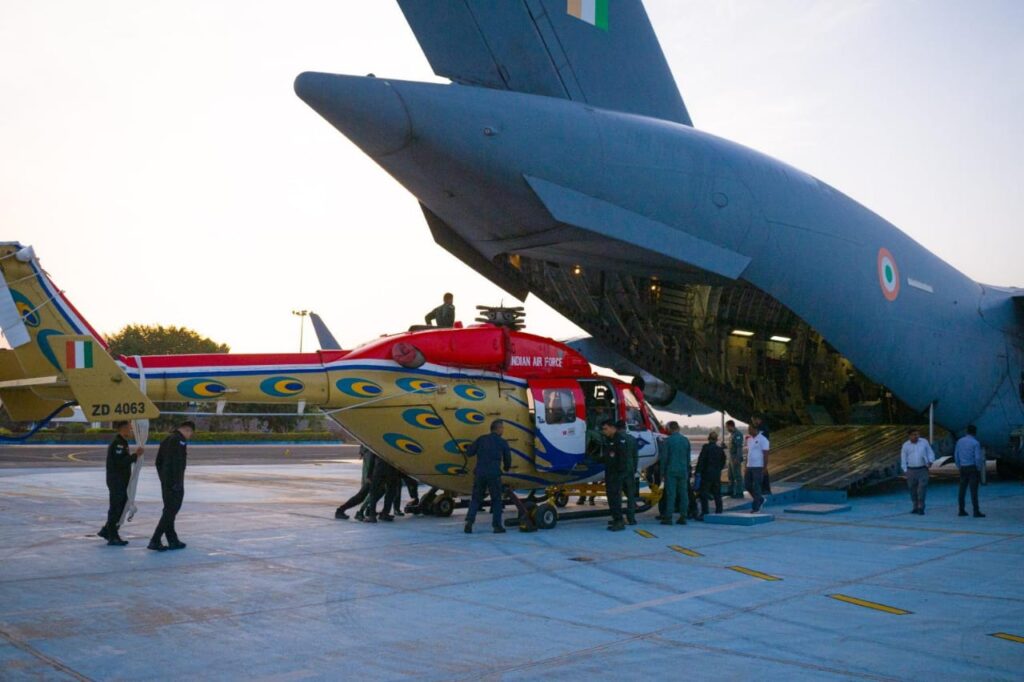
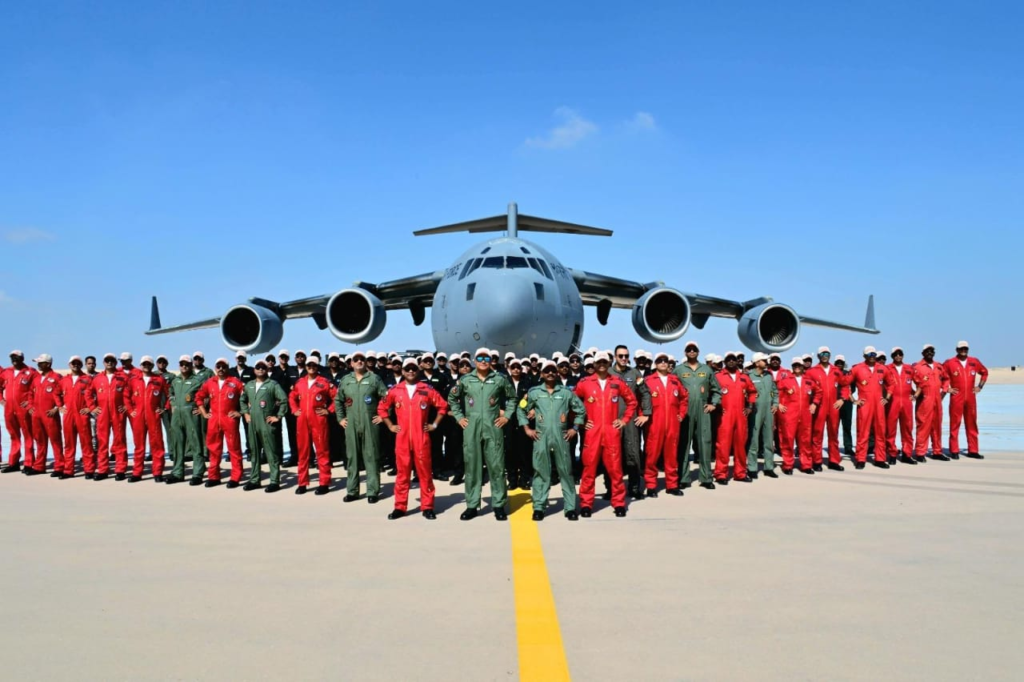
The Sarang Helicopter Display Team touched down in Egypt in the first week of September, its five Advanced Light Helicopters (ALH) Dhruv having made the long transit from their home base to join air forces, aerospace companies and defence industry professionals from around the world at El Alamein International Airport. For India, the visit is being framed as more than an aerobatic engagement. It is being read, deliberately, as a statement about how far the country’s indigenous aerospace programme has come — and about a defence relationship with Egypt that has been quietly deepening for several years.
A Team Built From a Test Flight
Sarang’s story does not begin with aerobatics at all. It begins with a far more mundane task: proving that an experimental Indian helicopter actually worked. In March 2002, the Aircraft and System Testing Establishment in Bengaluru raised an evaluation flight for the Advanced Light Helicopter, the aircraft that would later be named Dhruv, meaning “unshakeable” or “pole star.” The unit’s job was to put the new helicopter through its paces before it entered frontline service with the Indian armed forces.
It was only after that evaluation was complete that someone in the Air Force decided the aircraft’s handling was impressive enough to be worth showing off. The evaluation flight was repurposed to build a display profile, and a three-helicopter formation began developing manoeuvres that had rarely, if ever, been attempted by military helicopters anywhere. A fourth aircraft joined a year later. The team made its international debut at the Asian Aerospace show in Singapore in 2004, and by 2005 it had been formally constituted as No. 151 Helicopter Unit, based first at Yelahanka near Bengaluru before relocating to Sulur Air Force Station in Tamil Nadu, where it remains today.
The name chosen for the unit was Sarang — Sanskrit for peacock, India’s national bird — a nod to grace and vivid colour rather than raw power. It has not been an entirely smooth two decades. The team suffered its first fatal accident in February 2007, when one of its helicopters crashed during a rehearsal ahead of Aero India, and there have been other close calls over the years, including a crash-landing in 2010 that caused no injuries. Yet the unit has grown rather than retreated, expanding from three aircraft to four and, earlier this year, formally graduating to a five-helicopter formation — a configuration the Air Force describes as unique in the world for a rotary-wing display team. Over more than two decades, Sarang has flown upward of a thousand displays at several hundred venues, appearances that have taken it well beyond Indian airspace to events such as the Farnborough Airshow in England.
The Aircraft Doing the Talking
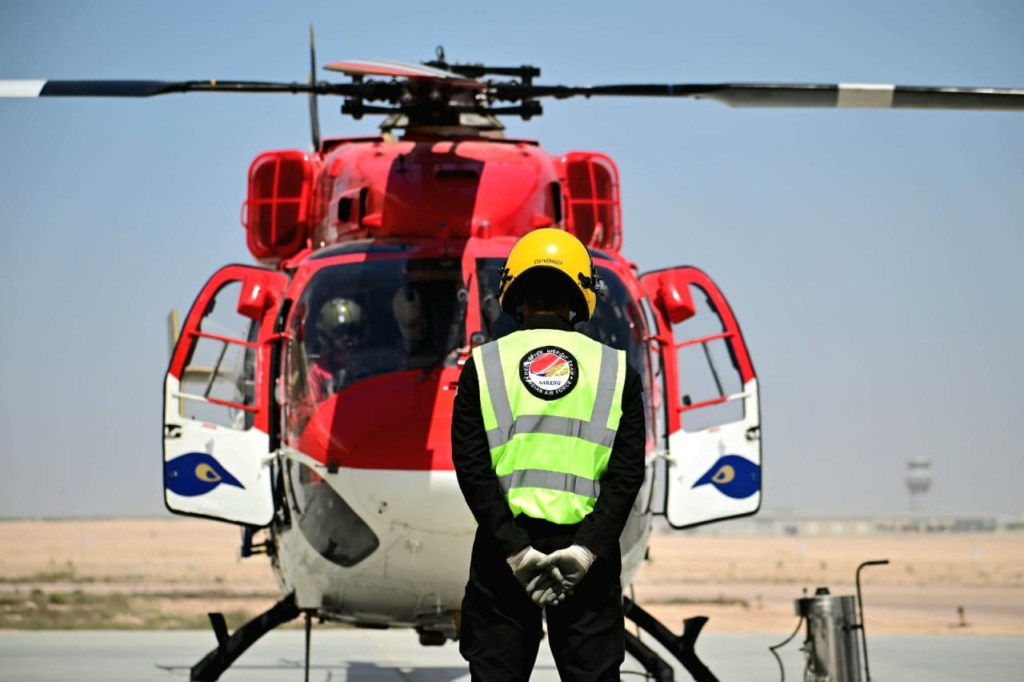
What makes Sarang’s story matter to more than aviation enthusiasts is the aircraft itself. The Dhruv was designed and built by Hindustan Aeronautics Limited, developed in partnership with the German firm MBB (now part of Airbus) from the mid-1980s, with its prototype first taking to the air in August 1992. It is a twin-engine, multi-role helicopter in the roughly five-and-a-half-tonne class, built with a hingeless rotor system that gives it unusually sharp manoeuvrability for an aircraft its size — precisely the quality that makes formation aerobatics possible in the first place. More than 400 Dhruvs have been built to date, flying in the colours of the Indian Army, Navy, Air Force and Coast Guard, and the type has also been exported to a handful of foreign operators, making it one of the more visible symbols of India’s push toward defence self-reliance.
That push has a name — India’s “Atmanirbhar Bharat” or self-reliance programme — and a set of figures the government likes to cite whenever an indigenous platform performs on an international stage. Domestic defence production is now estimated to meet roughly two-thirds of the country’s annual military equipment needs, and Indian-made defence products are today exported to more than 80 countries. A helicopter that started life as a test-flight subject and is now performing synchronised stall turns over the Mediterranean coast fits that narrative rather neatly, and Indian officials have not been shy about drawing the connection.
What the Crowd Will See
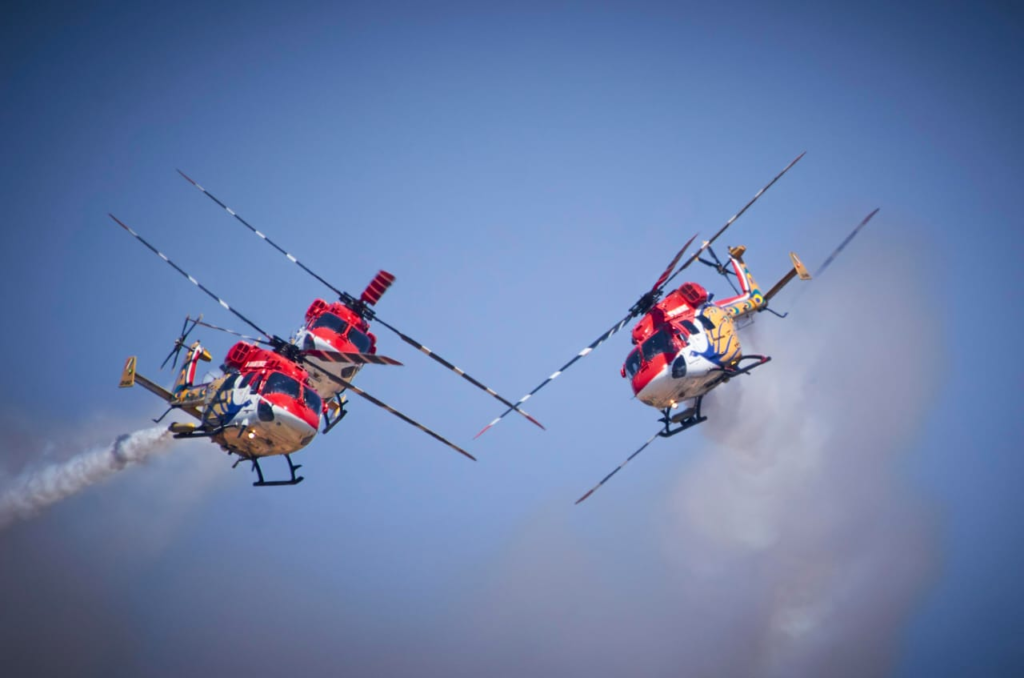
Sarang’s display profile typically runs around fifteen minutes and packs in a sequence of manoeuvres that sound almost more suited to fixed-wing jets than to helicopters: an entry in a “wineglass” formation, transitions between diamond and line-astern shapes, a “cross-over break,” a “level mesh” and a “level cross,” pair manoeuvres, and a formation called the “Sarang Split.” The signature move, though, is one the team calls the Dolphin Leap — a synchronised stall turn in which the helicopters appear to arc upward and flip back on themselves in unison, the closest a rotary-wing aircraft comes to mimicking a dolphin breaching water.
At El Alamein, the team is adding something new to that repertoire: a manoeuvre billed as the Spot Stall Turn, performed for the first time in front of an international audience. Details of exactly how it differs from the team’s existing stall-turn sequence have not been spelled out publicly, but its debut alongside the now five-helicopter formation suggests the team has spent the months since its formation upgrade refining a genuinely expanded show rather than simply adding an extra aircraft to the old one. Precision of this kind demands constant radio discipline between pilots and split-second judgement of spacing, since the aircraft often fly close enough that a small miscalculation would have serious consequences — which is presumably why the unit’s motto, “Apatsu Mitram,” translates roughly as “a friend in time of need.”
A Relationship Being Built One Exercise at a Time
The airshow appearance did not happen in a vacuum. India and Egypt elevated their ties to a Strategic Partnership in 2023, and the years since have seen a steady accumulation of smaller, more technical engagements that rarely make headlines individually but add up to something substantial. The two countries run an annual joint special-forces exercise called Cyclone, whose fourth edition was held at Anshas in Egypt in April this year, involving Indian Para Special Forces training alongside Egyptian commandos in desert and semi-desert conditions. India also sent more than 700 Army, Navy and Air Force personnel to Egypt’s multinational Exercise Bright Star in 2025 — its largest contingent ever for that drill.
Institutionally, the relationship runs through the India-Egypt Joint Defence Committee, whose eleventh meeting took place in Cairo in April 2026. That gathering produced a defence cooperation roadmap for 2026-27 built around expanding military exercises, deepening joint training and strengthening maritime security cooperation, and it also marked the first-ever Navy-to-Navy staff talks between the two countries. India used the occasion to highlight its defence manufacturing growth — production now exceeding $20 billion annually, with roughly $4 billion in exports — and both sides discussed possibilities for co-development and co-production of equipment. Air force cooperation featured too: India’s Chief of the Air Staff, Air Chief Marshal A.P. Singh, visited Egypt in December 2025 at the invitation of his Egyptian counterpart, a visit that appears to have helped set up the Sarang team’s appearance at El Alamein months later.
The Indian Embassy in Cairo marked the team’s arrival with an event on defence collaboration, attended by India’s Ambassador to Egypt, Suresh Reddy, alongside the Sarang team’s commander and pilots, who spoke about the ALH Dhruv and their preparation for the show. Egyptian officials have, for their part, described the aerial display as a major highlight of the wider airshow programme — a signal that the reception on the ground has matched the choreography in the air.
More Than a Photo Opportunity
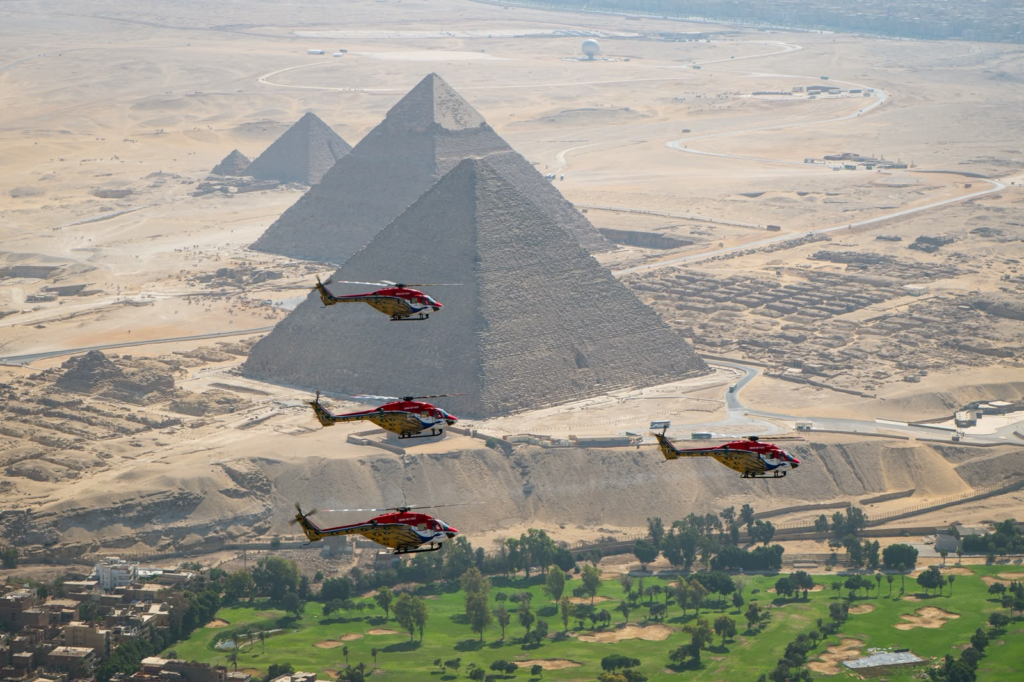
It would be easy to read all of this as pageantry — five red-and-white helicopters looping over a foreign airfield, a press conference, a diplomatic handshake. But air displays of this kind have long functioned as a genuine instrument of statecraft, precisely because they compress a country’s technological capability, its pilots’ training standards and its willingness to project itself abroad into a fifteen-minute spectacle that a general audience can actually watch and understand. A submarine deal or a satellite-launch agreement rarely draws a crowd; a synchronised helicopter formation performing a Dolphin Leap against the backdrop of the Pyramids, as Sarang was photographed doing in the run-up to the show, draws exactly that.
For Egypt, hosting a second edition of an international airshow that pulls in air forces and defence manufacturers from multiple continents is itself a statement of ambition — a bid to establish El Alamein, historically synonymous with wartime destruction, as a venue associated instead with aerospace commerce and international cooperation. For India, sending a five-helicopter team flying an entirely indigenous aircraft is a way of putting its “Make in India” defence narrative in front of an audience that includes potential customers, partner air forces and its own diaspora, all at once.
None of this guarantees any particular commercial or strategic outcome. Airshow appearances do not, by themselves, translate into export orders or new defence agreements. But they do tend to open conversations, and in a relationship that has been advancing steadily through joint exercises and committee meetings rather than through single dramatic announcements, a well-executed display can do useful work simply by being memorable. When the Sarang team lifts off from El Alamein International Airport over the coming days, the immediate audience will be watching for the Dolphin Leap and the new Spot Stall Turn. The longer-term audience — in defence ministries in New Delhi and Cairo — will be watching for what comes next.
There is, in the end, a quieter story running underneath the aerobatics. A helicopter that once existed only to be tested is now the face of a country’s aerospace ambitions abroad. A stretch of desert once defined by loss is, this week, defined by formation flying and diplomatic handshakes instead. Nothing about that transformation was inevitable — it took two decades of pilots, engineers and negotiators doing unglamorous work out of the spotlight. The Dolphin Leap only looks effortless from the ground. Everything that made it possible happened long before the helicopters ever left the runway.



