
By: Khushbu Ahlawat, Consulting Editor, GSDN
Introduction
The world’s highest court has said what survivors have been saying for nine years. Cox’s Bazar, where more than a million of them still live, will notice the difference slowly, if at all.
In Cox’s Bazar on the evening of 19 November, thousands of Rohingya refugees gathered around screens to watch a courtroom nearly 8,000 kilometres away. Some carried placards. Many simply sat in silence. When Judge Yuji Iwasawa, President of the International Court of Justice, read out the Court’s conclusion that Myanmar was responsible for genocide against the Rohingya, a word that survivors had used for years was finally spoken by the highest judicial body in the world.
It was a historic moment in more than one sense. In its roughly 80-year existence, the ICJ had never before found a state responsible for committing genocide. The Court voted nine to six, found that genocidal intent was the only reasonable inference from the evidence, and concluded that Myanmar’s military operations in northern Rakhine State in 2016-17 could not be explained away as a campaign against insurgents. A case that began in 2019, brought by The Gambia, a small West African country with no direct stake in the atrocities, had run for seven years and ended with a finding that few observers thought likely when it started.
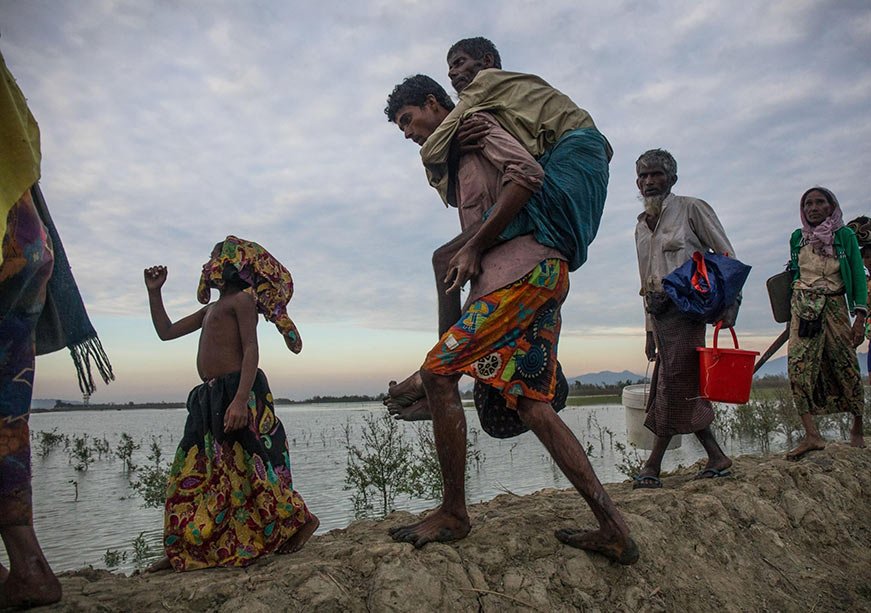
And yet, for the 1.2 million Rohingya living in Bangladesh, the day after the verdict looked much like the day before. The camps were still crowded. The rations were still being cut. The road home was still closed. The central question now is not whether Myanmar committed genocide, but what a legal finding can do for people who need food, safety, schooling and a country to return to.
How the Case Got Here
It helps to recall the sequence. In August 2017, after attacks by a Rohingya militant group on security posts, Myanmar’s military launched what it called “clearance operations” across northern Rakhine State. Soldiers and local militias killed civilians, raped women and girls and burned entire villages. Within weeks, hundreds of thousands of Rohingya had crossed the Naf River into Bangladesh. More than 730,000 people fled in that wave, adding to earlier waves of refugees. Médecins Sans Frontières estimated that at least 6,700 Rohingya were killed in the first month alone.
The roots go deeper. Under Myanmar’s 1982 Citizenship Law, the Rohingya were effectively excluded from the list of recognised national ethnic groups, leaving most stateless. Decades of restrictions on movement, marriage, education and work preceded the violence of 2017.
In November 2019, The Gambia, supported by the Organisation of Islamic Cooperation, filed a case against Myanmar under the 1948 Genocide Convention. The legal basis was that all states parties share an obligation to prevent and punish genocide, so a country need not be a victim to bring a case. The following month, the world watched Aung San Suu Kyi, then Myanmar’s State Counsellor, appear in person at The Hague to defend her country’s military.
In January 2020, the Court ordered provisional measures, directing Myanmar to prevent genocidal acts and preserve evidence. Myanmar raised preliminary objections in 2021, the year the military seized power in a coup, but the Court rejected them in July 2022 and allowed the case to proceed. Eleven states filed declarations of intervention between 2023 and 2025. Merits hearings took place in January 2026, and the judgment followed on 19 November.
The ruling goes further than the Court’s last major genocide judgment, in the 2007 case of Bosnia and Herzegovina against Serbia and Montenegro. There, the Court found that Serbia had failed to prevent genocide and to punish those responsible, but did not find that Serbia itself had committed it. Here, the Court attributed the commission of genocide directly to the state, finding genocidal intent alongside acts including killings, serious bodily and mental harm, and measures intended to prevent births. It also found Myanmar had violated its obligations to prevent and punish genocide, to enact domestic legislation implementing the Convention and to comply with the 2020 order to preserve evidence. It did not, however, uphold the claim that private persons had directly and publicly incited genocide.
What the Court Ordered, and What It Cannot Enforce
The remedies are substantial on paper. Myanmar must stop ongoing violations, pass legislation giving full effect to the Convention, investigate those reasonably suspected of genocidal acts and prosecute and punish them where warranted. The Court ordered guarantees of non-repetition and measures of restitution, including facilitating the safe, voluntary and dignified return of displaced Rohingya in several countries to their places of origin, and the reunification of families. Myanmar must also compensate the Rohingya, with the amount and modalities to be settled in a later phase, and report within two years on what it has done.
The weakness lies in enforcement. ICJ judgments are legally binding, but the Court has no police and no means of compelling compliance. In principle, the UN Security Council can act to give effect to a judgment, but geopolitical divisions, including China’s close relationship with Myanmar’s military, make that unlikely. The reaction from Naypyitaw suggests compliance is not around the corner. At a press conference on 20 November, a government spokesperson, Khaing Khaing Soe, rejected the verdict as unfair, said Myanmar had been wrongly accused and pointed to the split vote.
It also matters what the ruling is not. The ICJ settles disputes between states. It does not prosecute individuals. Criminal responsibility for commanders is a matter for other bodies, among them the International Criminal Court, which opened an investigation into crimes against the Rohingya involving Bangladesh and Myanmar in 2019, and the UN’s Independent Investigative Mechanism for Myanmar. Those tracks continue, but they move slowly and depend on states being willing to arrest suspects.
What Changes in the Camps
Start with the numbers, because they show why a legal victory is not the same as a practical one. Around 1.2 million displaced Rohingya live in 33 camps in Cox’s Bazar, with roughly 35,000 more on the island of Bhasan Char. About 150,000 more have arrived since 2024 as fighting has spread across Rakhine State, where the Arakan Army has expanded its control. The 2026 Joint Response Plan seeks US$710.5 million, a figure 26 percent lower than the previous year’s revised appeal. The UN describes this as the bare minimum, yet by August the plan was less than half funded. In April, the World Food Programme moved to needs-based targeting of food aid, a polite way of saying that fewer people will receive it.
Against that backdrop, the verdict has four broad implications.
First, its direct effect on camp conditions will be limited. It does not improve access to healthcare, education, food or livelihoods, and it does not change the rules governing refugee life in Bangladesh. Whatever benefit it brings will depend on the diplomacy, legal work and advocacy that follow.
Second, Bangladesh’s position is stronger, but the practical path to repatriation is no shorter. Dhaka has welcomed the ruling, urged Myanmar to respect it and begin repatriation, and called on the international community to press both the Myanmar authorities and the Arakan Army. The judgment reinforces the argument that return must be safe, voluntary and dignified. But Rohingya themselves have long said they will not go back without guarantees of citizenship, rights and security, and a legal finding does not supply those. Earlier attempts at repatriation, including arrangements in 2018 and 2019, collapsed when almost no one was willing to go. The ruling gives Bangladesh a firmer basis to demand recognition of Rohingya identity, restoration of citizenship, access to homes and land, protection from discrimination and mechanisms to monitor returns. Without these, repatriation would amount to relocation, not a durable solution.
Third, the judgment may help sustain international attention at a moment when attention is fading. The humanitarian response in Cox’s Bazar has been squeezed by falling donor commitments and competing crises in Gaza, Sudan, Ukraine and elsewhere. A genocide finding by the world’s highest court makes it harder to treat the Rohingya as a forgotten crisis. But a legal milestone should not be mistaken for resolution. Aid, protection services, education and livelihood support remain essential for people in what is now a protracted displacement.
Fourth, the judgment matters psychologically and socially. For a community that has endured years of denial, being named and recognised by an international court has real weight. Survivors have spoken of hearing the word “Rohingya” in the highest court in the world, a name that Myanmar’s authorities have long refused to use. That recognition can challenge denial and affirm testimony. But it does not restore citizenship, end statelessness or guarantee return.
The Regional Picture
Implementation will depend on Myanmar’s behaviour, and on how much pressure its neighbours and partners are prepared to apply. The regional response so far has been mixed and cautious.
ASEAN, the Southeast Asian grouping that includes Myanmar, has kept to its Five-Point Consensus, the roadmap agreed after the 2021 coup, although progress has been limited. At the 49th ASEAN Summit on 15 November, leaders reiterated their commitment to the framework and maintained restrictions on Myanmar’s political representation at the bloc’s meetings. The ASEAN Parliamentarians for Human Rights welcomed the judgment and urged accountability, protection of the Rohingya and engagement with Myanmar’s opposition National Unity Government, ethnic groups and the Arakan Army. Malaysia, which hosts a large Rohingya population, said it respected the judgment.
Larger neighbours have been more careful. China expressed reservations about the Court’s approach to jurisdiction while offering to help facilitate Rohingya repatriation, which fits its long-standing role as Myanmar’s key diplomatic partner and a mediator between Dhaka and Naypyitaw. India took note of the judgment and reiterated its support for the safe, speedy and sustainable return of displaced Rohingya to Rakhine State, but did not explicitly endorse the finding of genocide.
For India, the position reflects competing pressures. It shares a long and sensitive land border with Myanmar, has strategic and connectivity interests in Rakhine through the Kaladan project and the Sittwe port, and is wary of antagonising a neighbouring military government at a time when it also wants to limit Chinese influence. It also hosts its own Rohingya population and has taken a restrictive stance on them. Endorsing a genocide finding would sit awkwardly with all of that. But silence has costs too, particularly with Bangladesh, a key partner, which has borne the heaviest burden of the crisis.
The Hardest Part
Myanmar’s own circumstances complicate every possible route to compliance. The country is in the midst of a civil war, the military controls only part of its territory, and in Rakhine, the very area to which the Rohingya would return, the Arakan Army now holds much of the ground. The Arakan Army is itself accused by human rights groups of abuses against Rohingya civilians. Any repatriation scheme would therefore need to engage not just the central authorities but also the group that effectively governs large parts of northern Rakhine. Returning people to a conflict zone, where they would face threats from several armed actors and no guarantee of citizenship, would be neither safe nor voluntary.
This is why many analysts argue that the legal track and the political track need to move together. The ICJ judgment provides leverage. The question is who will use it. Western governments could tie sanctions and engagement to specific steps on citizenship and accountability. Muslim-majority states and the OIC, which backed the case, could keep it on the diplomatic agenda. Donors could treat the finding as a reason to sustain humanitarian funding rather than let it lapse. And Bangladesh can press for a coordinated approach, bringing in China, India and ASEAN, whose cooperation any workable return arrangement would need.
Conclusion
The ICJ’s judgment is a landmark. It is the first time the Court has found a state responsible for committing genocide, it rests on a careful reading of the evidence, and it gives survivors something that was denied to them for years: an authoritative, public acknowledgement of what was done to them. That counts for a great deal, and it would be wrong to dismiss it as merely symbolic.
But a judgment is a statement of law, not a change in circumstance. Myanmar’s government has already rejected it. No enforcement mechanism is in sight. The camps in Cox’s Bazar are underfunded and overcrowded, and the conditions that would make return possible, citizenship, security, restored property and a functioning state, are as distant as ever. The risk is that governments treat the verdict as a conclusion, a moral debt discharged, when it is really a starting point.
For Bangladesh, which has sheltered the Rohingya for nine years and carried most of the cost, the test is whether the ruling can be turned into sustained international pressure and concrete guarantees. For the rest of the world, the test is whether it will back a legal victory with the diplomatic, financial and humanitarian commitment needed to make it mean something. Justice has been delivered in The Hague. Whether it reaches the people living in the camps, and whether it ever leads them home, will depend on what is done in the months and years ahead.


