
By: Khushbu Ahlawat, Consulting Editor, GSDN
The Illusion of Stability: Decoding India’s Inflation
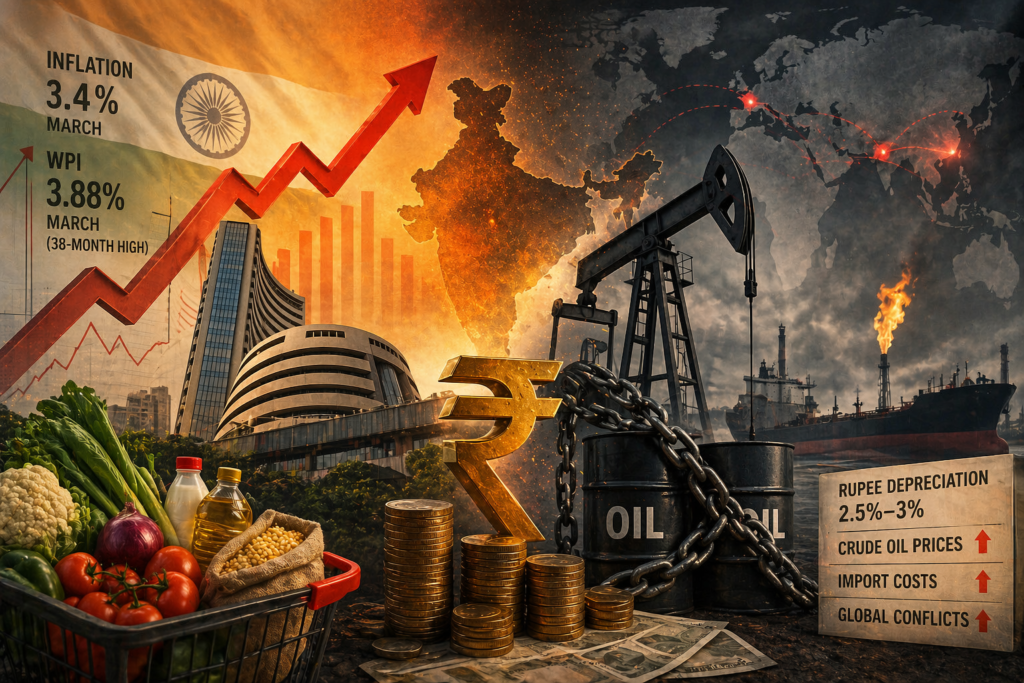
India’s inflation narrative in recent months appears reassuring at first glance. March retail inflation, measured by the Consumer Price Index (CPI), stood at 3.4%, only a marginal increase from February’s 3.2%. On paper, this keeps inflation comfortably within the Reserve Bank of India’s (RBI) tolerance band of 4% ± 2%, reinforcing a sense of macroeconomic stability and policy control. Yet, this surface-level comfort masks a far more complex and evolving reality—one that signals underlying stress rather than sustained stability.
CPI numbers fail to capture the full extent of price pressures building beneath the surface. A critical indicator in this regard is the Wholesale Price Index (WPI), which surged sharply to a 38-month high of 3.88% in March, up from approximately 2.4% in February. This sharp rise reflects intensifying cost pressures at the producer level—pressures that historically transmit to consumers with a lag. The divergence between wholesale and retail inflation is not merely statistical; it is symptomatic of a deeper structural imbalance where rising input costs are yet to fully translate into consumer prices.
At the same time, the broader inflation story cannot be understood in isolation from global and structural forces. External shocks—particularly fluctuations in global crude oil prices, geopolitical tensions, and supply chain disruptions—are steadily amplifying imported inflation. The depreciation of the rupee further compounds this challenge, making essential imports like fuel, fertilizers, and petrochemicals more expensive. These cost escalations ripple across sectors, affecting everything from agriculture to manufacturing.
What makes the current moment particularly critical is the illusion of stability created by short-term buffers. Supply gluts arising from redirected exports, along with temporary absorption of costs by firms, have delayed the full pass-through of inflation to consumers. However, such mechanisms are inherently unsustainable. As margins compress and global uncertainties persist, the likelihood of a sharper inflationary uptick becomes increasingly real.
This article argues that India’s inflation trajectory is at a pivotal juncture. Beneath the controlled headline figures lies a convergence of domestic and global pressures, deeply intertwined with the country’s dependence on fossil fuel imports. Addressing this challenge requires looking beyond conventional monetary tools and recognizing the structural vulnerabilities that continue to shape inflation dynamics.
An important technical nuance further complicates interpretation: while the CPI has transitioned to a new base year of 2024, the WPI continues to use the 2011–12 base year. This divergence in base years creates statistical inconsistencies, making direct comparisons difficult and potentially masking real inflationary pressures. Policymakers and analysts must therefore interpret these indices with caution, recognizing that the CPI’s comfort zone may not reflect the true state of price dynamics.
The divergence between CPI and WPI is not merely statistical—it reflects a structural disconnect between wholesale and retail price transmission. While wholesale prices are rising rapidly due to input cost increases, this has not yet fully translated into higher consumer prices. This lag creates a misleading sense of stability, delaying necessary policy responses.
Further evidence of this masking effect can be seen in food inflation. The Consumer Food Price Index (CFPI) rose moderately from around 3.4% in February to 3.8% in March. While this increase appears modest, it suggests that food prices are beginning to respond to upstream cost pressures, albeit slowly. The gradual nature of this rise reinforces the notion that inflationary pressures are building incrementally and may intensify over time.
In essence, India’s current inflation scenario resembles a calm surface over turbulent waters. The headline numbers may suggest control, but underlying indicators reveal growing stress points. Ignoring these signals could lead to delayed interventions, allowing inflation to accelerate more sharply in the future.
Imported Inflation and the Rupee Effect: External Shocks at Play
A major driver of India’s hidden inflationary pressures is imported inflation, exacerbated by currency depreciation and global geopolitical disruptions. The Indian rupee has depreciated by approximately 2.5%–3% against the U.S. dollar, significantly increasing the cost of imports. Given that critical commodities such as crude oil and natural gas are globally traded in dollars, even a modest depreciation can have a substantial inflationary impact.
India’s heavy dependence on imported energy makes it particularly vulnerable. Rising global crude oil prices translate directly into higher domestic fuel costs, which in turn affect transportation, manufacturing, and overall input costs across sectors. This creates a cascading effect, where increased costs at the base of the supply chain gradually permeate the entire economy.
Geopolitical tensions have further amplified these pressures. The ongoing U.S.-Israel conflict involving Iran has disrupted global supply chains for oil and gas, leading to price volatility. Such disruptions are not isolated events; they have far-reaching implications for energy-importing countries like India. As global prices rise, India faces a dual challenge—paying more for imports while also dealing with a weaker currency.
The impact of imported inflation extends beyond fuel. The rupee’s depreciation has increased the cost of a wide range of imported goods, including fertilizers, plastics, and petrochemical products. These inputs are critical for industries such as agriculture, pharmaceuticals, textiles, and automobiles. As production costs rise, firms face pressure to either absorb these costs—reducing profit margins—or pass them on to consumers.
So far, many firms have chosen to absorb a significant portion of these costs, which explains why CPI inflation has not surged dramatically. However, this strategy is not sustainable in the long run. As margins compress, businesses will inevitably begin to pass on costs, leading to higher retail prices.
Another dimension of imported inflation is its impact on trade dynamics. In March, exports contracted by approximately 3%–4% year-on-year, while imports declined by around 5%–6%. While this might suggest weakening demand, it is also indicative of supply chain disruptions caused by global conflicts. Exporters, particularly micro, small, and medium enterprises (MSMEs), are facing reduced international demand and logistical challenges.
To mitigate losses, many exporters are redirecting their output to the domestic market. While this increases local supply and temporarily suppresses prices, it creates distortions in market dynamics. Over time, these distortions can lead to inefficiencies and uneven price adjustments across sectors. Thus, imported inflation, driven by currency depreciation and global instability, is a silent but powerful force shaping India’s economic landscape. Its effects are widespread, touching every sector and influencing both production and consumption patterns.
Supply Gluts, Delayed Transmission, and the CPI Paradox
One of the most intriguing aspects of India’s current inflation scenario is the paradox of rising input costs coexisting with relatively stable consumer prices. This phenomenon can be attributed to a combination of supply-side dynamics and delayed price transmission.
As exporters redirect goods to the domestic market due to weak global demand, localized supply gluts are emerging. These gluts increase the availability of goods, particularly in sectors dominated by MSMEs. In the short term, this excess supply helps keep prices in check, preventing a sharp rise in CPI inflation.
However, this is not a sign of structural stability—it is a temporary buffer. The underlying cost pressures remain intact, driven by higher input costs and imported inflation. Producer margins are being squeezed as firms absorb these costs to remain competitive. Over time, this strategy becomes untenable, forcing businesses to adjust prices upward.
The delayed transmission of price increases from wholesale to retail levels creates a misleading picture. While consumers currently benefit from stable prices, the eventual pass-through of costs could lead to a sudden spike in inflation. This lag effect is particularly concerning because it reduces the window for proactive policy intervention.
Another factor contributing to this paradox is policy relaxation. Measures that allow export-oriented units to increase domestic sales have provided short-term relief but may have unintended long-term consequences. By distorting supply-demand dynamics, such policies can delay necessary market corrections, leading to sharper adjustments later.
The compression of producer margins is another critical issue. As input costs rise, firms are forced to operate with thinner margins, reducing their capacity for investment and expansion. This has implications for economic growth, as reduced investment can slow down productivity improvements and job creation.
Moreover, the current scenario risks creating stagflationary conditions—where inflation rises even as economic growth slows. The International Monetary Fund (IMF) has already flagged rising global recession risks and revised India’s FY27 growth forecast to around 6.2%. While this remains relatively robust compared to global standards, it represents a slowdown from India’s potential growth trajectory.
The RBI has also acknowledged these risks, emphasizing the need for vigilance. The central bank faces a delicate balancing act—tightening monetary policy to control inflation without stifling growth. However, the hidden nature of current inflationary pressures complicates decision-making, as policy responses based solely on CPI data may be insufficient.
In summary, the coexistence of stable consumer prices and rising production costs is not a sign of resilience but a warning signal. The temporary suppression of CPI inflation masks deeper structural issues that could surface abruptly, posing significant challenges for policymakers.
Breaking the Fossil Fuel Dependency: A Strategic Imperative
The current inflationary dynamics underscore a fundamental vulnerability in India’s economic model—its heavy dependence on fossil fuel imports. This dependence not only exposes the country to external shocks but also amplifies inflationary pressures during periods of global instability.
Transitioning to renewable energy is no longer just an environmental imperative; it is an economic necessity. By reducing reliance on imported oil and gas, India can insulate itself from global price volatility and currency fluctuations. Renewable energy sources such as solar, wind, and hydroelectric power offer a more stable and predictable cost structure, which can help stabilize inflation over the long term.
The shift to renewables also has broader economic benefits. It can reduce the import bill, improve the current account balance, and create new industries and employment opportunities. Investments in renewable infrastructure can drive innovation, enhance energy security, and support sustainable growth.
However, this transition requires significant policy support and investment. Infrastructure development, technological innovation, and regulatory reforms are essential to accelerate the adoption of clean energy. The government must also address challenges such as energy storage, grid integration, and financing to ensure a smooth transition.
At the same time, the transition must be inclusive. Sectors and communities dependent on fossil fuels need support to adapt to the changing energy landscape. Skill development, reskilling programs, and targeted subsidies can help mitigate the social and economic impact of this shift.
The current global environment provides a unique opportunity for India to accelerate this transition. As geopolitical tensions highlight the risks of energy dependence, countries are increasingly prioritizing energy security and sustainability. India can leverage this momentum to position itself as a leader in renewable energy.
Moreover, reducing fossil fuel dependence can help address the root cause of imported inflation. By minimizing exposure to global energy markets, India can achieve greater control over domestic price dynamics. This would not only enhance economic stability but also strengthen the country’s resilience to external shocks.
In conclusion, the illusion of benign inflation should not lead to complacency. The underlying pressures—driven by imported inflation, currency depreciation, and structural vulnerabilities—pose significant risks to economic stability. Addressing these challenges requires a multi-pronged approach, combining prudent monetary policy with strategic structural reforms.
Among these, the transition to renewable energy stands out as a critical solution. It offers a pathway to reduce inflationary pressures, enhance energy security, and support sustainable growth. The choices India makes today will determine whether it remains vulnerable to external shocks or emerges as a resilient and self-reliant economy.
Conclusion
India’s inflation story is far more complex than numbers suggest. Beneath the surface of “benign” CPI figures lies a web of rising input costs, imported inflation, supply chain disruptions, and structural inefficiencies. The divergence between wholesale and retail prices, coupled with delayed price transmission, creates a fragile equilibrium that may not hold for long.
The risks are clear: a potential surge in inflation, slowing growth, and increased vulnerability to global shocks. Yet, within this challenge lies an opportunity—to rethink economic strategies, reduce dependence on fossil fuels, and build a more resilient and sustainable economy. Recognizing the deceptive nature of current inflation is the first step. Acting on it decisively will determine India’s economic trajectory in the years to come.

About the Author
Khushbu Ahlawat is a research analyst with a strong academic background in International Relations and Political Science. She has undertaken research projects at Jawaharlal Nehru University, contributing to analytical work on international and regional security issues. Alongside her research experience, she has professional exposure to Human Resources, with involvement in talent acquisition and organizational operations. She holds a Master’s degree in International Relations from Christ University, Bangalore, and a Bachelor’s degree in Political Science from the University of Delhi.



