
By: Dhruva Shaw, Technical Research Assistant, CENJOWS
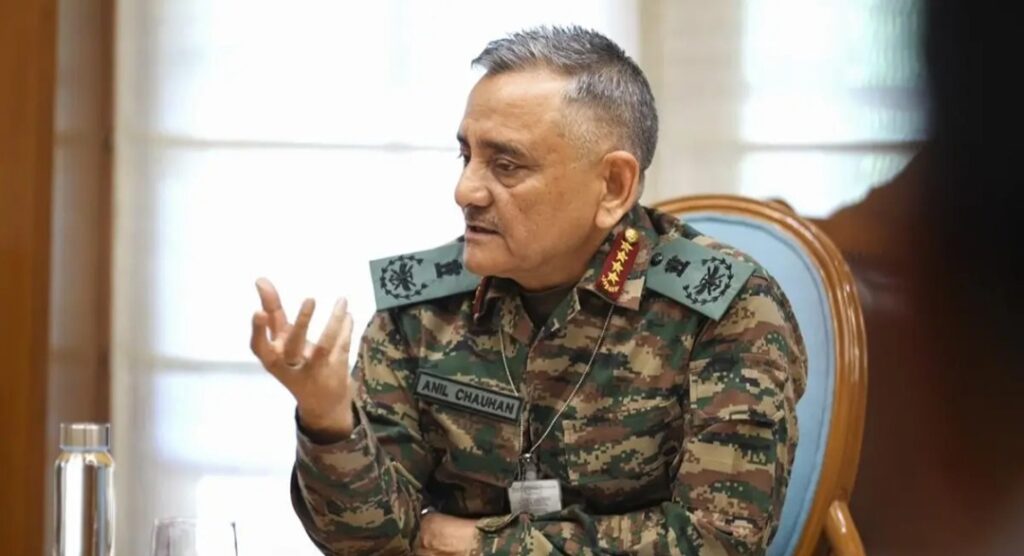
The trajectory of India’s strategic posture has undergone a profound metamorphosis under General Anil Chauhan, PVSM, UYSM, AVSM, SM, VSM, the second Chief of Defence Staff (CDS) of the Indian Armed Forces. Appointed on September 30, 2022, following the tragic demise of General Bipin Rawat, General Chauhan assumed responsibility during an era characterized by volatile border dynamics and emerging multi-domain threats. His tenure, extended until May 30, 2026, marks an epoch of comprehensive institutional overhaul. Serving dually as the Principal Military Advisor to the Government and the Secretary to the Department of Military Affairs, his mandate has centred on achieving deep civil-military fusion, driving indigenous defense manufacturing, and executing India’s definitive shift toward Integrated Theatre Commands.
Formative Years and Career Ascent
Born on May 18, 1961, in Pauri Garhwal, Uttarakhand, General Chauhan originates from a family with a deep martial tradition. Commissioned into the 11th Gorkha Rifles in 1981, his intellectual foundation was forged at the National Defence Academy, Indian Military Academy, Defence Services Staff College, and the National Defence College, later culminating in an M.Phil in Defence and Strategic Studies.
His ascent through the military hierarchy systematically exposed him to India’s dual-threat matrix. As a younger officer, he commanded an Infantry Battalion along the volatile Line of Control (LoC) in Jammu and Kashmir and a Mountain Brigade in Manipur. Upon elevation to Major General, he commanded the 19th Infantry Division in the critical Baramulla sector. As a Lieutenant General, he commanded 3 Corps in Dimapur, overseeing intelligence-driven operations that significantly degraded insurgent capabilities across the Northeast. His international exposure includes serving as a Military Observer for the UN Mission to Angola (MONUA).
Architect of Preemptive Deterrence
General Chauhan’s tenure as Director General of Military Operations (DGMO) from 2018 to 2019 represented a shift toward active, preemptive deterrence. He played an instrumental role in orchestrating terrestrial readiness during the historic Balakot airstrikes in February 2019, ensuring India maintained an overwhelming conventional posture to deter retaliation. Simultaneously, he managed “Operation Sunrise,” coordinating highly sensitive joint military operations with the Myanmar Army to systematically dismantle deeply entrenched insurgent camps along the porous Indo-Myanmar border.
As General Officer Commanding-in-Chief of the Eastern Command (2019-2021), he managed severe geopolitical turbulence during the escalating aggression from China’s PLA. He spearheaded the rapid mobilization of specialized mountain strike corps and the accelerated hardening of forward infrastructure, solidifying his reputation as a foremost expert on high-altitude border management. Following his retirement in 2021, he served as the Military Advisor to the National Security Council Secretariat (NSCS), situated at the nexus of military capabilities and civilian policy, perfectly positioning him for his subsequent elevation to CDS.
Apex Leadership: The Chief of Defence Staff
As CDS, General Chauhan’s immediate mandate was to aggressively drive the integration of the armed forces. Arguably his most formidable structural achievement has been the conceptualization and advancement of Integrated Theatre Commands under the internal moniker “Operation Tiranga.” Recognizing that legacy siloed commands resulted in operational challenges, he drafted the framework to dissolve multiple service commands into three geographically aligned tri-service integrated commands: the Northern Theatre Command, the Western Theatre Command, and the Maritime Theatre Command.
Understanding that the primary barrier was cultural rather than structural, he focussed on consensus-building, personally delivering over 100 lectures at military institutions to cultivate organic acceptance for joint warfighting among mid-level officers. He ensured immediate operational synergy by establishing a Joint Operations Centre by year 2026. This achievement ensures that his successor, Lt Gen NS Raja Subramani, inherits a structurally sound, fully negotiated blueprint ready for final Cabinet Committee on Security clearance.
Operational Mastery: Operation Sindoor (2025)
The most acute test of General Chauhan’s integrated warfighting philosophy was “Operation Sindoor” in May 2025. Triggered in response to a deadly terror attack in Pahalgam, the operation marked a heavily coordinated retaliation against terror infrastructure within Pakistan and PoK. Over an 88-hour conflict window, the Indian military executed rolling precision strikes and successfully utilized its S-400 missile defense system to entirely negate adversary retaliation.
General Chauhan stated that Indian forces “dominated the escalation matrix on all four days.” This dominance was achieved through superior battlefield transparency, technological integration, and unparalleled situational awareness, characterizing the operation as largely “non-contact and non-kinetic.” Validating his warnings against the “trap of long-duration warfare,” he strictly controlled the escalation ladder and enforced clearly demarcated exit strategies, halting hostilities by May 10 and operationalizing a mature doctrine of punitive deterrence.
The ‘JAI’ Triad: Jointness, Atmanirbharta, and Innovation
General Chauhan’s overarching approach is articulated through the ‘JAI’ triad (Jointness, Atmanirbharta, Innovation). He aggressively promoted defense indigenization, leveraging platforms like Aero India 2025 to shift India from a consumer of foreign hardware to a sovereign partner demanding joint development.[iv] He proposed the creation of a specialized Defense Bank to support indigenous projects and challenged the domestic industry to be innovative and cost-competitive.
He also brought critical attention to the ultimate high ground: space and multi-domain warfare. At the Indian DefSpace Symposium in 2026, he articulated that future conflicts will morph instantly into multi-domain engagements blending cyber, space, electronic, and conventional kinetics. Furthermore, he warned of adversarial cognitive warfare, where public sentiment is manipulated to achieve geopolitical concessions without a single physical shot being fired, demanding tailored defense policies for AI and autonomous systems.
Human Capital and Intellectual Legacy
Recognizing the necessity of an agile human resource base, General Chauhan focussed on skilling the HR substantially. He also prioritized military healthcare, awarding a prestigious unit citation to the Armed Forces Medical College (AFMC) in 2024 for its modernization and community outreach initiatives.
A prolific strategic scholar, General Chauhan enriched India’s military literature with his 2025 book(s), Ready, Relevant and Resurgent 1: A Blueprint for the Transformation of India’s Military & Ready, Relevant and Resurgent 2: Shaping a future ready force.[v] The text synthesizes ancient Indian strategic wisdom from sources like the Arthashastra with modern geopolitical theory, placing geography at the heart of grand strategy.[vi] Under his supervision, the military also accelerated its doctrinal output, publishing sixteen distinct joint doctrines in a highly compressed timeframe to institutionalize this multi-domain vision.
Military Honors and Decorations
A career defined by over four decades of intense operational deployments, strategic innovation, and administrative output is naturally accompanied by the highest state honors. General Chauhan is among the most highly decorated officers currently serving in the Indian Armed Forces, having received formal recognition for both peacetime administrative excellence and wartime operational leadership across the spectrum of conflict. Most significantly, in 2020, he was awarded the Param Vishisht Seva Medal (PVSM), the highest peacetime award for distinguished service of the most exceptional order. This premier honor crowns a long list of distinguished decorations, including the Uttam Yudh Seva Medal (UYSM) in 2018, the Ati Vishisht Seva Medal (AVSM) in 2015, the Sena Medal (SM) in 2014, and the Vishisht Seva Medal (VSM) in 2011. The highly rare combination of the Param Vishisht Seva Medal (PVSM) and the Uttam Yudh Seva Medal (UYSM) serves as the ultimate validation of his dual-profile excellence in administration and active combat leadership. Beyond these premier decorations, his extensive service history is reflected in a multitude of campaign, service, and anniversary medals, visually narrating a career spent entirely at the tip of the spear of India’s national security apparatus.
Conclusion
The tenure of General Anil Chauhan will be recorded as the definitive era when the Indian Armed Forces transitioned into a deeply integrated and multi-domain capable global force. By permanently dismantling outdated dogmas of strategic restraint through paradigms of escalation dominance like Operation Sindoor, and by patiently architecting the blueprint for Integrated Theatre Commands, he eroded institutional protectionism. Handing over a transformed and solidified foundation to his successor, General Chauhan’s ultimate legacy is a resilient, self-reliant, and fully integrated military architecture designed to secure India’s strategic autonomy for decades to come.




well comprehended and compiled, thank you for the true insight into the functioning