
By : Pratyush Raj, Research Analyst, GSDN
Introduction: Iran’s Rise in the Middle East
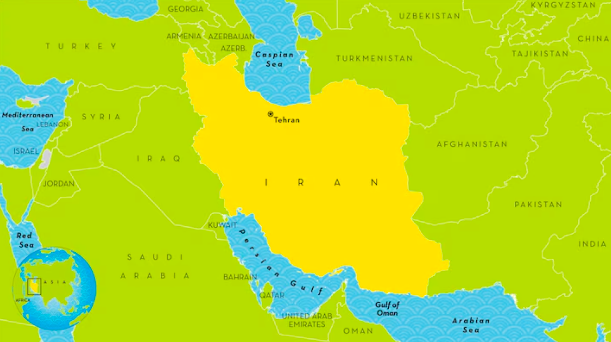
The Middle East remains a focal point of global attention, and a region of strategic importance. In this context, Iran emerged as a significant regional power, playing a vital role in shaping the power dynamics by expanding its influence through strategic alliances, military capabilities, and involvement in regional conflicts. This article analyses the emergence of Iran as a regional power and the driving factors responsible for its rise.
Historical Context
Pre-1979: Western Alignment
Before 1979, Iran functioned largely as a Western-Aligned state under the leadership of Mohammad Reza Pahlavi. Its foreign policy was intertwined with the United States, especially in the context of the cold war, where Iran acted as a strategic ally in countering the Soviet Union’s strategic dominance in the vicinity. It played a crucial role in ensuring that the oil-rich Gulf remained out of Soviet hands during the Cold War. Thus, while Iran held considerable strategic value during the Cold War, its lack of foreign policy autonomy prevented it from emerging as an independent regional actor, keeping it firmly within the Western sphere of influence.
1979 Revolution: Decisive moment in Iran’s history
The Islamic Revolution, which culminated on February 11, 1979, marked a decisive turning point in Iran’s political path. The establishment of the Islamic Revolutionary Guard Corps (IRGC) in the same year further strengthened the regime’s ability to pursue its strategic objectives. With the overthrow of Shah regime, Iran’s foreign policy took an anti-US and anti-Israel stance, marking a significant ideological and political change. It focused on exporting revolutionary ideas and embarking more regional assertive stances in the region. By the formation of proxy groups like Hezbollah in Lebanon, Houthis in Yemen, and Hamas, Iran effectively challenges U.S. and Israeli interests, causing significant regional instability.
Thus, Iran’s transformation post 1979 laid the foundation for its emergence as a regional power, driven by a combination of strategic, military, and ideological factors.
Drivers of Iran’s Rise: Understanding key factors
Iran-Iraq War
Religious conflict, territorial dispute, and the desire to assert regional dominance in the region led to the war which lasted for about 10 years (1980-1988) and ended in 1990 with UN intervention. Iraq under the leadership of Saddam Hussain miscalculated by expecting a quick victory over weaker and demoralised Iranian forces post 1979 revolution. During the war, Iran found itself isolated with very limited external support, giving birth to factors which were responsible for its emergence. It boosted self-reliance by realizing how to build a native defence industry. Today, its advanced missile and drone programmes are direct learning outcomes of the necessity-based innovations of the 1980s. Iran comprehended that it could not win a head-to-head battle against superior opponents like U.S., resulting in adopting asymmetric warfare. It involves low-cost tools like drones, speedboats, and proxy militias to inflict damage on enemies. The IRGC evolved from a loose militia group to a strong and sophisticated military during the war. It became the state’s primary tool to expand its ideological and military influence in the regions post-war.
Military and Asymmetry Strategy
Rooted in lessons learnt from Iran-Iraq war, it shifted its focus from direct conflict engagement to unconventional techniques. Their key pillar is massive missile programs active today. It started investing heavily in missile programmes, speed boats, mines deployment, drone warfare and expanding its influence through non-state actors. Since Iran lacks modern Airforce, missiles replace expensive fighter jets. They possess the Middle East’s largest arsenal, which is increasingly precise now. The concept of underground missile city is another key psychological tactic used. They built huge bases under mountains resistant to heavy aerial bombing. This means even if Iran is attacked, their response capability stays intact. Iranian suicide drones, like Shahed, are produced and used at negligible cost. They help inflict damage on enemies, costing only $20,000 each. Their low-altitude flight makes them difficult to detect by many advanced radar systems. Another strength is their low-cost naval warfare. At sea, Iran’s strategy differs from world’s classic standing armies. They have speed boats which is effectively used for mines deployment in vital shipping routes, like we recently saw the naval blockade in Strait of Hormuz. It has turned out to be Iran’s one of the strongest battlefield cards against global superpower like U.S. Despite possessing a relatable weaker navy compared to U.S., and Israel. It has managed to control Strait of Hormuz as a strategic chokepoint for the global economy.
Proxy Networks and Regional Influence
Proxy forces or the axis of resistance is Iran’s long arm regionally. From Hezbollah in Lebanon to resistance groups in Iraq, Syria, and Yemen, this vast human network gives Iran strategic depth that is vital. Before the enemy reaches Iran, they must fight on multiple other fronts. The smart point is that these groups make deniability entirely possible. When an attack happens, Iran can say- “Not us, they acted independently”. This ambiguity prevents the enemy from finding legal grounds to attack Iran. It has repeatedly leveraged its extended army in past, like in 2019, Houthis attacking Saudi Arabia’s critical energy infrastructure, Shia militias in Iraq targeting U.S forces following its invasion in Iraq, Hezbollah firing rockets on Israeli troops stationed in Southern Lebanon in April,2026 demonstrating Iran’s broader regional reach of its proxy networks. Iran finds maintaining these proxy forces less costly than getting involved in war.
Ideological Influence
Alongside strategic and military capabilities, ideology has remained an important factor for Iran’s regional influence. After 1979 Islamic revolution, Iran adopted a foreign policy rooted in opposing Western intervention and Israeli influence in the Middle East. The leadership under Ayatollah Khamenei promoted the idea that Iran was not merely a state pursuing strategic interests but also a nation defending oppressed Muslim communities, particularly Shia populations across the region. This reflects Iran stance against pro-western governments and given it a distinct identity in the Middle East. By claiming to be the protectors of Shia community, Iran established close ties with influential actors in countries such as Iraq, Syria, Yemen, and Lebanon. These relationships were not solely military or political in nature but strengthened by shared religious identity and united resistance against the Western world. Moreover, this ideological outreach has boosted Iran’s involvement in regional conflicts and support for non-state actors.
While these factors have contributed to expanding Iran’s influence in the region, regional power does not guarantee sustainability. Economic sanctions, regional rivalries, and internal pressure continue to challenge the durability of Iran’s influence.
Challenges
Economic Sanctions
For decades, Iran has been locked out of the global banking system. The story really begins in 1979 with the Islamic revolution. When Iran nationalized its assets and took American hostages, the US froze Iranian funds. This was the first shot in the financial war. However, for a very long period, sanctions were porous. European and Asian companies continued to buy Iranian oil. The real shift occurred in the early 2000s and then again more aggressively in 2018. In 2015, the world thought the conflict was over. The joint comprehensive plan of action, JCPOA, the nuclear deal, was signed. The economic logic was a simple trade, Iran gives up its nuclear ambitions, and in exchange, the west reconnects Iran with global banking system and allows it to sell oil. But, in 2018, the Trump administration withdrew from the deal, instituting a policy of maximum pressure. The goal was to reduce Iran’s oil exports to zero. As of today, the deal is officially dead. Iran has restarted high level Uranium enrichment, and European powers have triggered snapback sanctions, a mechanism that restores all prior UN penalties. The reimposition of sanctions significantly impacted Iran’s energy sector, with oil exports falling from roughly 2.5 million barrels per day in 2018 to well below 1 million barrels per day during periods of maximum pressure. Iran has realized that compliance with the west did not guarantee economic safety.
Regional Rivalries
Iran’s growing influence does not go uncontested; it is deterred by its reginal rivalries fighting for hegemony.
Iran-Saudi Clash
For a long stretch, Iran and Saudi Arabia have been waging proxy wars to assert regional dominance. This rivalry has drawn the region into chaos and ignited Sunni -Shia conflict across the Middle East. Animosity between the two countries have been sharpened by a series of events, from the war in Syria and Yemen to the test of strength in Iraq and Lebanon. But were Iran and Saudi Arabia always enemies? The answer to this can be traced back to the period before 1979, when both nations shared good diplomatic ties as they were governed by western backed monarchs. The root of the conflict lies in the 1979 Islamic Revolution which saw the pro-western monarch, Shah Mohammad Reza Pehlavi, toppled and replaced by Ayatollah Khomeini. Khomeini openly opposed the idea of monarchy and calling it against Islam, drawing parallels between both the nations. The fear of exporting Iranian revolution to neighboring countries triggered violent confrontation among protestors and further straining the relation. In Yemen, where Saudi-led coalition is engaged in a bitter fight against Iranian-backed Houthi rebels who are Shias. This has drawn country into a concerning humanitarian crisis; tens of thousands of people have been killed since the start of the conflict. Although Iran and Saudi Arabia have never engaged in a direct confrontation, their proxy battle in the middle east continue to escalate.
Iran-Israel Enmity
For centuries, Middle East has been witnessing long standing religious, territorial and military conflict between Iran and Israel, making the region unstable. Before 1979, Iran and Israel shared cordial relations under the leadership of Reza Pahlavi. The relationship between them has been marked by hostility since the 1979 Islamic Revolution, which transformed Iran, a close ally of Israel under the Shah, to anti-Israel. Iran, governed by Shia principles. Israel, which is predominantly a Jewish state now has strong religious and ideological differences. Israel sees Iran’s nuclear ambitions, support to its proxy groups as a threat to its national security and views it as a fight for existence. Iran’s support to its militias like Houthi rebels in Yemen, Hamas, and Hezbollah continue to vow for Israel’s destruction escalating a dangerous geopolitical rivalry in the region. Recent strikes by Israel and U.S., aimed at changing the regime and stop its Uranium enrichment programme. Ali Khamenei, former supreme leader of Iran was killed on February 28, 2026 in aerial strikes by Israel and U.S. Iran attacked multiple US bases present in the middle eastern countries like, UAE, Qatar, and Saudi Arabia. Iran thought that by blocking Strait of Hormuz, an important global trade route, responsible for handling about 25% of the world’s seaborne oil trade, it would put immense pressure on US and Israel to come at the negotiating table. Currently, situation remains unstable sparking global disruptions in trade and impacting world’s economy.
Conclusion
Today, Iran is standing at the crossroads of shaping regional power dynamics. Despite years of wars, sanctions, and internal pressure, it has established itself as a major actor in influencing Middle Eastern politics. From a western aligned monarchy to a revolutionary state seeking influence across middle east, Iran is asserting its presence more profoundly than ever before. It has continuously supported its proxy groups and has kept its enemies at their toes by rapidly progressing their advance missile programs and nuclear ambitions. On the other hand, factors like global banking isolation, domestic pressure, and regional rivalries continue to challenge its influence and question its intentions. Recent “Operation Epic Fury” carried out by US, what would have been a quick in and out operation according to US, has now been escalated to a global economy crisis as Iran has blocked the Strait of Hormuz, giving it a strategic leverage to put pressure on US and Israel. Although a month-long ceasefire is holding, and diplomacy is underway, the question of when the conflict will truly come to an end remains unanswered.




So well researched even a layman can know what IRAN stands for.
Very well written
Very infirmative and Well Articulated account of Iran and its influence in the geopolitics of Middle East and the world.
Very well researched and penned article!!
A informative read. Keep it up dear pratyush.
Very well researched and penned!!
Very nicely written narrating strengths and weakness.