
By: Khushbu Ahlawat, Consulting Editor, GSDN
From Naxalbari to the Red Corridor: Origins, Expansion, and Ideological Foundations
The trajectory of India’s Maoist insurgency, often referred to as the Naxalite movement, is deeply rooted in agrarian discontent, ideological mobilization, and state neglect in peripheral regions. The movement traces its origins to the 1967 uprising in the village of Naxalbari in northern Bengal, led by revolutionary ideologue Charu Majumdar. Drawing heavily from Mao Zedong’s doctrine, the movement advocated armed struggle as the primary means to overthrow what it termed a feudal and exploitative state structure. Majumdar emphasized that “political power grows out of the barrel of a gun,” and framed landlords and state authorities as “class enemies,” thus justifying violent resistance.
In its early years, the movement spread rapidly across parts of eastern and central India, particularly in regions marked by tribal marginalization, land alienation, and lack of governance. By the 1970s, however, state crackdowns led to a temporary decline. The movement resurged in the 1980s and 1990s, largely due to the consolidation of militant groups such as the People’s War Group (PWG) and Maoist Communist Centre (MCC). Their eventual merger in 2004 led to the formation of Communist Party of India (Maoist), marking a significant turning point.
At its peak, the Maoist movement established a vast “Red Corridor” stretching across nearly a dozen Indian states—from Kerala in the south to Nepal’s borders in the north. The insurgents developed parallel governance structures known as Janatana Sarkars (people’s governments), particularly in parts of Chhattisgarh, where they exercised de facto control over remote forested areas. These structures enabled them to mobilize local populations, collect resources, and sustain a prolonged insurgency.
The Maoists also developed a formidable armed wing—the People’s Liberation Guerrilla Army (PLGA)—which was trained in modern warfare techniques and improvised explosive device (IED) deployment. At one point, the insurgency was described by former Prime Minister Manmohan Singh as India’s “single biggest internal security threat.” The movement’s ability to recruit from marginalized tribal communities and educated youth alike allowed it to maintain both ideological depth and operational capacity.
However, the very factors that fueled its rise—rigid ideology, centralized control, and reliance on violence—would later contribute to its fragmentation and decline. As India’s internal security framework evolved and development initiatives penetrated previously inaccessible regions, the Maoist insurgency began to face unprecedented challenges.
Decapitation and Decline: Security Operations and Organisational Weakening
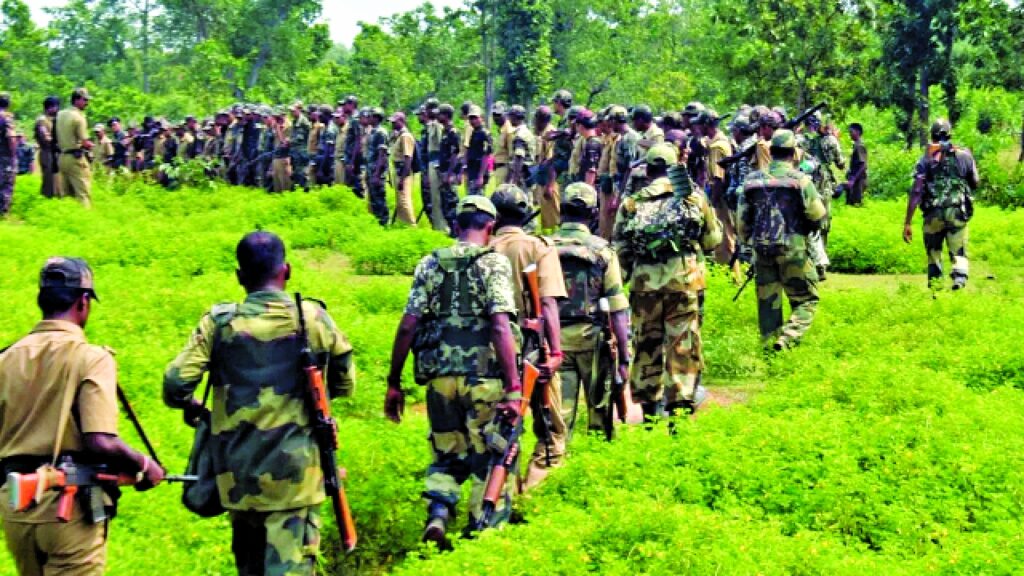
The most significant blow to the Maoist insurgency in recent years has come from sustained and coordinated security operations by Indian forces. A defining moment occurred on May 21, 2025, when Nambala Keshava Rao, the general secretary of the CPI (Maoist), was killed in an encounter in Chhattisgarh’s Abujhmad region. This operation, carried out by the District Reserve Guard (DRG) and the CRPF’s elite CoBRA unit, marked a decisive turning point in the state’s counterinsurgency efforts.
His successor, Tippri alias Sudhakar, reportedly surrendered by early 2026 along with critical intelligence, including addresses and weapons caches. These developments led to the arrest or neutralization of several top Central Committee leaders, effectively decapitating the organisation’s leadership. As per available data, the Central Committee membership has shrunk dramatically—from around 40 members in earlier years to just two active members remaining today.
Operation Kagar (Black Forest), launched in 2024, has been instrumental in this decline. Coordinated across multiple Left-Wing Extremism (LWE)-affected states, the operation has resulted in approximately 3,840 surrenders, 2,220 arrests, and over 600 Maoist deaths. Among those neutralized were seven Central Committee or Politburo members—12 of whom were killed—dealing a severe blow to the insurgency’s command structure.
An equally critical but often underemphasized factor behind the weakening of the Communist Party of India (Maoist) has been the parallel expansion of governance and development initiatives in Left-Wing Extremism (LWE)-affected regions. Over the past decade, the Indian government has significantly increased budgetary allocations under schemes such as the Security Related Expenditure (SRE) and Special Central Assistance (SCA), focusing on infrastructure, connectivity, and livelihood generation. More than 11,000 km of roads have reportedly been constructed in previously inaccessible tribal belts under the Road Requirement Plan, drastically reducing the geographical isolation that once enabled Maoist dominance. Simultaneously, the penetration of mobile networks and digital services has improved intelligence gathering while integrating remote populations into the national mainstream. Financial inclusion programs, including the expansion of bank accounts and direct benefit transfers, have reduced the Maoists’ ability to exploit economic grievances. Education and health infrastructure have also expanded, with residential schools and primary healthcare centers being established in remote districts of Chhattisgarh, Jharkhand, and Odisha. Importantly, the recruitment base of the insurgency has weakened as employment opportunities—particularly through schemes like MGNREGA—have provided alternative livelihoods to rural youth. Data from recent years indicates a steady decline in Maoist-related violence incidents, dropping by over 50% compared to a decade ago. Furthermore, local populations, once seen as passive supporters or coerced collaborators, are increasingly participating in democratic processes, including higher voter turnout in previously insurgency-hit areas. This gradual shift reflects a deeper erosion of Maoist influence—not just militarily, but socially and politically—suggesting that the state’s long-term strategy of combining security with development is yielding tangible results.
The geographical footprint of the Maoists has also shrunk drastically. From controlling nearly 180 districts in 2013, their presence is now largely confined to just two districts in Chhattisgarh—Bijapur and Sukma. This contraction reflects not only military success but also improved governance and infrastructure penetration in previously inaccessible regions.
Despite these setbacks, it would be premature to declare the insurgency entirely समाप्त. Historically, the Maoists have demonstrated resilience and the ability to regroup under adverse conditions. For instance, in 1991, they were reduced to a single dalum (unit), only to re-emerge stronger by the 2000s. However, the current scale of organisational collapse—particularly the loss of top leadership and shrinking cadre base—suggests a far more Serious existential crisis.
Internal Fault Lines: Ideological Erosion, Fragmentation, and Loss of Relevance
While state-led security operations have played a crucial role, the internal weaknesses of the Maoist movement have been equally decisive in its decline. One of the most significant issues has been factionalism. Since the early days under Charu Majumdar, the movement has been prone to ideological splits, leading to the formation of multiple factions—sometimes as many as 40 distinct groups.
These divisions often revolved around strategic disagreements. While some factions advocated mass mobilization and political engagement, others pushed for violent annihilation of perceived class enemies. This lack of ideological coherence weakened the movement’s ability to present a unified front and diluted its appeal among potential supporters.
Leadership struggles further exacerbated these issues. Senior leaders like Kondapalli Seetharamaiah were eventually sidelined by younger cadres, leading to generational divides. More recently, the promotion of figures like Madvi Hidma was seen as an attempt to address internal dissatisfaction, particularly among tribal cadres. However, such moves often came too late to reverse declining morale.
Another critical factor has been the erosion of ideological relevance. The Maoist framework, rooted in mid-20th century revolutionary theory, has struggled to adapt to contemporary socio-economic realities. Government welfare schemes, improved connectivity, and increased political participation in tribal areas have reduced the resonance of Maoist narratives. The concept of “class enemy” has lost its mobilizing power in regions where state presence has significantly improved.
Additionally, the movement has faced resistance from within tribal communities themselves. While tribals formed the backbone of Maoist recruitment, they have also borne the brunt of violence. This has led to growing disillusionment and, in some cases, active opposition. The rise of local defence groups and increased cooperation with security forces reflect this shift.
A crucial indicator of the weakening of the Communist Party of India (Maoist) has been the sharp decline in fresh recruitment and the aging profile of its existing cadre. Intelligence assessments and field reports suggest that the average age of active Maoist fighters has increased significantly over the past decade, reflecting the organisation’s inability to attract younger recruits. This shift is particularly important because the movement historically relied on mobilizing disaffected tribal youth and ideologically motivated students from urban centers. Today, however, improved access to education, expansion of road and digital connectivity, and greater exposure to mainstream economic opportunities have reduced the appeal of armed struggle. Additionally, surrender and rehabilitation policies introduced by various state governments have incentivized lower- and mid-level cadres to abandon insurgency, further weakening organisational depth. Reports indicate that many surrendered cadres cite fatigue, disillusionment with leadership, and fear of intensified security operations as key reasons for leaving. Importantly, the erosion of local support networks—once sustained through coercion or ideological alignment—has made it increasingly difficult for Maoist units to sustain themselves logistically in forested regions. Villagers are now more likely to share intelligence with security forces, reflecting a gradual but significant shift in ground-level dynamics. This combination of declining recruitment, aging leadership, and weakening social support underscores a deeper structural crisis for the movement.
Efforts at reconciliation and dialogue have also exposed internal contradictions. Some leaders reportedly explored peace talks as early as 2010, but these initiatives were often undermined by hardline factions. The inability to transition from armed struggle to political engagement has further isolated the movement. In essence, the Maoist insurgency is not just being defeated externally—it is unraveling from within.
Endgame or Evolution? Prospects of Revival and the Road Ahead
The question of whether India’s Maoist insurgency is truly over remains complex. While the current trajectory points toward decline, the possibility of a limited revival cannot be entirely ruled out. History offers cautionary lessons—the movement has repeatedly demonstrated an ability to adapt and re-emerge.
One potential pathway for revival lies in underground restructuring. Reports suggest that some leaders have gone into deep hiding, attempting to rebuild networks away from state surveillance. However, sustained security pressure and improved intelligence capabilities make such efforts increasingly difficult.
Another factor is the legal and rehabilitation framework. Many surrendered cadres face serious criminal charges, including murder. The process of reintegration into mainstream society is fraught with challenges, particularly when victims’ families oppose leniency. Judicial processes and state policies will play a crucial role in determining whether former insurgents can be successfully rehabilitated.
At the same time, the decline of armed insurgency does not automatically resolve the underlying socio-economic issues that gave rise to it. Land rights, tribal displacement, and resource exploitation remain contentious issues in several regions. If these grievances are not addressed effectively, they could create conditions for new forms of resistance—though not necessarily in the Maoist mold.
The Indian state’s approach has increasingly combined hard power with development initiatives. Infrastructure projects, digital connectivity, and welfare schemes have significantly improved state presence in former Maoist strongholds. This dual strategy has been instrumental in undermining the insurgency’s support base.
Ultimately, the future of the Maoist movement will depend on whether it can reinvent itself ideologically and organizationally. Given the current fragmentation, leadership vacuum, and declining relevance, a large-scale resurgence appears unlikely in the near term.
Conclusion
The decline of the Communist Party of India (Maoist) marks a significant turning point in India’s internal security landscape, but it should not be mistaken for a complete resolution of the challenges that gave rise to the insurgency. While the dismantling of leadership structures, shrinking territorial control, and declining violence indicate that the armed movement is nearing its end, the underlying socio-economic fault lines—land alienation, tribal marginalization, and uneven development—continue to persist in many regions. The Indian state’s success has largely stemmed from a calibrated strategy that combines coercive force with developmental outreach, signaling a shift from purely militaristic responses to more holistic governance models. However, the sustainability of this success will depend on deepening institutional presence, ensuring justice delivery, and fostering inclusive growth in historically neglected areas. The transition from conflict to stability is inherently fragile; without sustained engagement, there is always a risk of residual networks reorganizing or new forms of localized resistance emerging. Moreover, the ideological vacuum left by the decline of Maoism may not necessarily lead to peace unless it is filled with credible political representation and economic opportunity. Therefore, the real test for India lies not in eliminating insurgency alone, but in transforming former conflict zones into spaces of trust, participation, and development. In this sense, the end of Maoist violence—if it indeed materializes—should be viewed not as a conclusion, but as the beginning of a more complex phase of nation-building, where governance, equity, and inclusion will determine whether the “Red Corridor” finally fades into history or evolves into a different kind of challenge.

About the Author
Khushbu Ahlawat is a research analyst with a strong academic background in International Relations and Political Science. She has undertaken research projects at Jawaharlal Nehru University, contributing to analytical work on international and regional security issues. Alongside her research experience, she has professional exposure to Human Resources, with involvement in talent acquisition and organizational operations. She holds a Master’s degree in International Relations from Christ University, Bangalore, and a Bachelor’s degree in Political Science from the University of Delhi.



