
By: Avantika Roohi Kansal
When the most powerful man in the world flies to meet his rival- not to confront him, but to court him- you know that the world has changed.
In May 2026, Air Force One touched down Beijing carrying a message that the world had not expected from Donald Trump- Diplomacy over Dominance. For two days, the 47th President of the United States walked through Imperial Gardens, toasted at grand banquets, and sat across the table from Chinese President Xi Jinping- a man he called ‘friend’ five times in public, yet barely received a nod of reciprocation in return. The optics were unmistakable. China was no longer playing catch-up. It has arrived.
This was not merely a state visit. It was a geopolitical signal flare- one that illuminated the emerging G2 world order, China’s breathtaking technological ascent, and the complicated, high-stakes dance between the planet’s two most powerful nations.
The G2 Idea: Two Giants, One World
The concept of a ‘G2’- a world informally governed by the US and China- has been debated in foreign policy circles for over a decade. The premise is simple yet profound- no global challenge, whether climate change, nuclear proliferation, AI governance, or trade stability, can be meaningfully addressed without Washington and Beijing at the table.
For years, this idea remained theoretical. Relations between the two superpowers were defined more by tariff wars, chip bans, and military posturing in the South China than by diplomatic warmth. Trump’s first term intensified rivalry. His second term, it seems, is attempting to rewrite the script.
Xi Jinping’s announcement during the Summit- that the two nations had agreed to build a ‘constructive China-US relationship of Strategic Stability’ – was the closest either side has come to publicly acknowledging G2 reality. It was careful, measured language, but in the world of diplomacy, it carried enormous weight. Two rivals agreeing to stabilize their relationship is the first step towards managing the world together.
America’s Tech Dilemma: Working around the Dragon it cannot Ignore
Here lies one of the great contradictions of 21st-century geopolitics. The United States has spent years aggressively trying to contain China’s technological rise- banning Huawei from Western networks, restricting semiconductor exports through the CHIPS Act, pressuring allies to exclude Chinese firms from critical infrastructure, and blacklisting hundreds of Chinese tech companies. Washington’s message was clear- We will not let China dominate the technologies of tomorrow.
Yet Trump flew to Beijing anyway. And the reason is as old as geopolitics itself- you cannot indefinitely sanction, restrict, and compete with a nation that manufactures a significant share of your goods, holds hundreds of billions of US debt, and is rapidly outpacing you on key technological domains.
China today is not the low-cost manufacturing hub of the 1990s. It is a tier-one technology power. Its advancements in artificial intelligence rival Silicon Valley. Its 5G Infrastructure, built through Huawei and ZTE, covers more of the world than any American-built network. Its electric vehicle industry, led by BYD and CATL, is dismantling the dominance of Western Automakers. Its quantum computing research is advancing at a pace that alarms Western Intelligence agencies. And its high-speed rail network- the largest in the world- showcases an engineering and logistical capability that few nations can match.
The Trump Summit took place against this technological backdrop, With China projecting quite confidence. The elaborate security arrangements, seamless digital logistics, and grandeur of the welcome ceremony near Tiananmen Square were not accidental- they were a statement. This is what we have built. This is who we are now.
What was Actually Discussed- and What wasn’t Said
Behind closed doors, the two leaders covered an ambitious- if unresolved- Agenda.
Taiwan dominated private sessions. Trump later revealed to Fox News that the issue consumed an entire night of talks. He maintained Washington’s long-standing policy of strategic ambiguity, refusing to clarify whether the US will militarily defend Taiwan if China moves to reclaim it. Xi left without the explicit commitment he sought. The conversation, however, reflected just how Central Taiwan remains to any serious US China Dialogue- a flashpoint that neither side can afford to ignore, nor resolve overnight.
Trade and economic decoupling were also on the table, though Beijing arrived with no intention of offering concessions. Chinese officials had reportedly warned Trump’s team beforehand that insufficient preparation would limit any breakthroughs and they were right. No major trade agreements were signed. No new frameworks were announced. The Chinese government, confident in its economic trajectory, had little incentive to offer relief to an American administration it privately views as weakened and distracted.
Strategic stability and military communication channels formed the quieter, but arguably more important, thread of discussions. Preventing accidental escalation whether in the Taiwan Strait, the South China Sea, or cyberspace requires open military hotlines and shared protocols. Both sides acknowledged the need for such guardrails, even if concrete mechanisms were not finalized.
Potential Deals and What Lies Ahead
The most tangible outcome of the summit was an invitation: Trump asked Xi to visit the United States on September 24, 2026. If that visit materializes, it could serve as the venue for more substantive agreements on trade, AI governance, climate cooperation, or even a framework for managing Taiwan tensions.
The inclusion of top American business leaders in the U.S. delegation alongside Trump family members Eric and Lara Trump signalled that economic engagement, not complete decoupling, remains the direction of travel. The Trump Organization’s implicit appeal to Beijing for favourable treatment underscored the administration’s transactional approach to diplomacy.
Looking ahead, the world should watch three developments closely:
- Whether the September Xi visit to Washington produces binding agreements on trade or technology sharing that begin to reverse years of economic hostility.
- How China leverages its tech dominance particularly in AI and green energy as a bargaining chip in future negotiations.
- Whether the G2 framework solidifies into a genuine co-management of global affairs, or fractures again under the weight of Taiwan, chips, and competing visions of world order.
The Bigger Picture
Trump’s deference in Beijing marvelling at Chinese power, calling Xi his friend, asking whether he was ‘special’ to be admitted to Zhongnanhai was striking. Whether it reflected strategic calculation or genuine admiration, it told a story about where the world stands in 2026.
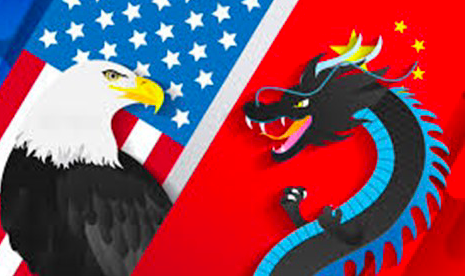
The Eagle still soars. But the Dragon, once dismissed as a rising power, has risen. The question now is not whether these two giants will shape the future together they already are. The question is on whose terms.
The world order is not collapsing. It is being renegotiated for one summit, one garden stroll, and one unanswered question about Taiwan at a time.



