
By : Simar Kaur, Research Analyst, GSDN
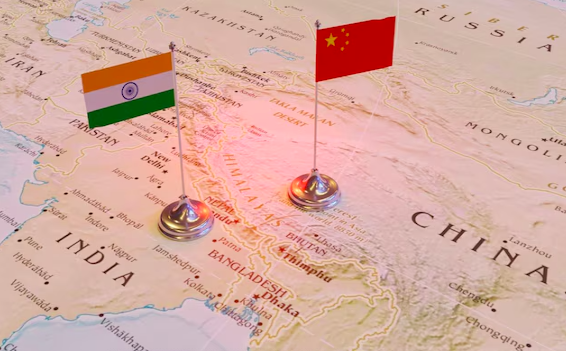
Introduction
The boundary dispute between China and India is one of the longest unresolved territorial disagreements in the world. Stretching across nearly 2,100 miles of the Himalayan frontier, the disputed boundary has shaped the relationship between the two most populous nations on earth for more than seven decades. The disagreement produced one full-scale war in 1962, a deadly military clash in the Galwan Valley on June 15, 2020, and several years of tense troop mobilization along the Line of Actual Control, commonly referred to as the LAC. At the same time, the two countries have also periodically negotiated disengagement agreements, resumed high-level political contact, and expanded trade to record levels. This apparent contradiction, tension along the frontier on one hand and deepening economic interdependence on the other, raises an important question. Can China and India ever truly resolve their border disputes, or are they destined to manage an uneasy and indefinite coexistence along a contested frontier? This article examines the historical origins of the dispute, the key flashpoints that have defined it, the diplomatic efforts undertaken so far, and the structural obstacles and opportunities that will determine whether a final settlement is achievable.
Historical Roots of the Boundary Dispute
The India-China boundary was never formally demarcated during the colonial period, leaving behind a legacy of competing claims once both countries emerged as modern nation states. The eastern sector of the boundary, covering the present-day Indian state of Arunachal Pradesh, is largely defined by the McMahon Line, a boundary drawn during the Simla Convention of 1914 between British India and Tibet. China has consistently refused to recognise the McMahon Line, arguing that Tibet did not possess the sovereign authority to conclude such an agreement independently. The western sector, covering the Aksai Chin plateau, presents a different set of complications. Aksai Chin is administered by China as part of its Xinjiang Uyghur Autonomous Region, but India claims it as part of the union territory of Ladakh. The middle sector, running through the Indian states of Himachal Pradesh and Uttarakhand, is comparatively less contentious but still lacks a mutually agreed boundary alignment. Because no treaty ever formally demarcated the frontier across its entire length, both countries have relied on the concept of the Line of Actual Control, an operational ceasefire line rather than a legally settled international boundary, to manage day-to-day military presence.
The 1962 War and Its Enduring Legacy
Tensions between the two newly independent Asian giants escalated through the 1950s as China consolidated control over Tibet and built a strategic road through Aksai Chin connecting Xinjiang to Tibet, a project India only discovered after its completion. Diplomatic protests failed to resolve the disagreement, and on October 20, 1962, Chinese forces launched a coordinated offensive across both the eastern and western sectors of the disputed boundary. The war lasted approximately one month and ended in a decisive military setback for India. China declared a unilateral ceasefire on November 21, 1962, and withdrew its forces to positions behind what later came to be recognized as the Line of Actual Control. The war left a deep imprint on Indian strategic thinking and created a residue of mistrust that continues to influence bilateral relations today. It also hardened each side’s territorial claims, making any subsequent settlement politically difficult, since conceding territory after a military defeat carries a heavy domestic political cost for Indian leaders, while China has shown little inclination to revisit an outcome it regards as settled in its favor.
Key Friction Points Along the Frontier
Beyond the broad sectoral disagreements, several specific locations have repeatedly triggered military standoffs. The Doklam plateau, a tri-junction area claimed by both China and Bhutan, became the site of a seventy-three-day standoff between Indian and Chinese troops beginning in June 2017, after India intervened to stop Chinese road construction that New Delhi viewed as a threat to a strategically vital corridor connecting India’s northeastern states to the rest of the country. The Depsang Plains and the Demchok sector in eastern Ladakh remained points of friction for years after the 2020 crisis, with Chinese patrols restricting Indian access to traditional patrolling points. Pangong Tso, a glacial lake straddling the Line of Actual Control, was the site of physical clashes between soldiers in 2020 before both sides withdrew heavy equipment from its northern and southern banks. More recently, in January 2026, China revived its historical claim over the Shaksgam Valley, a region in the Jammu and Kashmir union territory that India considers its sovereign territory but which has been under Chinese control since Pakistan ceded it under a bilateral agreement signed in 1963. India has consistently rejected the 1963 cession as illegal and void, and the renewed Chinese assertion added a fresh layer of complexity to an already crowded set of territorial disagreements.
The Galwan Valley Clash and the 2020 Standoff
The most crisis in the bilateral relationship since 1962 began in early May 2020, when Indian and Chinese troops clashed at multiple points along the Line of Actual Control in eastern Ladakh. The confrontation escalated dramatically on June 15, 2020, when a violent hand-to-hand clash in the Galwan Valley resulted in the deaths of twenty Indian soldiers and an undisclosed number of Chinese casualties, later acknowledged by Beijing to be four soldiers. It was the first fatal clash on the border in forty-five years and triggered a massive mobilization of troops, artillery, and air assets by both sides along the frontier. The crisis fundamentally altered the trajectory of the relationship. India suspended several bilateral initiatives, banned numerous Chinese mobile applications on security grounds, and tightened scrutiny of Chinese investment proposals. Both governments authorized their military commanders to hold a series of corps commander level talks, beginning shortly after the clash and continuing years afterward, aimed at achieving disengagement at multiple friction points. Progress was slow and uneven, with disengagement completed at some locations, such as the northern and southern banks of Pangong Tso in February 2021 and at Gogra-Hot Springs in September 2022, while other points, particularly Depsang and Demchok, remained unresolved for an extended period.
The Long Road to Disengagement and Diplomatic Reset
A significant breakthrough came in October 2024, when India and China finally reached a disengagement agreement covering the Depsang and Demchok sectors, the last two remaining friction points from the 2020 standoff. The agreement restored patrolling arrangements that existed prior to the crisis, allowing troops from both sides to patrol up to previously agreed patrolling points. Days after this agreement was finalized, Indian Prime Minister Narendra Modi and Chinese President Xi Jinping held bilateral talks on the sidelines of the BRICS summit in Kazan, Russia, on October 23, 2024, marking the first formal meeting between the two leaders in five years. The two leaders agreed to direct their special representatives, a mechanism led on the Indian side by the National Security Advisor, to resume dialogue aimed at achieving a fair, reasonable, and mutually acceptable settlement of the boundary question. Momentum continued to build through 2025. In August 2025, Modi travelled to the Chinese city of Tianjin to attend the annual summit of the Shanghai Cooperation Organization, a regional grouping that includes both countries, where he held extensive talks with Xi Jinping. During the 2025 round of the Special Representatives dialogue, Indian National Security Advisor Ajit Doval and Chinese Foreign Minister Wang Yi agreed to establish an expert group tasked with exploring the possibility of achieving what has been described as an early harvest, meaning a limited but concrete agreement on boundary delimitation in less complicated sectors of the frontier, even while the broader dispute remains unresolved.
This diplomatic momentum was carried into 2026. On May 27, 2026, India and China held the thirty-fifth round of the Working Mechanism for Consultation and Coordination, an institutional platform commonly known by the abbreviation WMCC that brings together diplomats from both countries to discuss border management issues, in Beijing. The talks were described by the Ministry of External Affairs as constructive and forward-looking, and it marked the first high-level diplomatic engagement specifically on the border situation since July 2025. Both sides used the meeting to review progress on maintaining peace and tranquility along the frontier and agreed to undertake substantive preparations for the next round of the Special Representatives dialogue, which both governments continue to describe as the principal political mechanism for resolving the boundary question. India also used the occasion to press for an early meeting of the Expert Level Mechanism on Trans-border Rivers, reflecting an additional area of cooperation tied to the management of rivers that originate in Tibet and flow into Indian territory.
Economic Interdependence as a Stabilizing Factor
Even as troops faced the frontier, trade between the two countries continued to expand, illustrating the complex and at times contradictory nature of the relationship. According to figures cited by the Chinese ambassador to India, bilateral trade between the two countries reached a record high of US$ 155.6 billion in 2025, an increase of more than twelve percent over the previous year. China remains among India’s largest trading partners, supplying critical inputs such as electrical machinery, bulk pharmaceutical ingredients, and industrial components that Indian manufacturing depends upon heavily. At the same time, the trade relationship remains heavily skewed in China’s favor. India’s trade deficit with China reached approximately US$ 99.21 billion in the 2024-2025 financial year, the largest trade deficit India runs with any single country, and this imbalance has widened almost every year for the past two decades. This economic interdependence cuts both ways when it comes to prospects for resolving the border dispute. On one hand, the scale of trade gives both governments a strong incentive to prevent military tensions from spiraling into a broader conflict that would disrupt commerce worth over US$ 100 billion annually. On the other hand, the size and persistence of India’s trade deficit have become a political irritant, with Indian policymakers arguing that genuine normalization of ties cannot occur while the border remains militarized and the economic relationship remains so lopsided.
Structural Obstacles That Persist
Despite the recent diplomatic thaw, several structural obstacles continue to make a comprehensive and final settlement of the border dispute extremely difficult to achieve. The first obstacle is the sheer scale of the territorial claims involved. China claims approximately 35,000 square miles of territory that India administers, primarily in Arunachal Pradesh, which Chinese officials often refer to as South Tibet. India, in turn, claims sovereignty over Aksai Chin, an area of roughly 15,000 square miles currently under Chinese administration. Neither side has shown any indication that it is prepared to formally cede its claims over these regions, making a full and final settlement covering the entire boundary a distant prospect. The second obstacle is domestic political sensitivity. Any Indian government that appears to concede territory, even in a limited technical sense such as adjusting the alignment of the Line of Actual Control, risks fierce opposition criticism and accusations of weakness, particularly given the legacy of the 1962 war. Chinese leadership similarly faces internal pressure to avoid appearing to make concessions on territorial sovereignty, a politically sensitive issue tied closely to nationalist sentiment. The third obstacle is the absence of a mutually agreed common understanding of where the Line of Actual Control actually runs. Unlike a demarcated international boundary, the LAC exists largely as a set of overlapping perceptions, and the two militaries frequently disagree over the precise location of patrolling points, creating recurring opportunities for friction even in the absence of any deliberate provocation. The fourth obstacle is the broader strategic competition between the two countries, which extends well beyond the border itself into contested spheres of influence across South Asia, the Indian Ocean region, and multilateral institutions, making the boundary dispute difficult to isolate from wider geopolitical rivalry.
The Role of External Factors
The India-China boundary dispute cannot be understood in isolation from the broader regional and global context. China’s close strategic and military partnership with Pakistan, including the China-Pakistan Economic Corridor, a large-scale infrastructure initiative connecting Xinjiang to the Pakistani port of Gwadar, runs through territory in Gilgit-Baltistan that India claims as its own, adding a trilateral dimension to what is nominally a bilateral dispute. India’s deepening security cooperation with the United States, Japan, and Australia through groupings such as the Quadrilateral Security Dialogue is viewed with suspicion in Beijing, which sees these arrangements as part of a broader strategy of containment. China’s construction of dual-use infrastructure, including villages and military facilities in disputed border areas, has similarly alarmed Indian security planners, who have responded with their own infrastructure build-up, including projects such as the Sela Tunnel in Arunachal Pradesh designed to improve troop mobility and logistics along the frontier. These external dynamics mean that even a technical resolution of specific friction points along the LAC is unlikely to fully de-link the border dispute from the wider strategic rivalry between the two Asian powers.
Possible Pathways Toward Resolution
Notwithstanding these obstacles, several pathways could allow China and India to manage, and eventually substantially resolve, their border disagreements over time. The most realistic near-term pathway is incremental progress through confidence building measures rather than a single comprehensive settlement. This approach, sometimes described by officials as pursuing an early harvest, involves resolving less contentious and more clearly defined sections of the boundary first, such as portions of the middle sector, while leaving the more politically fraught eastern and western sectors for later negotiation. A second pathway involves strengthening existing institutional mechanisms, including the Special Representatives dialogue and the Working Mechanism for Consultation and Coordination, to build sustained mutual trust through regular, predictable engagement rather than crisis-driven negotiation. A third pathway involves expanding economic and people-to-people ties as a means of creating broader constituencies within both countries that have a vested interest in stability, even if this does not directly resolve territorial claims. A fourth pathway, which remains more distant, involves formal boundary delimitation and demarcation across the entire frontier, potentially modelled on agreements China has previously reached with other neighbors, such as its 2004 boundary settlement with Russia, though the scale, historical baggage, and strategic stakes involved in the India-China case make such a comprehensive settlement considerably more difficult to achieve in the near term. Ultimately, most independent analysts and former diplomats suggest that a full and final resolution remains unlikely in the foreseeable future, and that the more realistic and achievable goal for both governments is to manage the dispute responsibly, preventing it from triggering renewed military conflict, while allowing the broader relationship to develop in parallel.
Conclusion
The question of whether China and India can ever resolve their border disputes does not have a simple answer. The historical depth of the disagreement, the scale of the territorial claims involved, the absence of a mutually agreed boundary line, and the weight of domestic political sensitivities on both sides make a comprehensive final settlement extremely difficult to achieve soon. At the same time, the events of the past two years, including the October 2024 disengagement agreement, the resumption of leader-level dialogue at Kazan and Tianjin, and the continued institutional engagement through mechanisms such as the Working Mechanism for Consultation and Coordination in 2026, demonstrate that both countries retain a strong shared interest in preventing their disagreements from escalating into open conflict. Rising trade, now exceeding US$ 155 billion annually, further reinforces the incentive for stability. The most plausible trajectory for the coming years is therefore neither a dramatic breakthrough nor a return to open confrontation, but a continued process of careful, incremental management, punctuated by periodic disengagement agreements and confidence building measures, that gradually narrows the scope of active disagreement even as the underlying territorial claims remain formally unresolved. Whether this process eventually culminates in a full and final settlement of the boundary or simply produces a durable and peaceful modus vivendi along a still-contested frontier, will depend on the political will of leaders in both New Delhi and Beijing over the coming decades.



