BY : Col Diganta Choudhury (Retd), Guest Author, GSDN
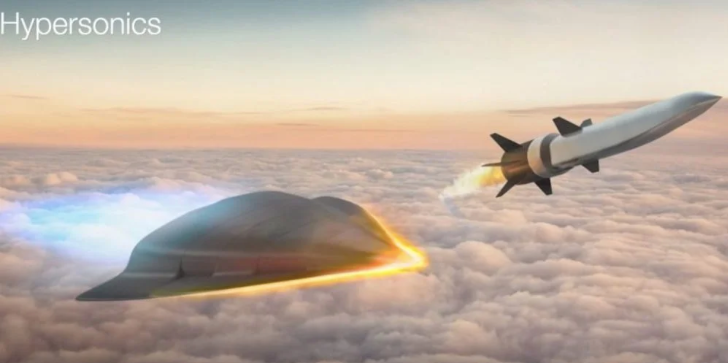
It is believed that in July 2021, China test fired a hypersonic missile which circumnavigated the earth and hit the designated target accurately. This test was meant to check the efficacy of its most advanced hypersonic missile system called the Dong-Feng 41. China called it a test of reusable space craft. However, China’s denial has been called out as an act of obfuscation and in fact, reflects the progress it has achieved in testing and developing the hypersonic missile systems. Undoubtedly, China along with Russia can be called world leaders in hypersonic technology, achieving great success in developing, testing and manufacturing these advanced weapons systems.
India successfully conducted a test of a long-range anti-ship missile system on November 16, 2024, from the Abdul Kalam island. This significant milestone was indeed a groundbreaking achievement, as it propelled India into an elite group of nations possessing hypersonic weapon system technology. It will be worthwhile to see how India measures up with other nations in terms of the complex, fast-evolving hypersonic technology, given the geo-political threat spectrum and the prevailing security
Hypersonic Weapon System
Hypersonic weapons travel at speeds exceeding Mach 5, which is a speed equal to five times the speed of sound (roughly 3.800 miles per hour). Speeds above Mach 5 fall into the hypersonic regime, where air compresses heavily around the designated craft, and the influence of the actual heating of the air becomes more dominant than the aerodynamic forces acting on the vehicle.
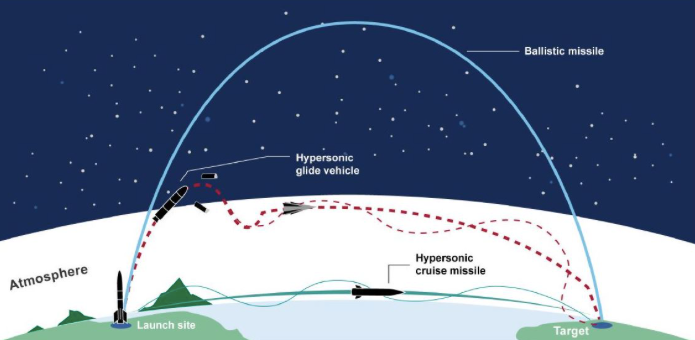
There are two main types of hypersonic systems currently being fielded for use. The Boost-glide system where a small hypersonic missile is boosted to high speed and altitude by a rocket and then released to glide to the target. Boost-glide hypersonic vehicles require exotic materials for construction and are thus expensive to develop and fabricate. It can fly higher and possibly faster. In the Air-breathing hypersonic system, the missile has its own scramjet propulsion system. This type is more complex and expensive to develop. A hypersonic weapon’s extremely high speed, along with its unique trajectory and high maneuverability make it very difficult to defend against, thus providing a capability to hit otherwise well-defended targets.
The development of hypersonic technology is very complex. It demands cutting edge advancements across multiple domains, including materials, guidance systems, and controls. It is also very expensive as it requires specific technological expertise as well as specialized facilities and equipment for testing. It is precisely for these reasons that hypersonic testing, development and operationalization have been limited to a few countries’ hitherto fore. However, the recent few years have seen rapid development in hypersonic arsenal and by all indications, it is set to grow even more in coming years.
The World of Hypersonic
China leads in the field of hypersonic design, development and testing, as well as arsenal. The GDF-600 is a hypersonic boost-glide vehicle which can release submunitions including missiles, drones and kinetic strike weapons during mid-flight. China has also unveiled to the world its arsenal of Dongfeng (DF) hypersonic missiles. Thanks to their speed and maneuverability, travelling more than five times the speed of sound, they are formidable weapon systems, so much so, that they could change the way warfare is fought.
Russia has heavily invested in hypersonic systems planning and has an arsenal in its armory. The Avangard hypersonic missile claims to have speeds of Mach 27, although, the figure around Mach 12 is more often cited, which equates to two miles per second. It is believed that Russia fired the Oreshnik hypersonic missile at the town of Dnipro, Ukraine, during the ongoing war. Reports suggest that the Oreshnik strike of November 2024 was a form of nuclear blackmail by President Putin to dissuade Western nations from militarily helping Ukraine. Russia has many more advanced hypersonic arsenals in its armory and leads the field along with China.
The United States has recently under invested in hypersonic systems, while other nations have forged ahead. In recent times, the US appears to be strengthening its deterrence and has debuted its ‘Dark Eagle’ hypersonic weapon. However, the US missile defences currently lack the capability to track hypersonic weapons throughout their launch, flight, and interception phases.
Hypersonic weapons have made its mark in the Korean Peninsula. South Korea operationalized its hypersonic booster-glide capability, with an ability to challenge its opponents beyond North Korea, up to China. North Korea purportedly tested two hypersonic missiles; however, it is yet unclear if it was with assistance of China. Israel has designed the hypersonic missile, Arrow-3, as an interceptor. Iran also claims to have hypersonic missiles, although it does not have the required maneuverability to make it effective and lethal.
Threats and Opportunities
India faces unique security challenges in this field due to its geographical proximity to China, the undisputed leader in the field of hypersonic systems. India’s hypersonic ambitions were showcased first in 2004 with the indigenous development of Hypersonic Technology Demonstration Vehicle (HTDV). The fact that it successfully conducted the long-range hypersonic missile booster test in November 2024 augers well for India’s ambition to be a power to be reckoned with in this field. It has also tested the booster glide hypersonic Long Range Anti-Ship Missile (LR-AShM) concept (tested in 2024 and showcased at the January 2026 Republic Day parade). Bharat Dynamics Limited (BDL) has also resorted to its limited production. Project ‘Dhvani’ is indigenous winged hypersonic glide vehicle under development by Defence Research and Development Organization (DRDO). It is derived from HTDV and the Agni missile technology and is designed for ranges exceeding 6000 kilometers. It is intended to strengthen India’s long-range deterrence and deep penetration strike capabilities against land and maritime targets. Project ‘Vishnu’, a DRDO initiative, is an indigenous scramjet powered hypersonic cruise missile designed to fly at speeds exceeding Mach 8. Additionally, India needs to invest more in further refining the guidance and sub-orbital maneuvering system in its quest for operationalizing the hypersonic glide vehicle to the optimum level.
India has a long history of friction in the border and security concerns with China. China surpasses Russia and the US in development and advancement of conventional and nuclear capable hypersonic weapons and therefore, presents a highly potent threat. It is imperative from India’s long-term security perspective that all out efforts is made to operationalize the country’s hypersonic projects in a time bound manner. Historically, Pakistan has relied on China for armaments and technology transfer, and it is likely that China may pass on hypersonic technology to bolster Pakistan’s ambitions. Pakistan Air Force claims to have developed a hypersonic capable missile to counter evolving threats. It also has a Chinese manufactured anti-ship missile (CM-400AKG) which travels at hypersonic speed.
While the advancements of China in development of hypersonic missile system pose a potent threat to India, it also provides an opportunity to the Nation to shore up its research and development in this field and achieve the designated milestones. Hypersonic systems offer India a capability of combining extreme speed, maneuverability with low-altitude flight, which are difficult to detect and track. Having a top end hypersonic weapon system also acts as a deterrence. Since developing hypersonic technology and systems is complex, deliberate collaboration amongst industry, government and academia is the order of the day to form a holistic, coordinated and carefully orchestrated system, keeping the geo-political threat in mind.