
By: Khushbu Ahlawat, Consulting Editor, GSDN
Introduction
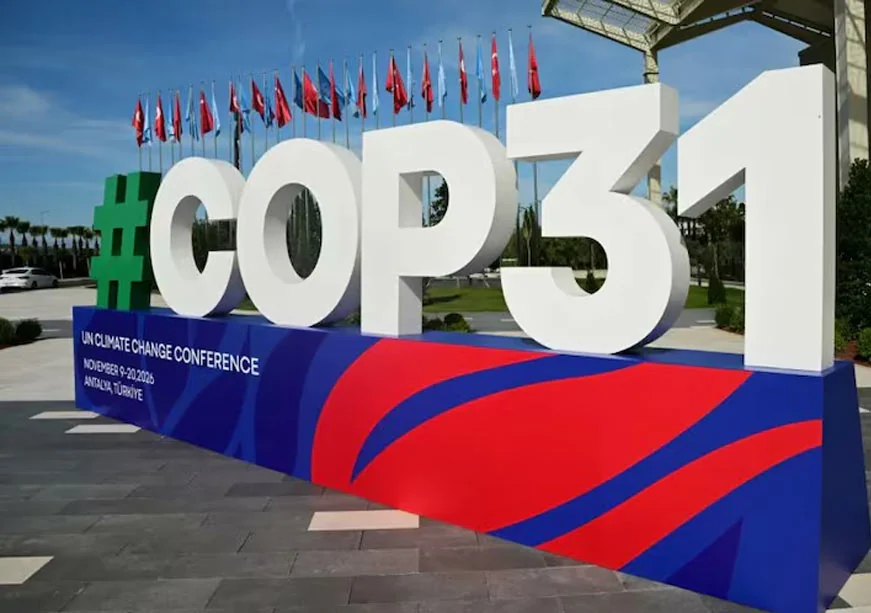
For the first time, urban resilience has its own high-level slot at a climate summit. Mayors in Mumbai, Dhaka and Lagos will not be celebrating until they can see what it pays for. On 12 November, in a convention complex on the Mediterranean coast, world leaders spent a day talking about cities. At the climate summit in Antalya, Türkiye, the programme of the World Leaders’ Climate Action Summit set aside a high-level dialogue for urban resilience, covering climate-proof infrastructure, sustainable buildings, disaster-risk management, electrification, water security, mobility and adaptation. For anyone who has followed the climate talks over the years, this was a small milestone. Cities, which have long complained of being talked about without being heard, finally had a stage.
Whether they get anything else is a separate question, and it is the one that matters most to the places where the consequences land. The 31st Conference of the Parties, running from 9 to 20 November under an unusual arrangement in which Türkiye holds the presidency and Australia’s Chris Bowen leads the negotiations, is being billed as a “COP of implementation.” The test of that label is not a communiqué. It is whether a municipal commissioner in a flood-prone Indian city can find funding for a drainage upgrade, or whether she will go on managing monsoon after monsoon with the same ageing pipes and a budget that depends on transfers from the state capital.
The Urban Century Is Already Here
The case for putting cities on the climate agenda is straightforward. Buildings and construction account for roughly 37 percent of global energy-related carbon dioxide emissions, according to the Royal Meteorological Society’s COP31 assessment. Asia and Africa are expected to drive the next wave of global urbanisation, and much of that growth is happening in places where infrastructure never kept pace with population: informal settlements without proper drainage, neighbourhoods built on floodplains, water systems that leak more than they deliver.
The consequence is that the choices made in the next decade on building design, density, public transport and land use will lock in emissions and vulnerability for generations. A bus corridor built now shapes how a city moves in 2060. A housing estate built without cooling or drainage will be exposed to heat and flood for as long as it stands.
Here, the standard playbook does not transfer neatly. The urban climate strategies developed in wealthy cities, retrofitting existing building stock or fine-tuning mature transit networks, assume a baseline of services that Mumbai, Dhaka, Lagos and Jakarta have yet to achieve. These cities have to close infrastructure gaps, manage informal settlements and absorb new residents while also preparing for heat, floods and rising seas. They are being asked to do several things at once, with fewer resources than any city that has already finished its industrial build-out.
A Gap You Could Drive a Bus Through
The financing numbers explain much of the frustration. The UNEP Adaptation Gap Report 2026 estimates that developing countries will need roughly US$305 billion a year for adaptation by 2035. In 2024, international public adaptation finance flowing from developed to developing countries stood at between US28.2billionandUS31.7 billion. Put bluntly, the money available covers about a tenth of the need, and that is before accounting for the fact that much adaptation finance arrives as loans, adding to public debt without generating the revenues needed to service it.
That is why the finance question has dominated the first week in Antalya. The African Group of Negotiators tried and failed to secure a separate agenda item on adaptation finance, a procedural defeat that revealed how far apart rich and poor countries remain. At the previous summit in Belém, Brazil, developed countries agreed to pursue efforts to at least triple adaptation finance by 2035, but campaigners at Antalya warn that this promise is now being weakened in the negotiating text. The Global Goal on Adaptation, a framework meant to give adaptation measurable targets, was also pushed into Antalya unresolved, with the tripling language still in brackets and small-island states calling the interim outcome unacceptable.
For cities, the problem is not only the size of the pot. It is the plumbing. International climate funds run through national governments, development banks and designated implementation agencies. A municipality, particularly a smaller or financially weaker one, rarely has the technical staff to prepare a bankable project, meet a fund’s due-diligence standards and manage the contracting that follows. The system, in effect, favours cities that already have strong project-preparation teams, which means the largest and richest urban areas get served first and secondary cities, where much of the future growth will happen, are left behind.
Türkiye’s Sustainable Urban Resilience Financing Facility, showcased at COP31 and developed with UN-Habitat and the World Bank, is one attempt to fix this by helping cities prepare projects and reach financing and technical support. Its worth will depend on whether the help reaches the municipalities that need it most, not merely those that already know how to ask.
India: Ambition at the Top, Constraints at the Bottom
India shows how difficult it is to turn national ambition into local delivery. Its cities are exposed to extreme heat, intense rainfall, flooding and water stress, and its coastal metropolises add sea-level rise and storm surge to the list. The memory of Mumbai’s deluge of July 2005, when nearly a metre of rain fell on the city in a single day, or of Chennai’s floods a decade later, is a reminder that urban flooding in India is not a hypothetical. Meanwhile the cities keep growing outward, covering farmland, wetlands and the natural drainage channels that once absorbed monsoon water.
New Delhi has not been idle. National missions on housing, sanitation, water supply, public transport and smart cities have put substantial money into urban infrastructure over the past decade, and many of those interventions have delivered climate benefits even though they were not designed as climate programmes. The weakness is integration. Because adaptation is not yet built into core urban planning and financing frameworks, the gains tend to be project by project rather than systemic.
Governance is the harder obstacle. A typical Indian city is not run by a single authority. A municipal corporation coexists with a development authority, a water board, a transport agency, a housing board and various state-controlled parastatals, each with its own mandate, budget and reporting line. When a neighbourhood floods, the question of who is responsible can have five answers. The constitutional amendment of 1992 that was meant to make urban local bodies true units of self-government has, three decades on, left many of them without real control over the functions it nominally assigned them.
Money is the other constraint. The Reserve Bank of India’s report on municipal finances points to a heavy reliance on transfers and grants from higher levels of government, and to own-source revenues that fall well short of what municipal services and infrastructure require. Municipal revenue in India is a small fraction of GDP compared with many other large economies. A city that cannot raise much of its own money, and cannot predict what the state will transfer from year to year, finds it hard to commit to the long-term, capital-intensive projects that adaptation demands, let alone to borrow against future revenue.
Real Progress, Fenced In
It would be unfair to say nothing has changed. UN-Habitat’s analysis of 142 national climate plans found that 80 percent now contain well-developed urban measures, up from 50 percent in the previous round of submissions. That is a significant shift in how governments think about climate: cities are no longer an afterthought tacked on to energy and forestry chapters. The 12 November dialogue also brought attention to adequate housing, upgrading of informal settlements, essential urban services and municipal infrastructure, priorities that matter acutely in developing countries, where climate exposure is bound up with existing inequality in living conditions.
Local governments are making themselves heard, too. The position paper of the Local Governments and Municipal Authorities Constituency, endorsed by 80 networks around the world, calls for cities and regions to have a bigger say in designing and carrying out national climate commitments.
But being named in a national plan is not the same as being able to deliver. Climate targets, whether set in capitals or city halls, often depend on decisions about land use, construction standards, drainage, mobility and public services that sit with state governments or specialised agencies, not with the elected municipal body that residents hold responsible. A city can be given a target without being given the lever.
There is a further trap that the Global South should avoid: confusing technology with resilience. An analysis from Loughborough University prepared for COP31 notes that technologically advanced cities are not necessarily better able to withstand and recover from climate disasters. A city with sensors, dashboards and command centres can still see its drains back up and its power fail in a storm. The real measure, as the analysis suggests, is not how many smart interventions a city has adopted but whether essential services have become safer, more reliable and more accessible, especially for the people who were worst served to begin with.
What Would Actually Help
Turning recognition into results requires changes in how cities are planned, financed and governed. Five priorities stand out.
First, adaptation has to move from standalone plans into the statutory machinery of urban development. India and other Global South countries should require climate-risk assessments in city development plans, infrastructure investment decisions and municipal budgets, so that a new road, housing scheme or drainage project is judged against the hazards it will face.
Second, climate finance must become reachable. National and state-level facilities should help smaller cities and vulnerable settlements identify priorities, prepare technically sound projects and secure appropriate financing, so that capacity, not just money, is on offer.
Third, international adaptation finance has to recognise that urban vulnerability and development deficits are the same problem. Investment in drainage, water supply, affordable housing, public health and urban ecosystems delivers climate benefits whatever label it carries, and funding rules should accommodate integrated projects instead of forcing artificial lines between development and adaptation spending.
Fourth, municipal finances and authority need strengthening. In India and much of the Global South, that means raising own-source revenues, making intergovernmental transfers predictable and spelling out who is responsible for what between urban local bodies and state agencies, so a city is neither blamed for what it cannot control nor starved of what it needs.
Fifth, adaptation should start with the most exposed. Residents of informal settlements, outdoor workers, women, older people and low-income households bear the heaviest burden when heat waves or floods arrive. Their needs should shape investment priorities, early-warning systems and the design of local measures, not appear as an afterthought in the final chapter.
Conclusion
Antalya has given cities something they have wanted for years: a place in the room. That counts for something. It signals that governments now accept what urban residents have long known, that climate change is first felt on streets, in homes and in water taps. But recognition is the cheap part. The expensive part, in every sense, is giving cities the money, the authority and the technical support to act on what they have been recognised for.
India’s own experience suggests that this is where the real work lies. A country can have ambitious national targets and substantial infrastructure programmes and still leave its cities fragmented, short of revenue and unable to plan for risks they can see coming. Unless the funding that emerges from the negotiations reaches municipalities in forms they can actually use, and unless domestic governance is reformed to give urban local bodies real control over the services that determine climate resilience, successive COPs will keep applauding cities while the water keeps rising. The measure of Antalya will not be the speeches made on 12 November. It will be what a city commissioner in Mumbai, Dhaka or Lagos can do the next time it rains.


