
By: Khushbu Ahlawat, Consulting Editor, GSDN
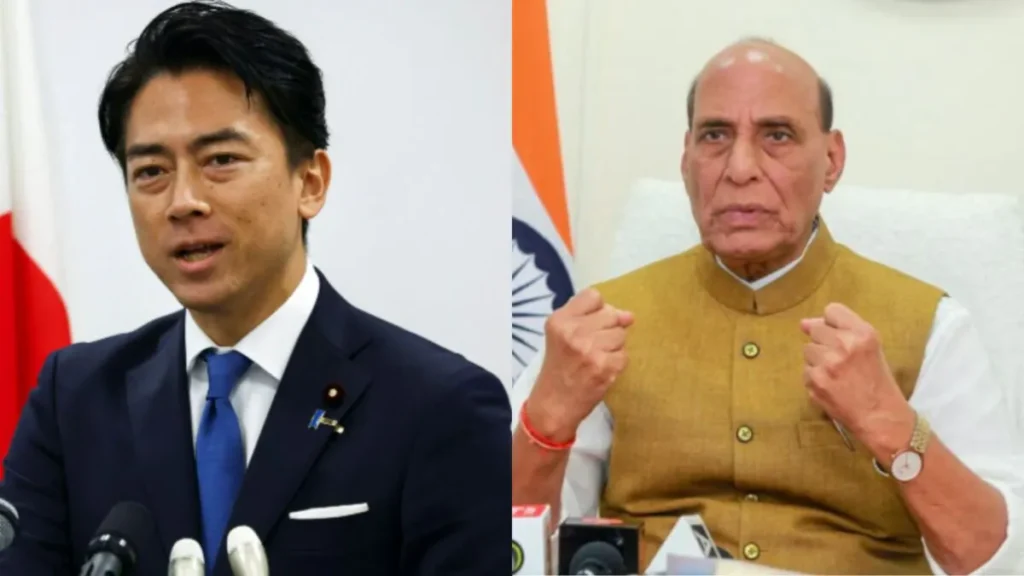
Shinjiro Koizumi’s two-day visit to India in August 2026 has been read, reasonably, as a turning point. A decade of dialogues, exercises and framework agreements between New Delhi and Tokyo finally produced something with teeth: a Memorandum of Arrangement on Maritime Security Cooperation, fresh commitments on shipbuilding and ship-repair, and a review of the one hardware project — the UNICORN naval antenna system — that both governments now point to as proof the relationship has moved from words to weapons. Set against the diplomatic and military architecture the two countries have spent more than ten years assembling, this looks like momentum.
Set against a different timeline, though, the same visit raises a harder question. Four months before Koizumi arrived in New Delhi, Japan did something it had not done in eighty years: on 21 April 2026, Prime Minister Sanae Takaichi’s government formally lifted the postwar ban on Japanese arms exports altogether, scrapping the last restrictions that had confined defence transfers to five non-lethal categories — rescue, transport, warning, surveillance and minesweeping — and opening the door, for the first time since 1945, to Japanese-made weapons systems being sold abroad. That is one of the most consequential shifts in Japanese security policy since Shinzo Abe first cracked open the arms-export ban in 2014. It is also a shift that, on paper, should have made this exact moment — a defence-ministerial visit to Tokyo’s most important Indo-Pacific security partner outside the US alliance system — the obvious occasion to announce something bigger than an antenna.
That it did not is worth taking seriously, because it says more about the real state of India-Japan defence cooperation than the framework agreements do.
A decade of loosening that has mostly bypassed India
Japan’s arms-export liberalisation has proceeded in visible stages, and each stage has had an obvious first beneficiary — and it has rarely been India. Abe’s 2014 reform opened the door to exports in principle; the first country to walk through it was the Philippines, which signed a contract in November 2023 for Japanese air-surveillance radar, becoming the first foreign recipient of Japanese-built defence equipment since the Second World War. Tokyo followed that with the transfer of retired patrol vessels to Manila and, in 2023, approval for the re-export of US-made Patriot missile interceptors back to the United States. In December 2025, the ruling coalition agreed to remove the five-category ceiling entirely for exports tied to the Global Combat Air Programme, the next-generation fighter jet Japan is co-developing with the UK and Italy, clearing the way for that aircraft to be sold to third countries. Then came April 2026’s wholesale removal of the ban.
India’s own defence-technology relationship with Japan, by contrast, has moved at a noticeably slower pace despite starting from a stronger position on paper. The 2015 bilateral agreement on transfer of defence equipment and technology predates the Philippines deal by eight years. Yet for most of the decade that followed, the flagship candidate for an actual transfer — the ShinMaywa US-2 amphibious search-and-rescue aircraft — was discussed, costed and re-costed without ever being signed, before quietly falling off the agenda. It was only in November 2024 that the two governments signed a Memorandum of Implementation for what is now the relationship’s one concrete hardware project: co-development of the UNICORN integrated mast, a stealth communications antenna already fitted to Japan’s Mogami-class frigates, to be adapted for Indian Navy ships by Bharat Electronics Limited. Even that milestone came with an asterisk — Japan’s own trade press has noted that India became only the second Asian country, after the Philippines, to receive any Japanese defence technology, a decade after the two sides signed their framework agreement and nearly a decade after Tokyo had already delivered hardware to a partner with a far smaller defence-industrial base and a much shorter strategic relationship with Japan.
Koizumi’s August 2026 visit added an actual signing to that picture — the Maritime Security Cooperation MoA — plus a commitment to “explore” joint naval shipbuilding and design, and to “examine” reciprocal ship-repair arrangements. Those are, in the vocabulary of defence diplomacy, first-stage verbs. They describe intentions to negotiate, not contracts to build.
Why India, despite the head start, keeps taking longer
Part of the answer is structural, and has little to do with either government’s enthusiasm. India’s defence procurement system is built around import substitution rather than straightforward purchase: any Japanese offer has to be routed through “Make in India” localisation requirements, indigenous-content thresholds and, increasingly, a preference for co-development over co-production, let alone outright import. That is precisely the model the UNICORN project follows — Bharat Electronics leading integration and manufacturing in India rather than simply installing an imported Japanese system — and it is a more defensible long-term industrial strategy than a straight purchase. But it is also slower, because it requires two defence bureaucracies to agree not just on price and specification but on technology-sharing terms, intellectual-property arrangements and local production standards, all before a single unit is built. The Philippines’ 2023 radar deal, by contrast, was a conventional government-to-government sale — Manila bought a finished Japanese system outright, which is why it could be signed within a few years of Japan’s 2014 reform while India’s more ambitious co-development model has taken until 2026 to produce its first project.
There is also a queue problem. India’s most consequential recent defence-industrial breakthroughs — the agreement to co-produce GE Aerospace F414 jet engines domestically, the deepening submarine and Rafale-linked cooperation with France, the continuing dependence on Russian-origin platforms and spares across large parts of the armed forces — all predate or run parallel to the Japan relationship, and each of those partners has been willing to move faster on transferring sensitive technology than Tokyo historically has been. Japan arrives at India’s door as one claimant among several on a limited pool of procurement bandwidth and political attention, competing against relationships that are older, deeper, or backed by more aggressive commercial terms. The 2015 framework agreement gave Japan an early seat at that table; it did not guarantee Tokyo would move up the queue.
Finally, there is Japan’s own domestic caution, only partly addressed by April’s reform. Even after the ban was lifted, the revised rules still route lethal weapons exports through a list of seventeen countries with which Japan has concluded defence equipment transfer agreements, and continue to bar transfers to states engaged in active conflict except in exceptional circumstances. Japanese firms — many of which built their post-war business models around never selling into a war zone or exporting anything that could kill — have also been slow to reorient production and marketing toward exports even where the legal barriers have fallen; SIPRI data cited in Japanese trade coverage shows major contractors’ arms-related revenue rising sharply in 2024, but from a small base, and mostly on the back of expanded domestic procurement rather than new export contracts. The legal architecture for a much bigger India-Japan hardware relationship now exists. Whether Japanese industry, or the Indian procurement system, is ready to use it at speed is a separate question.
What the maritime pact actually locks in
None of this is a case against what Koizumi’s visit did achieve. The Maritime Security Cooperation MoA is a meaningful step precisely because it addresses a genuinely under-built part of the relationship: shared maritime-domain awareness between two navies that sit at opposite ends of the Indo-Pacific’s main sea lanes, with the Indian Navy anchoring the western Indian Ocean and the Japan Maritime Self-Defense Force focused on the East China Sea and the waters around Taiwan. Better information-sharing between those two theatres, plus the logistics arrangements — port access, mutual repair facilities — that the agreement points toward, would genuinely extend both navies’ operational reach in a way that joint statements alone never could. Koizumi’s stop at India’s Western Naval Command in Mumbai before travelling to New Delhi, a part of the country’s maritime geography that Japanese defence visits have historically paid less attention to than the Bay of Bengal, is a small but real sign that Tokyo is thinking about the relationship in genuinely Indian Ocean-wide terms rather than only through the lens of its own immediate neighbourhood.
Koizumi himself, on his first visit to India as defence minister, was notably candid about this gap between aspiration and delivery, telling his hosts that the defence relationship had “yet to reach its full potential” even as the two sides signed a wide-ranging joint statement — an unusually direct admission, for a diplomatic visit, of exactly the pattern this piece has traced. The exercises are also becoming more ambitious in their own right: Japanese fighter aircraft joined the Veer Guardian drill in India for the first time this September, and the two sides have agreed to raise the complexity of future exercises, integrate unmanned systems, and open a dialogue between special-operations forces and India’s emerging integrated theatre commands.
The honest reading of the Koizumi visit, then, is not that India and Japan have failed to build a serious defence relationship, but that they have built two different things at two different speeds. The institutional and operational layer — dialogues, exercises, information-sharing, logistics access — has genuinely matured, and the new maritime pact extends it further. The hardware layer, the one that actually determines whether either navy’s capability changes because of the other’s technology, has been unlocked by Japan’s legal reforms far more than it has been built by either country’s procurement system. Japan removed its postwar arms-export ban in April; it did not thereby remove India’s localisation requirements, its competing supplier relationships, or the multi-year negotiation cycle that even the smaller, single-item UNICORN project needed to move from a 2015 framework to a signed 2024 implementation memorandum. The next real test of this relationship is not whether Tokyo is willing to sell — after April 2026, it plainly is — but whether New Delhi’s own defence-industrial machinery can move fast enough to take what is now, for the first time since the Second World War, actually on offer.
What would actually close the gap
Three things would tell us, over the next year or two, whether the hardware layer is catching up with the institutional one rather than simply being announced faster than it is delivered.
The first is the shipbuilding conversation the two defence ministries agreed to “explore.” Japan’s shipbuilders bring genuine, differentiated expertise — hull design, propulsion and stealth-signature reduction of the kind embodied in the Mogami-class frigate programme — that neither France nor Russia, India’s two largest current naval-technology partners, offer in quite the same form. But exploratory talks on joint design and reciprocal ship-repair facilities are a long way from a construction contract, and Japan’s own shipbuilding industry has limited spare capacity: Tokyo is simultaneously trying to expand naval output for its own fleet, support the Mogami-class export pitch to Australia and other partners, and now potentially service GCAP-related production, all with a shipbuilding workforce that has been shrinking for decades. Whether Japan can prioritise Indian yards over its own domestic orders, and whether India’s Make-in-India conditions can be reconciled with Japan’s traditionally tight control over hull and propulsion technology, will determine whether this becomes the relationship’s second hardware project or its second decade-long conversation.
The second is what happens to the Indigenous Integrated Mast programme that Bharat Electronics had already begun developing with the Indian Navy before UNICORN arrived. Naval-industry reporting has suggested the two projects may need to be merged or reconciled rather than run in parallel, and how that plays out will be an early signal of whether Indian and Japanese engineering teams can actually collaborate on a shared technical roadmap, or whether UNICORN ends up layered awkwardly on top of an existing indigenous effort rather than genuinely integrated with it.
The third, less visible but arguably more important, marker is procedural: whether the fourth 2+2 Foreign and Defence Ministerial Meeting, which both sides have now agreed to accelerate toward Tokyo, produces a second signed hardware project rather than another set of framework commitments. A single co-development agreement, however genuine, is a proof of concept. A second one, agreed on a shorter timeline than the nine years UNICORN took from framework to implementation, would be the first real evidence that Japan’s April 2026 policy shift is translating into an Indian defence-industrial pipeline rather than sitting, for now, as an open door that New Delhi has yet to fully walk through.
None of this diminishes what Koizumi’s visit achieved on the maritime and operational side, where the relationship’s progress looks considerably more solid than on the hardware side. But conflating the two — treating a maritime-domain-awareness pact and an antenna project as evidence that India-Japan defence cooperation has crossed some general threshold from institutional to operational — risks overstating how far the hardware relationship has actually moved relative to what Japan’s own policy reforms now make possible. The two governments have, in a real sense, finally built the legal and diplomatic scaffolding for a much larger defence-industrial partnership. Whether they build anything more inside that scaffolding than one stealth antenna is still an open question, and it is one that neither an MoA nor a joint statement can answer.



