
By : Bhavika Bhartiya, Research Analyst, GSDN
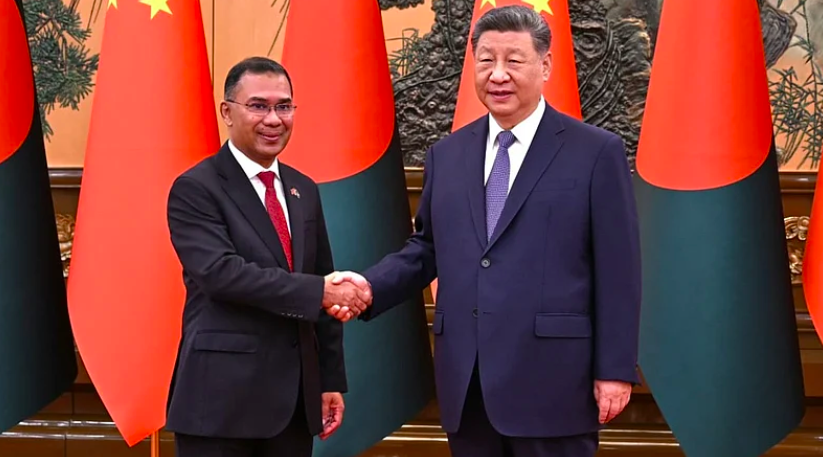
For almost fifty years, Bangladesh has been India’s closest ally in South Asia. The relationship started in 1971 when, with help from India, Bangladesh won independence from Pakistan. However, since the expulsion of Prime Minister Sheikh Hasina in August 2024 after the large democratic protests by students led to her exodus to India, the friendship has weakened considerably. Since then, Bangladesh has increasingly drifted towards China very noticeably in terms of foreign policy.
This diplomatic challenge to India is much larger than a mere political challenge, it cuts into one of India’s most sensitive regions, or national interests, the Siliguri Corridor. Most importantly, this presents an interesting dilemma for India in terms of determining how much of a hold or control India actually has over their own backyard. This paper provides an overview of the China-Bangladesh relationship in theoretical terms, as well as providing an explanation of why this relationship should be of concern to India.
A Change in Direction
In the past, every new Bangladeshi leader visited India first after taking office. This showed the close relationship between the two countries. Muhammad Yunus, who led Bangladesh’s interim government after Hasina left, broke this tradition. His first foreign visit was to Beijing in March 2025 to mark fifty years of diplomatic ties between China and Bangladesh. During the visit, China offered Bangladesh US$ 2.1 billion in investments, loans, and grants. This indicated that Dhaka no longer saw India as its primary partner. This change did not happen overnight. Even before 2024, Bangladesh was gradually developing ties with China. By the end of 2023, about seven hundred Chinese companies were already operating in the country. After Hasina’s departure, this process sped up and became more transparent. Many ordinary Bangladeshis were also dissatisfied with India due to unresolved water disputes, border issues, and a sense that India had aligned too closely with only one political party.
Growing Economic Ties
China’s economic role in Bangladesh has grown significantly. Total Chinese investment reached nearly US$ 42 billion by the 2024-25 financial year. Trade between the two countries has also increased rapidly. From August 2024 to August 2025, Bangladesh’s imports from China rose from US$ 1.54 billion to US$ 1.92 billion. During the same period, its exports to China grew from US$ 90.4 million to US$ 130 million. Since Bangladesh joined China’s Belt and Road Initiative (BRI) in 2016, China has helped build twelve roads, twenty-one bridges, and twenty-seven power plants in the country.
One notable example is Mongla Port, Bangladesh’s second-largest seaport. China is now investing US$ 400 million to upgrade this port. Just a year earlier, India had secured rights to operate a terminal there, which was seen as a victory for India at the time. This shift at Mongla highlights how quickly India’s earlier advantages are being overtaken by Chinese influence.
Water sharing is another contentious issue. China has offered to fund the Teesta River Comprehensive Management and Restoration Project. However, Hasina previously declined this offer in favor of collaboration with India. On October 19, 2025, a large protest at Chittagong University called for the immediate start of this Chinese-backed project. This unrest occurs as the India-Bangladesh Ganga Water Sharing Treaty is set to expire in 2026, creating more uncertainty in their relationship.
Military and Strategic Worries
India’s security experts aren’t worried about trade; they are worried about the deepening defence ties between China and Bangladesh. Reports say China has helped Bangladesh resurrect Lalmonirhat airbase, an old airfield located just twelve to fifteen kilometers from the Indian border and about one hundred and thirty-five kilometers away from the Siliguri Corridor. Bangladesh says this is a civilian airport, but Indian officials worry it could be used for surveillance or a quick military strike if tensions ever flare. Bangladesh has also reportedly been negotiating to buy Chinese J-10CE fighter jets, which Indian analysts believe is part of a larger Chinese plan to build defence links around the borders of India.
The Siliguri Corridor Problem
This is important to consider due to geography. The Siliguri Corridor or the “Chicken’s Neck of India” is a narrow piece of land in the state of West Bengal which connects India’s mainland to the country’s eight north eastern states. It measures about twenty to twenty-five kilometers across certain areas. It is situated near the borders of Nepal, Bhutan, Bangladesh and Chumbi Valley of China. The significance of this corridor lies in the fact that in case of its closure, India will lose its only connection by land with an area populated with over forty million people. That is why increased presence of Chinese interests in northern Bangladesh, located right next to this corridor, raises many concerns for India in New Delhi. However, one must acknowledge that Bangladesh itself is also vulnerable from the point of view of land corridors.
Political Undercurrents
China has also made relations with other political entities in Bangladesh aside from the country’s administration. An example of such political group is the Jamaat-e-Islami party, which is known for its close relationship with Pakistan and distant relationship with India. In September 2024, China’s envoy in Dhaka conducted a meeting with the head of this party, marking the first time that a diplomat from a foreign state has done so in over a decade. Other meetings also took place between Chinese officials and the leaders of Jamaat-e-Islami in the months following this event.
A New Government, A Cautious Reset
The first general elections were held in Bangladesh following the departure of Hasina on February 12, 2026. Bangladesh Nationalist Party (BNP), headed by Tarique Rahman, got a huge majority securing two hundred and nine out of the total three hundred seats. The second largest party, Jamaat-e-Islami secured seventy-seven seats which largely came from constituencies bordering India. Rahman was sworn-in as the new Prime Minister of Bangladesh on February 17, 2026, after having been in exile in London for seventeen years. Unlike previous leaders of the BNP, Rahman during the campaign did not indulge in anti-Indian rhetoric. Narendra Modi, the Indian Prime Minister, is believed to have been the first world leader to congratulate him following the electoral victory and India extended a state invitation to Rahman as well as relaxing the visa regime in good faith.
However, India is being cautious. Leaders of Bangladesh continue to pay visits to Beijing even after the change in the regime, and in one such visit both sides entered into an agreement aimed at intensifying their cooperation. This shows that closeness with China has now become a permanent feature of the foreign policy of Bangladesh rather than a temporary one of the interim phase.
The Way Forward for India
From the recent period of two years, the lessons are unambiguous. Relying solely on the goodwill of one leader or party in one’s neighborhood is not the way India should go. India losing its ground at Mongla port and on sharing water issues is an example of how progress can be rapidly reversed when one’s ties have not been established more generally, not only with one leader but with the politicians of the whole country. India will have to continue working on its trust with the Bangladeshi people, and not only with the government, by sorting out issues of visas, trade and water sharing that blame them for years.
On the other hand, India should be vigilant about security threats along the Siliguri Corridor and together with the new government, should continue to intensify the border security cooperation. Another reason to be uncertain about the future is that Jamaat-e-Islami, which will be the principal opposition party, has a strong presence in the border regions. China’s deepening presence in Bangladesh is not going to vanish altogether, and India should not expect that Dhaka will be forced to decisively pick either side. In fact, Bangladesh is simply attempting to maintain good relations with many powers simultaneously, which is something that a smaller country between two giants would naturally do. Nevertheless, the developments of recent two years have sent a very strong signal to India. Only diplomacy that is patient and enduring, and not relying on old assumptions of goodwill, will determine how this crucial relationship will unfold in the future.



