
By : Dhritiman Banerjee, Research Analyst, GSDN
Introduction
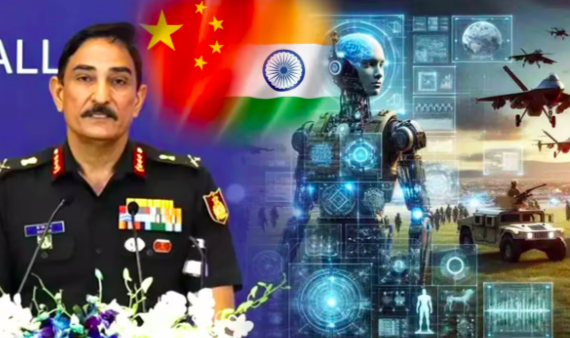
Technology has rapidly transformed the conduct of war since time immemorial. An example of the use of emerging technology in warfare can be found in the Blitzkrieg doctrine of Nazi Germany which used the emerging concepts of airpower and armored warfare to make exceptional early gains in the Second World War. Since that time, the history and conduct of warfare have rapidly evolved and now is in the AI age. The ongoing US-Iran military engagement shows the importance of AI in modern warfare where it can be seen the devastating role played by autonomous weapons systems like drones. The lessons learnt from this war can be carried forward to other militarized inter-state disputes like the India-China border dispute which is the world’s longest disputed border and stretches from Arunachal Pradesh to the Himalayas. Chinese advances in military AI in this regard poses significant concerns to India which shares asymmetric military capabilities with China. This article shows how advances in Chinese use of military AI can cause concerns for India.
Chinese advances in AI: Aims and development
Chinese interest in harnessing emerging technology in warfare can be traced to its keen interest in the conduct of the Gulf War where the coalition forces used modern technology to overwhelm the Iraqi forces. Consecutive Chinese regimes studied the use of technology in Western led campaigns in the Balkans, Afghanistan and Iraq and formulated its own military doctrine of winning wars on the information spectrum. Under the leadership of Xi Jinping, China sought to increase its advances in AI an create a new cognitive domain in warfare by developing the New Generation Artificial Intelligence Plan in 2017. The main aim of China is to develop AI to revolutionize warfare. China intends to achieve this objective through civil-military fusion by combining the People’s Liberation Army (PLA), civilian firms and universities jointly to produce AI innovation that meets the national goals of military security and economic advancement. This civil-military fusion policy allows rapid advancement in AI technology and in maintaining a high degree of AI competitiveness in great power rivalry. Therefore, it should be noted that, Chinese advances in AI are as much a product of its national policy as its technological innovation. The PLA has commendably infused civilian expertise with military efficiency to promote intelligization of warfare, which enables us to maintain a high degree of dominance in the information spectrum. The Chinese principles of mechanization, informatization and intelligization allows it to weaponize the information spectrum for military purposes and develop AI as a strategic asset. Chinese integration of AI with satellite technology including the self-developed Beidou system allows it to revolutionize its ISR (Intelligence, Surveillance, Reconnaissance) capabilities and maintain all-spectrum in a major global conflict.
China intends to use this new strategy to conduct its show of military strength in its major areas of military contention including the border dispute with India. For China the goal is to harness the power of military AI to immobilize the enemy while protecting its own systems. The Chinese interest in military AI is based on the US doctrine of the Revolution in Military Affairs and is keenly based on its observation of US policy. Chinese advances in military AI give it a key edge in warfighting in disputes where it holds an asymmetric advantage over its adversaries including on the Himalayan border with India. Advanced AI capabilities allow the PLA to locate necessary targets and use drone swarming capabilities. This poses a threat to India which has not developed military AI to the extent China has. The Chinese military leadership believes that the AI revolution in the PLA will help to win wars with states it has disputes with by creating a new cognitive domain of warfare where China will have an edge over its adversaries. This should worry states like India which views its disputed border with China as a key national security priority and therefore has engaged with the PLA in military confrontations related to territorial disputes in Doklam in 2017 and Ladakh in 2020. Chinese expansionist tendencies and its advances in AI therefore raise concerns in New Delhi over national security and the need to develop indigenous military AI for India. India aims to position itself as a major player in the Indo-Pacific and balance Chinese influence in the region. India has high military asymmetry with China which is a major concern for New Delhi particularly due to the border dispute with Beijing and therefore, the recent Chinese goals of AI in military development increase all spectrum battlefield dominance poses a significant challenge to India.
India’s concerns with Chinese advances in AI
India stands as a competitor to Chinese great power ambitions. However, New Delhi has yet to achieve all spectrum parity with China. While India has forged alliances with states like the US to balance Chinese dominance in the Indo-Pacific, those alliances are currently under strain due to the actions of the Trump administration. Also, with US-China relations becoming more adversarial and Indo-Chinese competition not reaching a thaw, Chinese advances in military AI and particularly its ability to project power over the Himalayan border is set to worry India. Chinese support and cooperation with Russia in the Russo-Ukraine War which extends to providing cooperation in AI technologies shows the significant advantage of Beijing with respect to military AI. While India is trying to compete b hosting AI summits and encouraging FDI up to 100% in AI development, its indigenous AI capabilities are still not enough to balance China.
This results in strategic insecurity for India on the disputed territorial Himalayan border and in the Northeastern states. AI in the Himalayan sector allows China to monitor sensitive regions including Ladakh, Aksai Chin and Arunachal Pradesh allowing it to monitor key Indian troop movements in the region. While India aims to counter Chinese influence through cooperation with entities such as the Quad and European democracies, New Delhi realizes that international cooperation is not a substitute for Indigenous AI development and therefore, it understands that Chinese developments in military AI has consequences for India. Thus, New Delhi realizes that it must do more in the military AI sector to counter Beijing
Conclusion
It should be noted that, China has made significant gains in military AI to pose a serious security challenge for India. While India has made progress in indigenous AI development, more needs to be done in this regard for India to balance China. While both states engage in Great Power competition, India faces an increasing asymmetry with China in the AI sector which poses serious security ramifications for New Delhi. Therefore, in this regard it is of paramount importance that New Delhi ramp up its efforts in developing indigenous military AI capabilities rather than depending on international cooperation to balance China in great power competition.



