
By: Khushbu Ahlawat, Consulting Editor, GSDN
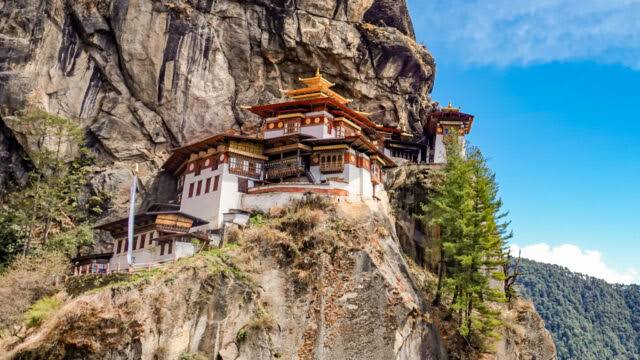
A Himalayan kingdom of fewer than 800,000 people is building religious infrastructure, hosting royal visits, and convening Buddhist gatherings at a pace with no precedent in its recent history. A temple complex broke ground in Lumbini in June. A shrine went up in Rajgir last September. Land has been earmarked for a temple and guest house in Varanasi, near Sarnath, where the Buddha delivered his first sermon. Sri Lankan Prime Minister Harini Amarasuriya’s five-day visit to Bhutan this past August, capped by the keynote at Thimphu’s first Global Conscious Food Systems Summit, was the latest entry in that pattern, not an isolated courtesy call. None of this is happening in a vacuum — except that, in the most literal sense, it is. A real vacuum is opening in the leadership of world Buddhism, in the very institution that has anchored Himalayan Buddhist authority for nearly a century, on a timeline nobody controls. Bhutan appears determined to be ready for it before anyone else is.
The clock that is actually running
The proximate cause of that vacuum is not abstract. The 14th Dalai Lama, Tenzin Gyatso, turned 90 in July 2025, and in the days before his birthday he made a declaration that has since reshaped the succession question from a distant hypothetical into an active geopolitical dispute: his reincarnation, he said, will be recognised solely by the Gaden Phodrang Trust, the nonprofit institution he established for that purpose, and by no other authority. Beijing’s response came within hours. A Chinese foreign ministry spokesperson reiterated that any reincarnation of the Dalai Lama, like that of the Panchen Lama, must be selected by drawing lots from a golden urn under the supervision of the central government — the same 2007 regulation, “Order No. 5,” that requires state approval for the recognition of all Tibetan Buddhist reincarnations on Chinese soil. When India’s minister for minority affairs, Kiren Rijiju, publicly backed the Dalai Lama’s position, Beijing warned New Delhi to “be prudent” on what it called a highly sensitive matter, and India’s foreign ministry retreated to studied neutrality, saying only that the government does not take positions on matters of religious belief.
The likeliest outcome, according to most scholars tracking the dispute, is not a resolved succession but a contested one: two rival 15th Dalai Lamas, one recognised by the Tibetan exile establishment operating out of Dharamsala and one installed through Beijing’s state apparatus, each claiming legitimacy before a global following that will have to choose. That prospect carries particular weight for the countries clustered along the Himalayan arc — India, Nepal, Mongolia and Bhutan — where nearly half of the Tibetan exile community still lives, mostly in India, and where the institutional authority the Dalai Lama has held since fleeing Tibet in 1959 has functioned as a kind of gravitational centre for Vajrayana Buddhist practice across the region. Some analysts have gone further, suggesting the next Dalai Lama could plausibly be identified on Indian soil, conceivably even in Tawang — the birthplace of the sixth Dalai Lama and a district China formally claims as part of its own territory — a scenario that would fuse the religious succession dispute directly onto the unresolved India-China border question.
Bhutan sits inside all of this without being a direct party to it, and that position — adjacent to the dispute but not implicated in it — is precisely what its recent diplomacy has been built to exploit.
Why Bhutan, specifically, can do this
The detail that gets lost in most accounts of Bhutan’s Buddhist outreach is that Bhutanese state Buddhism is not the Dalai Lama’s own school. Bhutan’s national religion, formalised under the 17th-century unifier Zhabdrung Ngawang Namgyal and enshrined today in the 2008 constitution, is the Drukpa Kagyu lineage — a distinct branch of Tibetan Vajrayana Buddhism from the Dalai Lama’s Gelug tradition, with its own historical hierarchy, its own monastic institutions, and its own claim to religious authority that predates and does not depend on Lhasa’s Gelug establishment. That distinction matters enormously for how Bhutan can behave right now. A country whose state religion were itself Gelug, or that hosted the Dalai Lama’s own exile institutions the way India does, would face an almost impossible choice as the succession dispute sharpens — recognise the Gaden Phodrang Trust’s candidate and risk Beijing’s fury, stay silent and risk its own religious community’s anger, or attempt open neutrality and satisfy no one. Bhutan, by contrast, can expand its own religious infrastructure, host interfaith gatherings, and position its monarchy as a custodian of Himalayan Buddhist heritage without ever being asked to rule on who the next Dalai Lama actually is, because that question sits outside its own lineage’s chain of authority.
The Global Peace Prayer Festival that Bhutan hosted in Gelephu in November 2025 is the clearest illustration of what this buys Thimphu. The ten-day gathering brought together lamas, scholars and practitioners from across Buddhism’s schools — including figures close to the Dalai Lama himself — under prayers led by Bhutan’s own Chief Lama, with relics from the Piprahwa-Kapilavastu excavation brought over from India to lend the event additional weight. A festival like that is not a neutral act in the ordinary sense; convening rival Buddhist constituencies under one roof, at a moment when those constituencies are edging toward an institutional split, is itself a form of influence-building. But it is influence Bhutan can accumulate specifically because nobody needs to ask the Bhutanese monarchy whose side it is on in a succession dispute that, doctrinally, is not its dispute to settle.
The economic engine behind the religious outreach
None of this soft-power accumulation would carry the weight it currently does without the domestic project underwriting it: the Gelephu Mindfulness City, the special administrative region King Jigme Khesar Namgyel Wangchuck unveiled on Bhutan’s 116th National Day in December 2023 and which has since become the organising frame for almost everything else in Bhutanese foreign policy. GMC is an unusually large bet for a country this size — a masterplan spanning more than a thousand square kilometres of southern Bhutan along the Indian border, pitched to investors at a scale approaching $15 billion, designed around eleven mandala-inspired neighbourhoods by the Bjarke Ingels Group, and structured as a “one country, two systems” jurisdiction with its own legal code, drawing partly on Singaporean commercial law, its own executive and legislature operating under the King’s direct guidance. Its first completed sacred landmark, the Ugyen Norlha Chorten, dedicated to a manifestation of Guru Rinpoche associated with prosperity, was a deliberate signal that this is meant to be read as spiritual infrastructure as much as economic infrastructure — an attempt to make Bhutan’s Buddhist identity and its development strategy the same project rather than two competing ones.
The urgency behind that fusion is domestic and demographic as much as geopolitical. Roughly 71,000 Bhutanese — about a tenth of the country’s population — have emigrated in recent years, driven by the same pull factors reshaping small economies everywhere: better wages abroad, urban aspiration, exposure to a wider world through social media that an isolated Himalayan kingdom spent decades trying to manage carefully. Bhutan’s total fertility rate has fallen to around 1.4 children per woman, a level associated with long-term population decline. For a state whose foreign policy, security doctrine and even its signature Gross National Happiness framework have always rested on the idea that Bhutanese culture and religious identity are themselves the country’s chief strategic asset — the thing that has kept a nation of fewer than a million people sovereign between two Asian giants — a hollowing-out of that identity through emigration is not a soft social problem. It reads, in Thimphu’s own framing, as an existential one. GMC’s spiritual-economic hybrid model is meant to answer both problems with one instrument: give young Bhutanese a reason to stay by building a globally connected, high-value economic zone at home, and give the outside world’s Buddhist tourism and investment interest a specific place to land, rather than leaving Bhutan simply exporting its youth while other countries harvest its cultural cachet.
A fragile kind of leverage
It would be a mistake to read Bhutan’s Buddhist diplomacy as a bid for the kind of religious leadership India, Thailand or China itself has invested in — each of those states has poured far greater resources into monastic education, scholarly institutions and multilateral Buddhist convening than Bhutan’s more modest, temple-by-temple approach can match, and Bhutanese officials have never suggested they are trying to compete on that scale. What Bhutan appears to want instead is narrower and more achievable: enough institutional presence at Buddhism’s sacred sites, enough convening credibility, and enough diplomatic diversification beyond its overwhelming dependence on India, that the kingdom’s survival does not rest on any single relationship or any single unresolved dispute working out in its favour.
That is also, precisely, why the strategy carries real fragility. Bhutan’s neutrality on the succession question is sustainable only as long as the dispute stays where it currently is — a war of statements and legal claims rather than a live crisis with a named successor on the ground. If the next Dalai Lama is in fact identified somewhere in India, as several analysts now consider plausible, Beijing’s warnings to New Delhi about “interference” in Tibet-related matters would almost certainly extend to any Himalayan state seen as legitimising that recognition through its own religious convening — a category Bhutan’s festivals and temple-building have deliberately, if implicitly, placed it in. Bhutan’s own unresolved boundary negotiations with China, still unsettled in areas adjacent to the Doklam plateau where Indian and Chinese forces faced off in 2017, give Beijing additional leverage over how much diplomatic room Thimphu actually has whenever a genuinely hard choice arrives. The outreach documented over the past three years has been possible precisely because the vacuum it is filling has remained, so far, a vacuum of anticipation rather than a fully realised institutional rupture. The real test of Bhutan’s Buddhist diplomacy will not be this year’s temple groundbreakings or peace festivals. It will be the moment, whenever it comes, when the 14th Dalai Lama’s passing turns two competing claims to a still-empty title into two actual claimants — and Thimphu, for the first time, has to decide whether convening everyone is still an option, or whether survival now requires choosing a side.
Bhutan’s Buddhist diplomacy, then, is best understood not as a finished strategy but as a wager placed against a clock the kingdom does not control. Every temple groundbreaking, every royal visit to Ulaanbaatar or Hanoi, every prayer festival that manages to seat Dalai Lama loyalists and other Buddhist schools at the same table is another brick laid while the foundation underneath — the assumption that the succession question can remain unresolved a while longer — still holds. That assumption has an expiry date, even if nobody can name it precisely: the 14th Dalai Lama is 90, and the moment of his passing will convert a dispute conducted so far in statements, regulations and diplomatic warnings into one conducted through actual, competing claimants. When that happens, the very quality that has made Bhutan’s outreach possible — its doctrinal distance from the fight, its ability to convene without having to choose — will be tested in a way it has not yet been. Gelephu Mindfulness City, the economic engine meant to give this soft-power project material weight, faces its own test on a similar horizon: whether a $15 billion vision drawn on paper by Danish architects can actually slow the emigration of a tenth of Bhutan’s population before the country’s demographic base erodes further. Neither test can be won through diplomacy alone, and neither can be delayed indefinitely. What Bhutan has built in three years is real, and it has genuinely expanded the kingdom’s room to manoeuvre between two much larger neighbours. Whether that room survives contact with an actual, contested succession — rather than the anticipation of one — is the question Thimphu has bought itself time to prepare for, but not the power to postpone.



