
By : Ritika Biswas, Research Analyst, GSDN
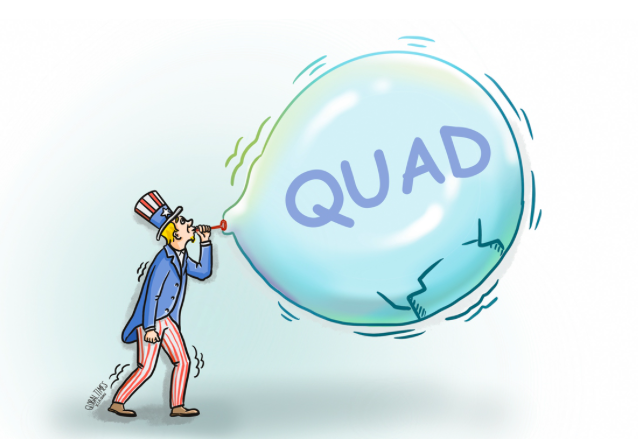
“The Quad Is Dead, Long Live the Quad” “Did Trump Kill the Quad?” “The US Built the Quad, But Now It’s Letting It Fail”. Throughout 2025, headlines across the United States and international media were saturated with titles like these, fueling a growing sentiment that the Quad was falling apart. These reports suggested that the partnership, once seen as a key part of security in the Indo-Pacific, was losing strength because the administration of the United States of America under President Donald Trump seemed to be pulling back from its leadership role. Although these news articles do not claim that the Quad’s strategy or its goals were dead, they pointed to a shift in how the partnership functions, showing that the regional stability remains active.
But What Is the Quad?
The Quadrilateral Security Dialogue (Quad) is a team of four democracies: Australia, India, Japan and the United States of America acting as a strong partner against China’s growing power and to help keep the Indo-Pacific region free and open for everyone. The Quad traces its origins to the December 2004 Indian Ocean tsunami, when the United States, India, Japan and Australia worked together to provide emergency help, even though they didn’t have a formal group set up for it. The success of that cooperation led the Japanese Prime Minister at that time, Shinzo Abe, to propose a more structured Quadrilateral Security Dialogue in 2007. However, the group stopped meeting in 2008, largely because Australia’s Prime Minister Kevin Rudd withdrew, being unwilling to go against Beijing at the height of the Sino-Australian economic boom. The Quad was restored in 2017 during the Trump administration, driven by shared anxieties over China’s bold behavior over territory in the South China Sea, the building of military bases on man-made islands and the fast growth of the People’s Liberation Army (PLA) Navy.
Since its revival in 2017 under the first Trump administration and its subsequent major summit-level partnership under President Joe Biden, the Quad has been seen as a key part of maintaining security in the Indo-Pacific. The Biden era transformed the Quad from a consultative forum into a summit-level coalition, with leaders holding their first virtual meeting in March 2021, followed by face-to-face meetings at the White House in September 2021, in Tokyo in May 2022, in Hiroshima in May 2023, and in Wilmington, Delaware, in September 2024. Under President Biden, the Quad began working on a long list of goals, spanning maritime security, vaccine distribution, climate change, technology standards, infrastructure financing and cybersecurity. Critics felt the group was taking too much, but supporters believed this wide-ranging plan showed an affirmative vision for the region. Despite this ambitious agenda, the momentum slowed. Now, in the middle of 2026, leaders in cities like New Delhi, Tokyo and Canberra are all asking the same worried questions: Is the Quad finished, or is it just taking a break?
The second Trump administration began with what appeared to be a strong signal of continuity in the Quad. On January 21, 2025, the Quad foreign ministers met in Washington under Secretary of State Marco Rubio, promising to keep the Indo-Pacific free and open. This indicated that the Quad had strong support from both U.S. political parties. However, these hopes did not last long. President Trump’s “America First” policy focused on making direct, one-on-one deals rather than working with a group of partners. Washington soon imposed high tariffs of up to 50 percent on Indian products and criticized India for buying cheap oil from Russia. These actions hurt the trust that the four countries had spent years cultivating.
India was supposed to host the Quad Leaders’ Summit in 2025. Prime Minister Narendra Modi formally invited President Trump to New Delhi in June 2025. Yet 2025 came and went without any leaders’ meeting. Trump reportedly canceled his trip because of the trade disagreements. Because India was also unhappy about the new taxes and the criticism regarding Russia, it did not push for the meeting to be rescheduled. By September 26, 2025, it became clear that the summit would not take place at all that year. As a result, the Quad’s most important event – the annual leaders’ meeting – did not happen in 2025.
Is the Quad Really Dead?
Even when news articles and media headlines in 2025 painted a dark picture, they never actually claimed that the Quad’s main goals were dead. While they focused on the fact that the leaders were not meeting and the partnership seemed to be “dying” in the public eye, they were really describing a shift in style. These reports highlighted that while the “public face” of the Quad- the grand summits and media spectacle were gone, the core mission was not. In reality, the Quad has not been entirely inactive. In fact, behind that silence, the Quad’s actual work has continued. Exercise Malabar, the yearly naval drill featuring all four countries, was held in Guam from October 28 to November 8, 2025, and was one of the largest in recent years. A workshop on disaster response was held in Honolulu and the third Quad Counterterrorism Working Group met in December 2025. Foreign ministers met in Washington in July 2025 and again in New Delhi on May 26, 2026. These meetings proved that the partnership remains very active. In short, the Quad has not stopped working; it has simply lost its “voice” at the top level.
On February 7, 2026, the United States and India made a big breakthrough by announcing a new trade plan. As part of this deal, the U.S. agreed to lower the tariffs on Indian products from 25 percent down to 18 percent. This was a partial fix for the high taxes that had been put in place because India was buying oil from Russia. This agreement helped fix the relationship between the two countries, which is the foundation needed for the Quad to work. It was a necessary but not sufficient condition for Quad revival.
On May 26, 2026, the Quad foreign ministers met in New Delhi. Many observers characterized it as a damage control exercise and an attempt to rescue the grouping’s relevance. The meeting led to several major results. First, the four ministers announced a plan called the Quad Critical Minerals Framework. This plan aims to strengthen supply lines, so countries do not have to rely on just one nation – a clear reference to China’s near-monopoly on the processing of important minerals. Second, they started the Indo-Pacific Maritime Surveillance Collaboration (IPMSC). It enhanced real-time maritime domain awareness across the region. Finally, they moved forward with the Ports of the Future Partnership, especially promising to work with Fiji to build and improve its ports.
Will India Be Replaced in the Quad?
Yet even as the New Delhi meeting produced these deliverables, a more uncomfortable question was being whispered in the strategic cycle: Was India still the right member, or could it simply be replaced?
The question gained real attention in 2025 with the quiet rise of a new group called the “Squad,” which includes the United States, Japan, Australia and the Philippines. Unlike India, the Philippines is an official U.S. military ally, has no complicated ties to Russia and has been on the front lines of direct standoffs with China in the South China Sea. The “Squad” has already conducted naval exercises. Analysts at the Center for Strategic and International Studies pointed out bluntly that India is seen as a weak link in the Quad. They argue that India is not a formal ally, is hesitant to join freedom of navigation patrols and is often pulled in many different directions at once.
However, the Squad and Quad have different goals. The Squad is narrowly focused on hard maritime security in the South China Sea. The Quad has a wider vision for the whole Indo-Pacific region, which requires India’s massive size, its key position in the Indian Ocean and its large population and economy. Replacing India would not save the Quad; it would simply create a different grouping entirely. The real question is not whether India can be replaced, but whether India and the United States can rebuild enough trust to make the Quad worth keeping.
Is the Australia Summit a last chance for the Quad?
The clearest sign that the Quad is not finished is what is now planned for later in 2026. Australia is the leader of the group this year and is expected to host a Quad Leaders’ Summit that never happened in India in 2025. All four countries’ defence and foreign ministers continue to talk through regular channels, and the militaries are working together even more closely than before. The question now is not whether the Quad is working. Clearly it is, but whether President Trump will attend a leaders’ meeting and bring back the political importance that the group has been missing for over a year. If he does, the Quad gets a genuine second wind. If he does not, the gap between the group’s hard work on the ground and its lack of political attention will become impossible to ignore.
In the end, while the Quad might not be in the news as much as it used to be, it is still doing important work behind the scenes. The idea of “Long live the Quad” means that even when things get difficult, the group’s mission to keep the region stable and safe continues to be a vital part of world politics.
Author



