
By : Simar Kaur, Research Analyst, GSDN
Introduction
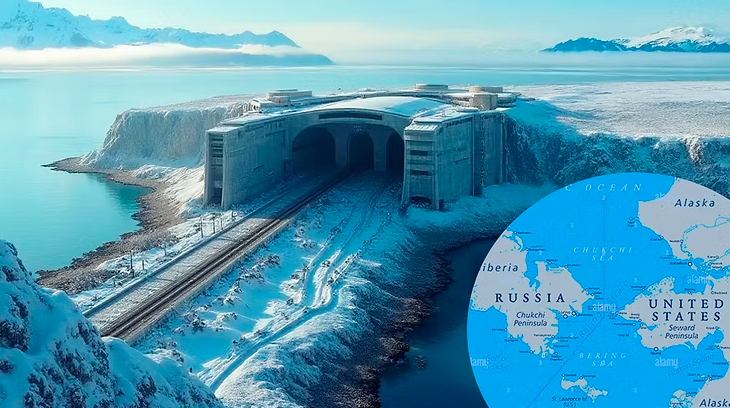
It is not futuristic speculation that has given rise to the notion of creating a bridge between the Russian Far East and North America through the Bering Strait; the idea of building it dates back a century and has been brought up several times, each time being dismissed due to the difficulties of distance, climate, and finances. Nevertheless, in June 2026, a radical resurgence of the concept of bridging the Bering Strait took place with the name of “Putin-Trump Tunnel.” The reason for such a name was an official declaration of Kirill Dmitriev, Russian Special Presidential Representative for Investment and Economic Cooperation. According to him, the project includes a railway tunnel that crosses underwater at about 86 km and cuts the cost of the construction from US$65 billion to less than US$8 billion with the help of modern boring technologies. This article critically assesses the viability of the Russia-Alaska tunnel considering its technological, financial, and geopolitical aspects, as well as the question of whether it will materialize soon.
Historical Context and the New Proposal
This concept of joining these two places together has existed for more than a hundred years already. This modern version of this idea was proposed in October 2025 by Kirill Dmitriev, who is the CEO of the Russian Direct Investment Fund (RDIF). He described it as “a 112-kilometre link, symbolizing unity. It started getting a lot of attention during the St. Petersburg International Economic Forum (SPIEF) in June 2026. Dmitriev mentioned that he signed a design agreement with an engineering company. He hoped that the design process would finish no later than December 31, 2026, and the decision about building the bridge would depend on its economic feasibility. It should be noted that the modern project differs greatly from the earlier, too expensive for projects in using tunnel technology. Dmitriev mentioned that applying ideas of The Boring Company of Elon Musk could lower the price of the construction process from US$65 billion to as little as US$8 billion in under 8 years. It was reportedly discussed with the leading figures of the United States, such as Steve Witkoff and Jared Kushner, and China could be involved too.
Technical Feasibility and Logistical Hurdles
Technically, construction of the tunnel under the Bering Strait is possible from the point of view of engineering. Specialists indicate that the underwater stretch of the tunnel is just about 1.5 times larger than that of the Channel Tunnel. Nevertheless, environmental conditions and logistics are extremely challenging. The major problems are not related to building the tunnel itself, but to a lack of auxiliary infrastructure. The closest Russian railroad is situated thousands of kilometers away from Chukotka through the zone of permafrost and mountains. In addition, Alaska is isolated from the railroad system of the United States. Transport of materials, fuel, and food for the building of the tunnel at the distant construction site in Chukotka, where there is an annual “northern supply”, is a highly challenging logistical task. There are no existing roads, cities, or energy systems in the region to support such a megaproject, which means that the transport approach to the construction of the tunnel should be built from scratch. Operating and maintaining the tunnel would be more costly than in the case of developed regions because of the Arctic climate.
Economic Viability and the Question of Cargo Base
The main obstacle standing in the way of implementation of the project is the absence of economic feasibility. The core issue here is which cargo can justify the investment in construction of such a massive tunnel. At present, the trade flow between Russia and the US is very low, and there is no apparent freight basis for the project to become commercially successful. As experts note, the project can be viable only as a part of a logisticschain that does not exist at present. Though the tunnel can serve as a shortcut between Asia and North America, the expenses of building the railroad over thousands of kilometers of wilderness tundra outweigh any time savings in comparison to sea routes, which at present handle more than eighty per cent of world trade volume. The claim of about three to five per cent of global sea trade passing through the tunnel seems rather doubtful. In addition, the shorter time it takes to deliver products through a land route is not sufficient due to the requirement of air or marine transportation of cargo up to the tunnel at each end point. According to one specialist, “‘ any saving of a few days compared with maritime travel is quickly wiped out by the staggering costs of laying thousands of kilometres of new track'”.
Geopolitical Dimensions and Strategic Interests
This tunnel idea is both a statement on geopolitics and a project of infrastructure development. Even Dmitriev referred to it as a “project that unites continents.” However, in the context of increasingly fragmented geopolitics, the tunnel is offered as a symbol of possible cooperation among Russia, the United States, and China. The geopolitical situation, however, is rather fragmented. It was met with skepticism by the president of Ukraine, Volodymyr Zelensky, who said he was “not happy with this” after Donald Trump mentioned it. Present-day geopolitical tensions, along with sanctions, make this kind of cooperation rather difficult. Besides, China being a possible participant in the project means that there is a complicated situation – although it could become one of the biggest beneficiaries of the new transcontinental land connection. Experts warn that “a key facility owned by one party and a main user being another is a definite time bomb”.
Conclusion: Will It Fructify?
Russia-Alaska tunnel project, as it currently exists in 2026, is an ambitious plan but also a highly uncertain one. With its emphasis on revolutionary technology that will dramatically lower construction costs, the new proposal has added a second wind to an idea that had existed for decades already. Completion of technical design by the end of 2026 may help gather some more data on its feasibility. However, there are many barriers to overcome that cannot be easily overcome with the help of technology. First, there is a tremendous logistical barrier connected with building and sustaining required infrastructure in the region, which is one of the most remote in the world. Second, there is no clear rationale or cargo base for it, and third, the serious geopolitical confrontation makes project cooperation highly unlikely. Thus, even though the project is a good example of what can be achieved with peace and investment, it does not seem likely to fructify in the medium term.



