
By: Shaurya Pandey, Research Analyst, GSDN
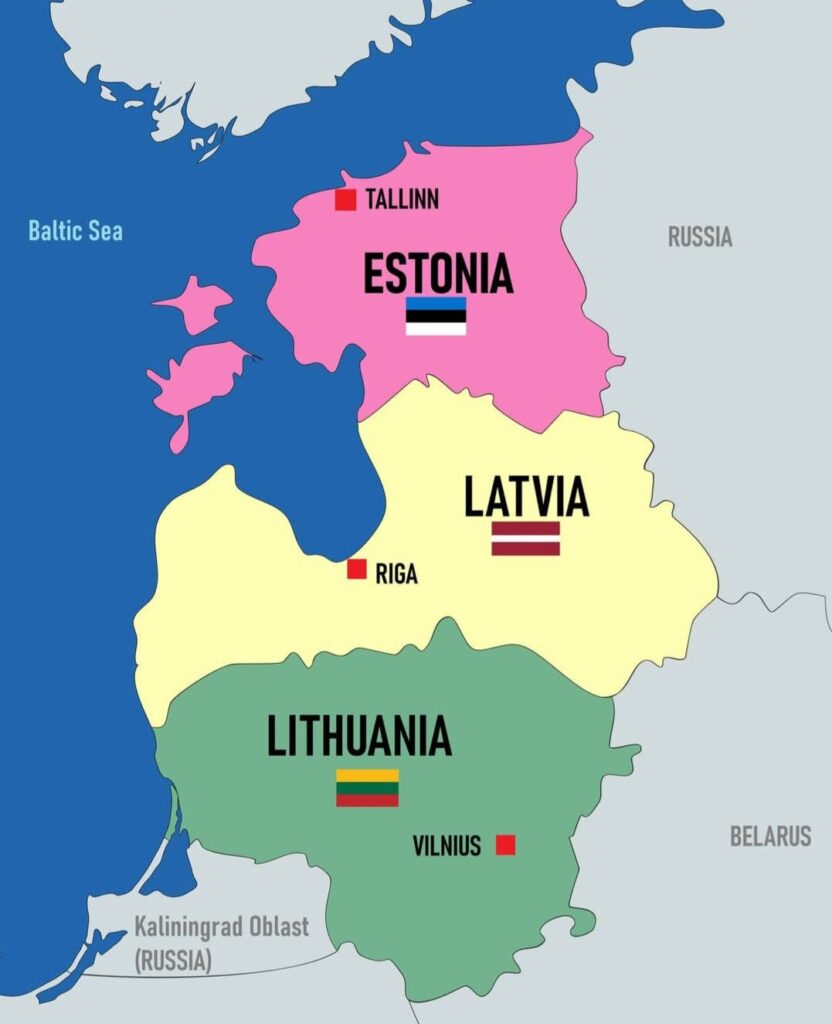
The question of whether Russia will mount a military invasion against one or more of the Baltic states Estonia, Latvia, or Lithuania has moved from the margins of strategic discourse to its very centre. All three nations are members of the North Atlantic Treaty Organization (NATO) and the European Union (EU), share borders with Russia or its close ally Belarus, and occupy a geographic position that makes them uniquely vulnerable to Russian pressure. A convergence of recent analytical studies, intelligence assessments, and investigative journalism published in early 2026 has shed new and disturbing light on both Russia’s strategic intent toward the region and its growing military capability to act on that intent. Taken together, these sources demand a serious reassessment of how close the Baltic states may be to the front line of the next major European conflict.
Four key developments frame this analysis. First, a Vilnius-based think tank has constructed a detailed scenario showing how Russia could force Lithuania into capitulation within 90 days without deploying a single soldier across the border. Second, a George C. Marshall European Centre for Security Studies analysis argues that Russia views the Baltic states less as immediate territorial targets and more as strategic levers against the West, preferring political warfare over conventional military action. Third, a Foreign Policy Research Institute (FPRI) study examines the specific infrastructure chokepoints in Russian and Belarusian territory that NATO and Baltic forces would need to strike in the event of war. Fourth, and most alarmingly, a joint Nordic and Baltic media investigation based on satellite imagery has revealed large-scale Russian military construction along NATO’s northern and Baltic borders, capable of accommodating up to 115,000 troops once the war in Ukraine subsides.
The 90-Day Scenario: Russia Without Boots on the Ground
In April 2026, the Baltic Défense Initiative (BDI), a small think tank based in Vilnius, Lithuania, published a scenario study that attracted wide international attention. The study was drafted by Thiebaut Devergranne, the BDI’s founder and a former official with the General Secretariat for Defence and National Security (SGDSN), which reports to the French prime minister. Drawing on lessons from the ongoing Iran war, the study modelled how Russia could force Lithuania into capitulation in 90 days with no soldiers crossing the border.
The scenario is set in December 2027 and posits a convergence of adverse political and military conditions. Far-right political movements have taken power across parts of Europe; France’s Marine Le Pen, as president, has withdrawn France’s nuclear umbrella from all NATO allies; and the United States is eighteen months into a draining Iran war with depleted weapons stocks. Against this backdrop, Russia launches hypersonic missiles against Lithuania’s government and follows this with more than 170,000 Shahed drone strikes over the next 60 days, systematically destroying every bridge, every power plant, every hospital, and every water treatment facility in the country. On day 90, Moscow issues an ultimatum: all three Baltic states must accept Russian occupation, or Riga and Tallinn face the same fate.
The BDI stressed that its scenario is constructed entirely from verified weapon system capabilities, observed production rates for military equipment such as drones, and documented global political trends making it a plausible projection rather than speculation. Beyond the scenario itself, Devergranne identified a critical structural flaw in Lithuania’s constitutional order. The constitution does not foresee a line of succession ensuring continuity of government after the speaker of the Seimas, the country’s unicameral parliament, were to be incapacitated. As a result, if a strike succeeded in neutralizing both Lithuania’s president and the speaker simultaneously, the authority to act as commander-in-chief would be legally unclear. The BDI has called for this gap to be addressed urgently. The initiative has developed more than 200 defence-focused proposals for Lithuania, built on what it describes as France’s post-World War Two deterrence model of sovereignty through strength.
Opinions among officials and analysts vary on Russia’s actual appetite for attacking the Baltic nations. The Estonian Foreign Intelligence Service published an assessment in early 2026 finding that Russia was not expected to attack any NATO member state within the next two years — crediting European efforts to rapidly boost collective defences. All Eastern European nations have significantly increased defence spending in recent years. Yet the BDI scenario is a reminder that deterrence calculations can shift quickly if political conditions in Western capitals deteriorate, and that the window of relative safety is not guaranteed to remain open.
Russia’s Strategic Use of the Baltic States: Targets and Levers
The Marshall Centre’s analysis provides an essential conceptual framework for understanding Russian behaviour in the Baltic region. Russia’s approach to the three Baltic states, the analysis argues, is driven by a distinctive strategic culture and operational code that inclines the Kremlin toward offensive actions as a means of defending itself. NATO is not accepted by Moscow on its own terms as a genuinely defensive alliance; simply by constraining Russia’s strategic options, the Baltic states’ firm commitment to NATO becomes, in Moscow’s eyes, a challenge to Russian security and freedom of manoeuvre.
Russia’s strategic culture also inclines it to view the Baltic states as possessing what might be described as limited or modified sovereignty justified, in Moscow’s view, by the region’s historical incorporation into the Russian empire and the Soviet Union, and by the presence of Russian-speaking minority populations in Estonia and Latvia in particular. The Kremlin’s 2015 decision to direct its Prosecutor General’s Office to review the legality of the 1991 decision to grant the Baltic states independence was symbolic, but it reflected a broader conviction in Russian official circles that the Baltic states owe Moscow something. However, the Marshall Centre analysis notes that Russian-speaking populations in cities such as Narva, Estonia, and Riga, Latvia, show no enthusiasm for exchanging membership in prosperous democratic European states for Kremlin rule. As one recently retired Russian general staff officer acknowledged in conversation with the study’s author, the trouble with the Baltic states is that they are full of Balts a people with a demonstrated will and capacity to resist under overwhelming odds.
Rather than viewing Russia’s Baltic policy as a prelude to imminent kinetic operations, the Marshall Centre’s analysis argues that the Kremlin uses the Baltic states primarily as a theatre for signalling offensive intent and demonstrating offensive capabilities leveraging them for effect on external audiences rather than pursuing territorial ambitions within the region itself. Russia uses pressure on the Baltic states to generate discord within the EU, to strain NATO by raising the costs of Baltic defence for member states facing threats elsewhere, to complicate U.S. strategic calculations, and to keep Nordic states uncertain about whether to seek accommodation with Moscow. The deployment of Iskander-M (SS-26) ballistic missiles, which can carry nuclear warheads, into Kaliningrad in 2016 was as much a political act as a military one calculated for its symbolic impact on NATO cohesion and on local confidence in the Article 5 guarantee.
Russia’s preferred instruments in the Baltic context are those of political warfare: disinformation, intelligence operations, cyber-attacks, and the manipulation of civil society organizations and political parties. Russian information operations have sought to exploit minority grievances, fabricate incidents including false reports of crimes committed by NATO troops stationed in Lithuania and Latvia and turn the presence of allied forces into a political liability. The Marshall Centre analysis notes, however, that Russia’s aggressive political warfare has had the perverse effect of giving Baltic security agencies experience, determination, and stronger budgets. NATO is more active in the region than ever, and Sweden and Finland have joined the alliance, fundamentally altering the Baltic Sea’s strategic geometry.
The Military Dimension: Targeting Russia’s Rear Zone
While Russia’s preferred approach may be political warfare rather than conventional military attack, serious analytical work has been done on what a hypothetical Baltic war would actually look like at the operational level. The FPRI’s March 2026 study examined the concept of targeting Russian rear-zone infrastructure as a means of degrading any hypothetical invasion force — drawing on the Cold War-era Follow-on Forces Attack (FOFA) doctrine that NATO developed in the 1980s to address a structurally similar problem: how to stop a larger attacking Soviet force by striking the logistics infrastructure that sustains it.
The FPRI study identified the approximate 50-kilometer band of Russian and Belarusian territory that would constitute the rear zone in any hypothetical invasion of the Baltic states, and catalogued specific infrastructure chokepoints within it. Along the northern axis from St. Petersburg toward Tallinn, multiple road and rail bridges across the Luga River at Ust-Luga, at and around Kingisepp, and at Porech’e would be critical interdiction targets. Their destruction would delay and complicate Russian efforts to sustain any offensive across the Narva River into Estonia.
Pskov would function as a major logistical hub for any Russian operation into southern Estonia or eastern Latvia, with three road bridges and one rail bridge across the Velikaya River. Destruction of these crossings would seriously compromise Russia’s ability to sustain operations out of or through the city. Further south, the rail line from Pskov through Ostrov to Rezekne in eastern Latvia runs so close to the Latvian border at points —at times barely 50 meters from it that it would require Russia to commit substantial resources to fully secure it against sabotage by NATO special operations forces.
From Belarus, potential Russian axes of advance toward Daugavpils would be significantly complicated by the Daugava River, with limited crossing points that could be interdicted. Along Lithuania’s border with Belarus, key bridge clusters at Astravets and its environs, Ashmany, and Lida would constitute priority targets. The Kaliningrad exclave presents a particular complexity: NATO has publicly signaled it would invade and occupy Kaliningrad in the event of war, which means that destroying bridges in the exclave which would impede Russian forces would equally impede subsequent NATO reinforcement through it. This tension between early interdiction and later reinforcement would require careful operational judgment.
The FPRI study emphasizes that Baltic states have made clear they have no intention of permitting a hypothetical war to remain confined to their own territories. Estonian officials in particular have been vocal about carrying the war into Russian territory if necessary. Targeting Russian rear-zone infrastructure would not be decisive in isolation damaged bridges can be repaired or bypassed but it would meaningfully degrade Russian operational momentum and buy critical time for NATO reinforcements to arrive. The study’s core message is that geography offers NATO and the Baltic states real opportunities to complicate Russian plans, provided they invest now in the air power and ground-based missile forces capable of exploiting those opportunities.
The Infrastructure Build-Up: Russia Prepares for the Next War
The most alarming new evidence bearing on the question of a Russian invasion of the Baltic states comes from a joint investigation by Nordic and Baltic media outlets Sweden’s SVT, Norway’s NRK, Denmark’s DR, and Estonia’s Delfi published in June 2026. Drawing on satellite imagery and interviews with senior intelligence and military officials from across Scandinavia, the investigation found that Russia is conducting a large-scale expansion of military infrastructure along its borders with Northern Europe and the Baltic region, with facilities capable of accommodating up to 115,000 troops. This figure represents nearly six times the troop strength Russia maintained in its northwestern direction before the full-scale invasion of Ukraine.
New barracks, military towns, warehouses, and equipment depots are being constructed at multiple locations. New barracks and clusters of military equipment have been identified near Pechenga, approximately 10 kilometres from the Norwegian border in Lapland. Significant construction is underway near Petrozavodsk, close to the Finnish border. A new base is being constructed near Novaya Vilga, capable of housing up to 6,000 Russian troops, situated approximately 100 miles east of the Finnish border. Satellite imagery from September 2025 showed undeveloped forested land at the Petrozavodsk location; imagery from June 2026 showed completed military infrastructure. The scale and character of the construction — including large barracks, logistics centres, and vehicle depots exceeds what analysts describe as purely defensive requirements.
Thomas Nilsson, head of Sweden’s Military Intelligence and Security Service (MUST), assessed that his agency does not believe this build-up is for demonstration purposes; rather, it represents the preparation of military potential intended for use in a future large-scale confrontation with NATO. Scandinavian defence officials have assessed the current threat level as higher than at any point during the Cold War. NATO Commander for the Baltic states and Poland, Major General Brian Nissen, offered a qualified reassurance: as long as Russia remains heavily engaged in Ukraine, the direct military threat is limited. However, he warned explicitly that this could change very quickly if a ceasefire is reached in Ukraine. Russian forces could additionally transfer hundreds of thousands of troops with combat experience from other parts of Russia to the northwestern theatre within weeks if necessary.
The crucial analytical point here is the distinction between current capability and future intent. Most of the new garrisons are currently empty their intended occupants are fighting and dying in Ukraine. But Russia is methodically building the physical infrastructure for a major offensive capability on NATO’s northern and Baltic flanks. The buildings are a statement of intent measured in years, not a threat measured in weeks. NATO and the Baltic states have a window of time to prepare; the question is whether they will use it.
Conclusion
The four analytical perspectives examined here converge on a disturbing picture. Russia is not likely to invade any Baltic state in the immediate term — the Estonian intelligence assessment, NATO commander assessments, and Russia’s current military preoccupation with Ukraine all support this conclusion. But the medium and longer-term picture is significantly more concerning. Russia is constructing military infrastructure capable of holding 115,000 troops on NATO’s northern and Baltic flanks. It has demonstrated, through the Ukraine war, both its willingness to absorb enormous costs in pursuit of strategic goals and its capacity to deploy drone and missile systems on a mass scale that the BDI’s Winter Storm scenario shows could devastate a small Baltic state within 90 days under the right political conditions. Russia’s preferred method of influence in the region is political warfare and coercion rather than immediate military action — but that preference is not permanent, and it rests on a cost-benefit calculation that could shift rapidly if NATO’s political cohesion weakens.
The prescriptions that follow from this analysis are clear. The Baltic states must close the legal and constitutional vulnerabilities that analysts have identified, including Lithuania’s command succession gap. NATO must sustain and deepen its forward presence in the region and invest in the air and missile strike capabilities that would allow it to impose real costs on a hypothetical Russian invasion force in its rear zone. The alliance must also maintain its political cohesion, since the BDI scenario’s most dangerous preconditions are political — the withdrawal of nuclear guarantees, the exhaustion of American will — rather than purely military. And all NATO members must take seriously what Russia’s construction program on its northwestern frontier reveals about its intentions. The barracks being built today will not remain empty indefinitely.



