
By : Kumar Aryan, Research Analyst, GSDN
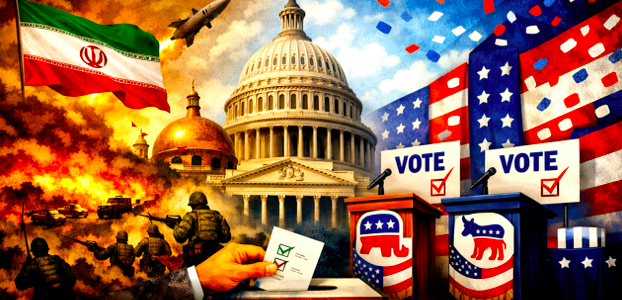
The political question surrounding the Iran war is no longer limited to foreign policy. Since the U.S.-Israeli air campaign began on February 28, 2026, the conflict has become a test of presidential credibility, economic management, congressional authority, and party discipline. A ceasefire framework and interim memorandum of understanding were announced in mid-June 2026, but the domestic political damage may already have been done. For Republicans, the issue is not only whether the military campaign achieved its stated objectives. The larger question is whether the war has weakened the party’s ability to defend its narrow congressional majority in the November 2026 midterm elections.
The war as a domestic political test
Foreign conflicts often reshape midterm politics when they become linked to pocketbook issues, presidential competence, and public trust. That pattern is especially important in 2026 because the Trump administration tied the campaign against Iran to national security, oil-market stability, and deterrence. Once the conflict disrupted shipping lanes and pushed energy prices higher, the political frame shifted. Voters were no longer evaluating only military action; they were also evaluating inflation, gasoline prices, household costs, and the risk of escalation.
That dynamic matters because midterm elections are usually a referendum on the party in power. If a war is seen as successful, limited, and decisive, it can produce a rally effect. If it looks open-ended, expensive, or strategically confused, it can depress approval and widen the opposition’s advantage. The Iran war has moved through both phases: initial force, sustained uncertainty, and then an uneasy ceasefire process that did not erase public concern.
What the polling says
The public record is unfavorable for Republicans. A Reuters/Ipsos poll conducted from March 31 to April 02, 2026, found that 66% of Americans wanted the United States to end its involvement quickly, even if the administration did not fully achieve its objectives. In that same survey, 60% disapproved of the strikes on Iran, and only 27% preferred a prolonged campaign to secure the government’s goals. The same polling stream showed that gasoline had crossed US$ 4 per gallon, reinforcing the sense that the war was reaching into everyday economic life.
Public opinion remained soft until June 2026. A Reuters/Ipsos poll reported on June 08, 2026, found Trump’s approval near a record low at 35%, with the war cited as a major factor in the decline. The same reporting noted that voters were still expecting higher fuel prices, which is politically damaging in an election cycle where inflation remains the dominant issue for many households.
The coalition picture is more complicated than a simple partisan split. On June 12, 2026, Reuters reported that 54% of evangelicals opposed Trump’s military use in Iran and that his approval among evangelicals had fallen to 52%, down from 61% in August 2025. That matters because evangelical voters are one of the most reliable Republican constituencies. Any fracture there increases the risk of depressed turnout or protest abstention in competitive districts.
Why the war is politically dangerous for Republicans
The first source of risk is economic spillover. The conflict strained global energy markets, and even when prices later eased, the initial shock had already translated into higher inflation expectations, transport costs, and consumer anxiety. Republicans usually benefit when voters focus on border security, crime, and cultural issues. They are far less comfortable when the dominant question is whether the party in power made life more expensive. The Iran war pushed the debate toward exactly that terrain.
The second risk is strategic ambiguity. Trump initially framed the campaign as a short, overwhelming operation with clear objectives. As the conflict stretched on, that promise became harder to defend. On June 15, 2026, Reuters reported that the United States and Iran had signed a memorandum of understanding to halt the war and reopen the Strait of Hormuz, but that agreement immediately generated criticism from Republicans who thought it conceded too much. A policy that can be attacked both as too aggressive and too conciliatory is a political liability.
The third risk is internal party fragmentation. The Republican coalition is no longer uniformly interventionist. Some lawmakers and commentators support Trump’s use of force, while others in the America First camp are skeptical of foreign entanglements and wary of spending political capital on Middle East operations. Once a conflict generates public division inside the governing party, it becomes harder to sustain a unified campaign message.
The fourth risk is institutional. On June 03, 2026, the U.S. House of Representatives passed a war-powers resolution seeking to end continued military action in Iran without fresh congressional authorization, with several Republicans breaking ranks. On June 16, 2026, the Senate narrowly blocked a similar effort. These votes do not resolve the conflict by themselves, but they signal discomfort inside Congress. In midterm campaigns, such fissures often matter as much as formal policy outcomes because they shape perceptions of control and competence.
Historical midterm logic
Historical precedents also point toward risk for the president’s party. Brookings has noted that the president’s party has lost ground in 20 of the last 22 midterm House elections dating back to 1938. The main exceptions, in 2002 and 1998, reflected highly unusual circumstances: the post-September 11 security rally around President George W. Bush and the impeachment fight surrounding President Bill Clinton. In other words, only extraordinary national cohesion has reliably offset the normal midterm penalty.
Brookings also emphasizes the link between presidential approval and midterm losses: the higher the president’s approval, the smaller the seat losses for the president’s party. That relationship matters because war usually helps incumbents only when it produces a strong rally effect and quick success. The Iran war did not do that. Instead, the conflict appears to have lowered approval rather than raised it, which is precisely the condition that tends to magnify midterm losses.
House and Senate implications
The House is the most likely point of vulnerability. Republicans entered 2026 with only a narrow margin, meaning even modest shifts in turnout or persuasion can alter control. A national environment defined by high prices, fatigue with the war, and doubts about the administration’s messaging could be enough to flip several swing districts. The June 03, 2026, House war-powers vote suggests that some Republican incumbents already view the conflict as politically hazardous in competitive seats.
The Senate is harder to predict because the map is smaller and more state specific. Still, the war may indirectly assist Democrats in states where moderate and independent voters are more sensitive to economic disruption and executive overreach. If the party becomes identified with prolonged military engagement, congressional candidates in suburban and swing-state contests may be forced to defend a policy they did not design but are expected to own.
Republicans would normally expect a foreign-policy win to stabilize the coalition. In this case, the ceasefire framework may reduce the most immediate political damage, but it is unlikely to create a durable rally unless it also delivers lower energy prices, visible de-escalation, and a convincing narrative of strategic success. Without those follow-through effects, the issue may remain a source of voter doubt rather than a source of credit.
What would blunt the damage
Three developments could limit the electoral cost. First, if the ceasefire holds through the summer of 2026 and oil and gasoline prices continue to fall, the economy may reclaim center stage from foreign policy. Second, if the administration releases a coherent post-conflict rationale that appears credible to independents, some of the uncertainty could fade. Third, if Democratic candidates fail to convert anti-war sentiment into a broader affordability message, the war alone may not be sufficient to determine control of Congress.
Even so, the available evidence suggests that Republicans are more exposed than helped. Polling shows that the war is unpopular, the economic effects are visible, and the party’s internal messaging is fractured. Midterm elections rarely reward a governing party that is defending a costly conflict with uncertain strategic payoff.
Conclusion
The Iran war is not automatically a guarantee of Republican defeat, but it is a serious electoral headwind. As of June 2026, the conflict has weakened Trump’s approval, intensified concerns about inflation and energy costs, and exposed divisions inside the Republican coalition. Historical midterm patterns work against the president’s party even in ordinary conditions, and the 2026 environment is not ordinary. Unless the ceasefire solidifies quickly and economic pressure eases, the war is likely to function less as a victory lap and more as a liability in the November 2026 midterm elections. That does not make it the sole determinant of the outcome, but it may well be one of the most consequential factors shaping whether Republicans keep control of Congress.




Well done aryan!
A thought-provoking and well-argued analysis that presents a nuanced perspective on the possible political implications of the Iran conflict. Great read!
Well Written.
It has a clear central thesis and is very timely. Excellent writing (i would rate it an 8.5/10)
Analysis is pretty damn good!
A very interesting way to look at this.. will look forward to more 👍🏻
Nice nice
Nice