
By: Khushbu Ahlawat, Consulting Editor, GSDN
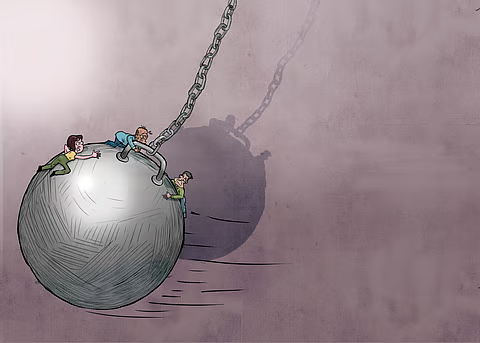
Climate Vulnerability Amid Structural Financial Inequities
Least Developed Countries (LDCs), particularly in Sub-Saharan Africa, stand at the frontline of the global climate crisis despite contributing minimally to historical greenhouse gas emissions. This paradox reflects a deeper structural inequity embedded in the global financial architecture. These countries face disproportionately high borrowing costs—often reaching 25 percent interest rates—while requiring an estimated US$ 40 million annually per country for climate adaptation. Yet, a persistent financing gap of nearly US$ 20 million per year continues to undermine their resilience.
Existing financial mechanisms such as the Least Developed Countries Fund (LDCF), administered by the World Bank, have disbursed around US$ 1.7 billion, but a significant portion is skewed towards mitigation rather than adaptation. This misalignment is critical, as LDCs require urgent investments in climate-resilient infrastructure, disaster preparedness, and agricultural adaptation rather than long-term emission reduction strategies alone. The issue is not merely financial scarcity but systemic exclusion—where high-risk premiums, weak credit ratings, and limited institutional capacity restrict LDCs’ access to affordable capital. Without structural reforms, climate vulnerability in these regions will translate into broader global instability.
Debt Trap and Climate Crisis: A Vicious Cycle of Underdevelopment
LDCs today are caught in a “triple crisis” of climate vulnerability, debt distress, and economic fragility. According to recent estimates, their average debt-to-GDP ratio reached 55.4 percent in 2022, significantly constraining fiscal flexibility. A large share of national revenue is directed toward servicing external debt rather than investing in climate adaptation or social development.
A key dimension of this crisis is the growing external debt dependence, particularly on bilateral creditors. Nearly 60 percent of Sub-Saharan Africa’s external government debt is owed to China, raising concerns over strategic vulnerabilities often framed within the discourse of “debt-trap diplomacy.” While this narrative is debated, the reality remains that high-interest and non-concessional loans exacerbate fiscal distress.A critical yet often overlooked dimension of climate finance for LDCs is the issue of credit rating bias and risk perception in global financial markets, which significantly inflates borrowing costs for vulnerable economies. International credit rating agencies frequently assign lower sovereign ratings to LDCs due to structural vulnerabilities, governance challenges, and exposure to external shocks. However, these assessments often fail to adequately factor in climate resilience investments, international support mechanisms, and long-term sustainability gains, thereby creating a distorted risk profile. This results in a “climate penalty,” where countries most in need of affordable finance are charged the highest premiums. Recent discussions at global platforms such as COP28 (2023) and the Paris Summit for a New Global Financing Pact (2023) have highlighted the urgent need to reform the global financial architecture, including the methodologies used by rating agencies. Proposals include incorporating climate vulnerability indices, resilience-building efforts, and access to multilateral support into sovereign risk assessments. Additionally, the role of blended finance—where public funds are used to de-risk private investments—has gained traction as a viable solution to crowd in capital for LDCs. Institutions like the World Bank and regional development banks are increasingly deploying guarantees and first-loss mechanisms to make LDC investments more attractive. If effectively implemented, these reforms could unlock billions in private capital, reduce dependency on high-interest loans, and enable LDCs to transition from being perceived as “high-risk borrowers” to emerging hubs of sustainable investment and green growth.
This debt burden directly affects climate preparedness. Governments struggling to meet immediate livelihood needs—healthcare, food security, employment—are unable to prioritize long-term investments in climate resilience. Consequently, climate shocks such as floods, droughts, and cyclones further erode economic stability, triggering migration, conflict, and regional insecurity. Recent global developments, including the outcomes of COP28 (Dubai, 2023) and the establishment of the Loss and Damage Fund, acknowledge these vulnerabilities. However, operationalisation remains slow, and funding commitments fall far short of actual needs, reinforcing the urgency for alternative financial pathways.
Innovative Climate Finance Mechanisms: Pathways to Resilience
Addressing the climate finance gap in LDCs requires a shift from traditional debt-based financing to innovative, flexible, and inclusive instruments. Another crucial dimension in advancing climate finance for LDCs is the role of technology transfer and capacity-building within the framework of climate justice. Financial resources alone are insufficient if LDCs lack the technical expertise, institutional mechanisms, and governance structures required to effectively deploy these funds. Many LDCs face challenges in designing bankable climate projects, meeting compliance standards for green financing instruments, and monitoring the impact of funded initiatives. This creates a paradox where available funds remain underutilized due to limited absorptive capacity. International frameworks such as the Paris Agreement (2015)—particularly Article 10 on technology development and transfer—emphasize the need for developed countries to facilitate access to climate technologies for developing nations. More recently, initiatives under COP28 (2023) have reiterated the importance of scaling up climate technology partnerships, including digital climate modelling, early warning systems, and renewable energy innovations. Additionally, institutions like the Climate Technology Centre and Network (CTCN) have begun supporting LDCs in building technical capacity, but their outreach remains limited relative to demand. Strengthening domestic institutions, training local experts, and fostering public-private partnerships can significantly enhance the efficiency and transparency of climate finance utilization. Furthermore, integrating indigenous knowledge systems with modern technological solutions can create context-specific adaptation strategies, particularly in agriculture and water management sectors. By prioritizing capacity-building alongside financial flows, LDCs can move beyond dependency and evolve into active agents of climate innovation, ensuring that climate finance translates into tangible, sustainable outcomes on the ground.
a) Debt-for-Nature Swaps: Aligning Ecology with Economics
Debt-for-nature swaps offer a transformative mechanism by linking debt relief with environmental conservation. Countries can restructure or reduce debt in exchange for commitments to biodiversity protection and climate adaptation. A landmark example is Ecuador’s 2023 agreement, which enabled US$ 1.126 billion in debt savings, channelled toward marine conservation. Supported by multilateral actors like the Inter-American Development Bank and the U.S. Development Finance Corporation, the deal highlights how multi-stakeholder cooperation can convert fiscal stress into ecological investment. For African LDCs with rich biodiversity and high climate risk, such swaps can simultaneously address debt burdens and environmental degradation, fostering sustainable development.
b) Green Bonds: Unlocking Sustainable Capital Markets
Green bonds represent a powerful instrument for mobilizing large-scale climate finance. While widely used in developed markets, their adoption in LDCs remains limited due to weak financial institutions and underdeveloped capital markets. However, success stories like Egypt demonstrate their potential. In 2022, Egypt issued US$ 500 million in green bonds, attracting US$ 3.7 billion in investor interest at a relatively low coupon rate of 5.25 percent. The funds supported renewable energy and sustainable urban infrastructure projects.
For LDCs, green bonds can:
- Lower borrowing costs
- Diversify investor bases
- Promote clean energy transitions
- Strengthen financial credibility
To scale this model, international institutions must provide credit guarantees, technical assistance, and risk mitigation frameworks.
c) Sustainability-Linked Bonds (SLBs): Flexibility with Accountability
Unlike green bonds, Sustainability-Linked Bonds (SLBs) are not restricted to specific projects but are tied to measurable sustainability outcomes. This flexibility makes them particularly suitable for LDCs with diverse development needs. Rwanda’s 2023 issuance of Eastern Africa’s first SLB raised US$ 24 million, supported by the World Bank. The bond incorporated innovative features such as a US$ 10 million escrow account to reduce investor risk and focused on ESG goals, including women-led enterprises and affordable housing.
SLBs enable:
- Performance-based financing
- Capacity-building through institutional partnerships
- Integration of social and environmental goals
Their success signals growing investor confidence in LDC markets when backed by credible governance frameworks.An equally significant yet underexplored avenue for strengthening climate finance in LDCs lies in the reform and effective utilisation of carbon markets under Article 6 of the Paris Agreement. Carbon markets, both compliance-based and voluntary, offer LDCs an opportunity to generate revenue by trading carbon credits derived from emission reduction and climate mitigation projects such as afforestation, renewable energy deployment, and sustainable land use. However, LDCs have thus far remained largely marginalised in these markets due to limited institutional capacity, lack of standardised measurement, reporting, and verification (MRV) systems, and concerns over market transparency and equity. The operationalisation of Article 6 at COP26 (Glasgow, 2021) and subsequent efforts at COP28 (2023) to streamline carbon trading rules have created a renewed momentum for integrating LDCs into global carbon finance systems. If governed effectively, carbon markets could provide a non-debt creating source of finance, reducing reliance on high-interest external borrowing. Moreover, initiatives such as the Integrity Council for the Voluntary Carbon Market (ICVCM) are working towards improving credibility and standardisation, which could enhance investor confidence in projects originating from LDCs. However, ensuring that carbon markets do not perpetuate new forms of inequality is crucial; safeguards must be in place to prevent exploitation, ensure fair pricing, and protect local communities. By strengthening regulatory frameworks, building MRV capacity, and ensuring equitable participation, LDCs can leverage carbon markets not only as a financial tool but also as a mechanism to assert their role in global climate governance, thereby aligning economic incentives with environmental sustainability.
Way Forward: Towards an Inclusive and Equitable Climate Finance Architecture
The future of climate resilience in LDCs lies in restructuring the global financial system to prioritize equity, accessibility, and sustainability. Emerging economies, particularly within platforms like BRICS, have a critical role to play in advancing South-South cooperation.
A transformative approach to addressing climate finance challenges in LDCs lies in the integration of climate finance with broader development financing through the concept of “climate-development nexus” and SDG alignment. Climate vulnerability in LDCs is deeply intertwined with structural issues such as poverty, weak healthcare systems, food insecurity, and inadequate infrastructure. Therefore, isolating climate finance from development priorities often leads to fragmented and inefficient outcomes. Recent global policy discourse, particularly following the UN Sustainable Development Goals (SDGs) Summit 2023, has emphasised the need for holistic financing frameworks that simultaneously address climate resilience and developmental deficits. For instance, investments in climate-smart agriculture not only enhance adaptation capacity but also improve food security and rural livelihoods. Similarly, renewable energy projects contribute to both emission reduction and energy access, directly supporting SDG 7 (Affordable and Clean Energy). Multilateral initiatives such as the Global Gateway (EU, 2021) and the G20 New Delhi Leaders’ Declaration (2023) have increasingly highlighted integrated financing models that align climate objectives with long-term economic transformation. However, LDCs often face institutional silos, where climate and development ministries operate independently, limiting policy coherence. Bridging this gap requires mainstreaming climate considerations into national budgeting processes, strengthening inter-ministerial coordination, and adopting integrated policy frameworks. Furthermore, development finance institutions (DFIs) and multilateral development banks (MDBs) must shift from project-based lending to programmatic and sector-wide approaches, ensuring that climate finance contributes to systemic transformation. By embedding climate finance within the broader development agenda, LDCs can maximise the impact of limited resources, avoid duplication, and create resilient economies capable of withstanding future shocks, thereby moving closer to achieving both climate and development goals in a sustainable and inclusive manner. Recent developments such as the expansion of BRICS (2024) and discussions around a BRICS Development Bank reform agenda offer opportunities to channel low-cost capital into LDCs. Similarly, institutions like the Asian Infrastructure Investment Bank (AIIB) and African Development Bank (AfDB) must expand their focus on adaptation infrastructure in vulnerable regions.
Key policy priorities include:
- Establishing integrated financial management systems for transparency and accountability
- Enabling local currency financing to reduce exchange rate risks
- Enhancing institutional capacity and governance frameworks
- Scaling up the operationalisation of the Loss and Damage Fund
- Promoting blended finance models combining public and private capital
Ultimately, climate finance must transition from a model of conditional assistance to one of climate justice and shared responsibility. Empowering LDCs is not merely a moral imperative but a strategic necessity for global stability.
Conclusion
The climate crisis is no longer a distant environmental concern—it is a present and escalating threat that is reshaping global economic, political, and social realities. For Least Developed Countries (LDCs), this crisis is particularly existential. Despite contributing the least to global emissions, they remain disproportionately exposed to climate shocks while being constrained by a deeply unequal financial system that limits their ability to respond effectively. This contradiction underscores a fundamental failure of the current global order to align responsibility with capability.
Addressing this imbalance requires more than incremental reforms; it demands a paradigm shift in the architecture of global climate finance. Instruments such as debt-for-nature swaps, green bonds, sustainability-linked bonds, and carbon markets provide promising pathways, but their transformative potential lies in how equitably and inclusively they are implemented. Without addressing structural barriers—ranging from high borrowing costs and credit rating biases to weak institutional capacity—these mechanisms risk remaining underutilised or inaccessible to those who need them most.
At the same time, emerging global platforms and initiatives—from the operationalisation of climate funds to South-South cooperation frameworks—offer a window of opportunity to reimagine financial flows in a way that prioritises resilience, inclusivity, and long-term sustainability. Empowering LDCs must therefore move beyond rhetoric to actionable commitments, backed by predictable financing, technology transfer, and institutional support. Ultimately, placing LDCs at the centre of climate finance is not an act of charity—it is a strategic imperative. In an interconnected world, climate instability in one region inevitably reverberates across borders through economic disruption, migration pressures, and geopolitical tensions. The choice before the international community is clear: invest collectively in resilience today or confront far greater costs tomorrow. The path to a sustainable future will be defined by how decisively and equitably we act now.

About the Author
Khushbu Ahlawat is a research analyst with a strong academic background in International Relations and Political Science. She has undertaken research projects at Jawaharlal Nehru University, contributing to analytical work on international and regional security issues. Alongside her research experience, she has professional exposure to Human Resources, with involvement in talent acquisition and organizational operations. She holds a Master’s degree in International Relations from Christ University, Bangalore, and a Bachelor’s degree in Political Science from the University of Delhi.




Thanks for breaking this down so clearly.