
By : Shaurya Pandey, Research Analyst, GSDN
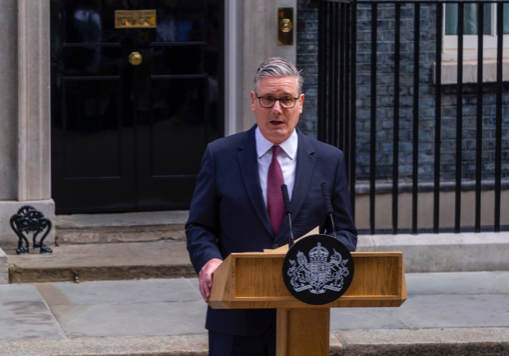
On June 22, 2026, United Kingdom (UK) Prime Minister Sir Keir Starmer stood outside 10 Downing Street and announced his resignation as leader of the Labour Party and as head of government. The announcement came less than two years after Labour’s landmark landslide election victory in July 2024, which had ended nearly fifteen years of Conservative Party governance. Starmer’s departure, shaped by internal party revolt, plummeting approval ratings, and the dramatic electoral resurgence of the far-right Reform UK party, marks another turbulent chapter in Britain’s increasingly volatile political landscape. With his exit, the UK is now preparing for its seventh prime minister in a decade a statistic that underlines the deep structural difficulties confronting any leader who occupies the office of the Prime Minister.
Background: A Landslide Victory and a Swift Decline
When Keir Starmer led Labour to a sweeping general election victory in July 2024, the expectation was one of transformational governance and long-overdue political stability. After years of turbulence under Boris Johnson, Liz Truss (whose 50-day premiership remains the shortest in British history), and Rishi Sunak, the British public delivered an emphatic verdict at the ballot box in favor of Labour. The scale of that majority one of the largest in modern British history should, in theory, have provided ample room for a bold programme of government reform.
Yet, from almost the very beginning, Starmer’s administration found it difficult to translate parliamentary dominance into meaningful public confidence. His government inherited a strained fiscal position, an underfunded National Health Service (NHS), significant pressure on immigration numbers, energy cost instability, and a deeply polarized electorate. Public satisfaction with the government’s handling of these areas deteriorated rapidly. By September 2024, polling by YouGov indicated that 67% of respondents held negative views of Labour’s immigration policies, while 64% considered the NHS to be poorly managed under the government. By November 2025, Starmer’s net approval rating had plunged to an average of 46%, placing him among the most unpopular prime ministers in modern British history.
The Unravelling: Internal Rebellion and Ministerial Exits
The formal unravelling of Starmer’s authority accelerated dramatically in May 2026. Labour’s performance in the May 2026 local elections was, by almost any measure, disastrous. The far-right populist party Reform UK, led by Nigel Farage, won big, seizing council seats that Labour had hoped to defend. The results triggered a wave of pressure from Labour’s parliamentary party urging Starmer to step aside in the national interest.
The cascade of ministerial resignations that followed signaled that Starmer’s authority within his own cabinet had fundamentally collapsed. On May 14, 2026, Health Secretary Wes Streeting resigned, publicly stating that it was “clear that [Starmer] will not lead the Labour Party into the next general election.” Safeguarding Minister Jess Phillips also departed, declaring that “deeds, not words, are what matter.” The Defence Investment Plan (DIP) triggered a further crisis when, on June 11, 2026, Defence Secretary John Healey resigned followed by Armed Forces Minister Al Carns and Parliamentary Private Secretary Pamela Nash citing Starmer’s failure to commit sufficient resources to defence in a period of acute global insecurity. The loss of the two senior-most defence officials in a single day sent shockwaves through Westminster.
Adding to the instability, the appointment of Peter Mandelson as British Ambassador to the United States in December 2024 intended to strengthen the UK’s relationship with the incoming administration of US President Donald Trump backfired dramatically when, in September 2025, the full extent of Mandelson’s relationship with convicted child sex offender Jeffrey Epstein became public following the release of the Epstein files. Starmer dismissed Mandelson, but the episode damaged the government’s credibility. Starmer’s Chief of Staff and close ally Morgan McSweeney accepted responsibility and resigned in February 2026.
The Makerfield By-Election: The Final Trigger
The defining blow to Starmer’s grip on power came from an unusual constitutional manoeuvre. In a coordinated strategy to install Andy Burnham the popular and widely respected Mayor of Greater Manchester as a credible leadership challenger, Labour MP Josh Simons resigned his Makerfield parliamentary seat on May 14, 2026, specifically to create a vacancy through which Burnham could enter Parliament and thereby become eligible to contest the party leadership.
The resulting by-election, held on June 18, 2026, was the first such event since the 1965 Leyton by-election to be called specifically to provide a parliamentary seat for a person not currently in the legislature. Burnham won the contest with nearly 25,000 votes and a majority exceeding 9,200 for a performance that surpassed the expectations of most opinion polls, which had predicted a narrower margin. The fact that Burnham defeated a strong Reform UK challenge in an area where Reform had recently swept all local council seats made his victory particularly potent. As Burnham declared in his victory speech, “everyone knows that politics isn’t working,” adding that his win could be a “turning point” a final chance for Labour to renew itself and reconnect with the public.
The following Monday, June 22, 2026, the political arithmetic had become undeniable. Starmer informed His Majesty King Charles III of his decision. Standing outside Downing Street, Starmer said: “The question my party is asking now is whether I am best placed to lead us into the next general election. I have heard the answer of my parliamentary party to that question, and I accept that answer with good grace.”
The Succession: Andy Burnham and the Road Ahead
With Starmer announcing his intention to remain as caretaker Prime Minister until a successor is chosen, a leadership timetable was established. Nominations for the Labour leadership contest are set to open on July 9 and close by the summer recess of July 16, 2026, ensuring that a new leader is in place before Parliament returns in September. Burnham immediately confirmed his candidacy, and the contest quickly took on the character of a near-coronation. Wes Streeting, who had previously been Burnham’s most formidable potential rival, announced on the same day as Starmer’s resignation that he would instead endorse Burnham for a decision that significantly narrowed the field. The Eurasia Group, a political risk consultancy, projected that Burnham would take office as Prime Minister on approximately July 18 or 19, 2026.
Burnham brings a distinctive political identity to the contest. Regarded as a unifying figure who can speak to Labour’s traditional working-class base while appealing to urban progressives, he had previously sought the Labour leadership in 2010 and again in 2015. His record in Greater Manchester overseeing housing investment, public transport reform, and integrated health and social care gave him credibility as a pragmatic executive rather than a purely ideological figure. His Makerfield by-election triumph, achieved against a Reform UK tide in a region susceptible to populist right-wing messaging, positioned him as the candidate best equipped to recapture the voters Labour was hemorrhaging to Farage’s movement.
Structural Crisis: Britain’s Leadership Instability
Starmer’s resignation must be situated within the broader pattern of profound leadership instability that has characterized British governance in recent years. Since 2016, the United Kingdom has now witnessed seven prime ministers in approximately ten years. This phenomenon wholly without precedent in modern British democratic history raises urgent questions about whether the difficulties confronting successive prime ministers are primarily personal and political failures, or whether they reflect something deeper and more structural in British public life.
Analysts point to several systemic pressures. The protracted political and economic aftermath of Brexit, which the UK formally left the European Union (EU) on January 31, 2020, continues to distort trade relationships, labour markets, and fiscal planning. The COVID-19 pandemic imposed fiscal costs and structural damage from which the economy has not fully recovered. Successive governments have confronted energy price shocks exacerbated by the Russia-Ukraine war beginning in February 2022 inflation spikes, and chronic underfunding of public services. The NHS represents a perennial political vulnerability, with waiting lists remaining at historically high levels despite record spending commitments.
Reform UK’s rapid rise is itself partly a symptom of this structural disillusionment. Opinion polling following the May 2026 local elections found that in England, only 5% of those who had voted Labour in the 2024 general election had switched to Reform, while 32% had moved to the Greens or the Liberal Democrats (Lib Dems). This data suggests that Labour’s primary challenge is not simply the threat from the populist right, but a broader fragmentation of its electoral coalition with centrist and progressive voters also drifting away.
Economic and Market Implications
Starmer’s resignation triggered measured concern in financial markets, though the initial reaction was notably restrained. This relative calm was partly a function of the orderly transition process Starmer had outlined, and partly a reflection of the expectation that Chancellor of the Exchequer Rachel Reeves who has been the anchor of the government’s fiscal credibility would be retained, at least in the short term, by any successor administration. Burnham was reported to be actively considering keeping Reeves in post, a move that would signal continuity in the UK’s fiscal framework and its adherence to rules designed to put public borrowing on a sustainable trajectory.
Sterling remained broadly stable in currency markets in the days following the announcement, though traders noted that it remained sensitive to any campaign pledges that deviated significantly from the established fiscal rules. Gilt yields the interest rates the UK government pays to borrow were also closely watched. Market participants drew pointed comparisons with the disastrous mini-budget tabled by the Truss government in September 2022, which had triggered a gilt market crisis and the near-collapse of UK pension funds, ultimately precipitating Truss’s resignation after only 50 days in office. The institutional memory of that episode functions as a powerful constraint on any future UK government contemplating unorthodox fiscal measures.
The independent oversight provided by the Office for Budget Responsibility (OBR) and the Bank of England (BoE) has become a genuine anchor of market confidence in the UK’s fiscal and monetary frameworks. Any incoming prime minister who respected the judgements of these bodies would likely receive a more favorable market reception than one who sought to challenge their authority. Analysts at RBC Wealth Management noted that UK equity markets were ultimately more sensitive to company fundamentals than to political transitions, and that a well-managed handover of power was unlikely to materially alter the outlook for diversified investors.
Beyond domestic politics, global economic factors particularly the gradual and fragile reopening of the Strait of Hormuz, through which a significant proportion of the world’s energy supply passes were assessed as potentially more consequential for UK gilt markets in the near term than the change of government. A sustained reopening would ease energy costs and reduce inflationary pressure, lessening the need for fuel bill subsidies of the kind that had cost the Treasury significant sums during the energy crisis of 2022.
International and Geopolitical Dimensions
The international reaction to Starmer’s resignation was broadly muted, though significant. The United States, under President Donald Trump, had developed an increasingly difficult relationship with Starmer particularly in the context of the fallout from the Iran conflict and divergences over energy policy, with Trump publicly criticizing Starmer for “failing badly” on immigration and energy. Trump’s early commentary on the resignation, while formally polite in wishing Starmer well, was widely interpreted as reflecting a degree of satisfaction at the departure of a leader with whom his administration had frequently clashed.
For the UK’s relationship with the European Union, the leadership transition presents both risks and opportunities. Starmer had cautiously sought to repair some of the trading and diplomatic frictions that had accumulated since Brexit, though his government had explicitly ruled out rejoining the EU’s single market or customs union. An incoming Burnham government would face pressure from within Labour’s progressive wing to adopt a more openly cooperative posture towards Brussels, though the domestic political constraints given Reform UK’s nativist positioning would counsel against any move that could be framed as a return to EU integration.
Conclusion: Systemic Lessons and the Way Forward
The resignation of Sir Keir Starmer on June 22, 2026, is more than a personal political failure; it reflects the profound difficulty of governing Britain in an era of fragmented public trust, accelerating geopolitical instability, and structural economic strain. Starmer entered office with genuine democratic authority and a historically large parliamentary majority. His departure in less than two years underscores the degree to which the machinery of popular consent has become extraordinarily difficult to maintain.
For Andy Burnham, or whoever ultimately leads the Labour Party into the next general election now expected no later than 2028 the structural challenges are unchanged. Reform UK’s populist insurgency will not abate simply because a more charismatic personality occupies Downing Street. The NHS, housing affordability, energy costs, and the fiscal constraints imposed by decades of underinvestment will demand difficult trade-offs that any government must make. The credibility of independent institutions in the OBR, the BoE, and the Civil Service remains the most important buffer against the kind of market shocks that have punished previousgovernments that overreached.
Britain’s political crisis, in other words, is not simply one of leadership. It is one of governance of the capacity of democratic institutions to translate complex, contested mandates into durable, credible policy. Until that deeper challenge is addressed, the revolving door at 10 Downing Street is unlikely to stop turning anytime soon.



