
By : Hridbina Chatterjee, Research Analyst, GSDN
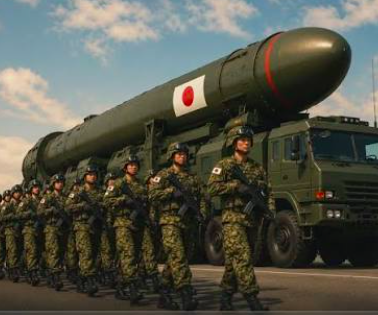
For nearly eight decades, Japan’s geopolitical identity was anchored by a singular, legally binding philosophy: absolute pacifism. Enshrined in Article 9 of its 1947 constitution, the nation famously renounced war as a sovereign right and pledged never to maintain land, sea, or air forces for offensive purposes. For generations, the Japan Self-Defense Forces worked under strict constitutional constraints, maintaining a defense budget informally capped at one percent of gross domestic product and focusing strictly on the immediate protection of the home islands. This defensive posture, known as exclusively defense-oriented policy, relied heavily on the security umbrella provided by the United States of America under the bilateral security treaty. Under this arrangement, Japan acted as the shield while the United States provided the spear. This system provided unprecedented stability during the Cold War and the immediate post-Cold War eras, allowing Japan to focus its resources on national economic reconstruction and technological development.
However, the security landscape of East Asia has fundamentally shifted over the past decade. Confronted by what Tokyo officially describes as the most severe and complex security environment since World War II, Japan has embarked on its most radical military transformation in the postwar era. This historic pivot is marked by a massive surge in national defense spending, the acquisition of long-range counterstrike capabilities, and a major reinterpretation of its traditional defensive doctrine. Japan is rapidly transforming from a highly restrained island nation into a proactive, heavily armed pillar of Indo-Pacific security. The shift is driven by a realistic assessment of regional threats, including the rapid military expansion of the People’s Republic of China, the unpredictable nuclear provocations from North Korea, and a newly hostile relationship with the Russian Federation following global geopolitical shifts.
The Shifting Regional Matrix: The China Challenge
Tokyo’s increased military buildup is largely due to the fast expansion and aggressive behavior of the People’s Republic of China. Japan had long viewed China primarily as an economic partner, developing extensive interdependencies through trade, investment, and manufacturing networks. However, the large investment by Beijing to modernize its military and its willingness to use its military for hard-power purposes have caused Japan to re-evaluate its entire approach toward China. Japan’s strategic documents now clearly identify the military activities of the People’s Republic of China as the most significant strategic threat to regional peace and stability. The rapid modernization of the People’s Liberation Army, including its naval expansion, advanced ballistic missile capabilities, and sophisticated cyber warfare divisions, has altered the balance of power in the Western Pacific.
This issue is not likely to remain theoretical, because every day Japanese territory is under dispute with the People’s Republic of China in the waters and airspace around Japan. The two nations are involved in a continuous territorial dispute over the Senkaku Islands, which are referred to as the Diaoyu Islands by China, located in the East China Sea. Ships of the Chinese Coast Guard and Navy are continuously violating Japan’s territorial waters to assert China’s claims to the Senkaku Islands. These incursions have become highly systematized, with Chinese vessels staying for extended periods within the contiguous zone and territorial seas, actively challenging the administrative control that Japan has maintained for decades. In response, the Japan Coast Guard and the Maritime Self-Defense Force have been forced to deploy substantial assets continuously, straining operational readiness and creating dangerous friction points that could trigger an accidental military escalation.
In addition to these localized confrontations, Japanese strategists are deeply concerned about the risk of conflict in relation to Taiwan. Taiwan lies not more than 100 kilometers away from Japan’s furthest inhabited island of Yonaguni and has a key geostrategic link to Japan’s existence. Japan understands that an armed conflict in Taiwan would inevitably involve the United States, a long-term ally of Japan, and an entity directly endangering Japan’s territory. The maritime supply lines passing through the Taiwan Strait and the Bashi Channel are the economic lifeblood of Japan, carrying most of its energy imports and trade goods. A blockade or invasion of Taiwan would effectively allow the military forces of the People’s Republic of China to project power directly into Japan’s southern flank, jeopardizing the security of the entire southwestern island chain.
Chinese military operations, including carrier operations and large-scale missile firing exercises that landed within Japan’s Exclusive Economic Zone on August 4, 2022, have resulted in forming a common opinion among Japanese leaders that Taiwan’s defense is closely related to the defense of Japan. During those exercises, five ballistic missiles fired by the People’s Liberation Army landed inside Japan’s designated waters, demonstratingclearly that any cross-strait conflict would immediately spill over into Japanese sovereign territory. This realization has galvanized public opinion and unified political factions in Tokyo around the necessity of preparing the nation for a high-intensity regional conflict.
The Proximate Threats: North Korea and Russia
While China is a long-term structural problem, North Korea is a short-term and highly unpredictable military menace. Pyongyang has sped up the pace of ballistic missile tests and fired missiles that either fly directly over the Japanese archipelago or fall into the Sea of Japan. These are no longer just simple tests, as North Korea has developed advanced solid-fuel missiles, hypersonic glide vehicles, and underwater missiles made for circumventing regional defenses against missiles. The transition to solid-fuel technology means that missiles can be fueled in secret and launched with minimal warning, severely reducing the reaction time for defensive systems.
Furthermore, North Korea’s advanced nuclear program made Japan acknowledge that it has an aggressive neighbor that can strike Japanese cities with nuclear weapons in a matter of minutes. The changes in the quality and quantity of Pyongyang’s strike capabilities have made Japan realize the limitations of its purely defensive missile interception systems. Seeing the threat of saturation attacks, where dozens of missiles are launched simultaneously to overwhelm defense networks, Japan recognized that it could not rely solely on anti-missile defense. The existing two-tier defense system, consisting of Aegis-equipped destroyers with Standard Missile-3 interceptors and land-based Patriot Advanced Capability-3 batteries, requires expansion to address these advanced threats.
Among the factors contributing to this complex threat matrix is a newly unfriendly Russia. Up until recently, Japan maintained a prudent diplomatic engagement with Moscow, hoping to solve a historic territorial issue regarding the Northern Territories, known as the Kurile Islands in Russia. Russia’s invasion of Ukraine on February 24, 2022, however, ruined these diplomatic efforts. Japan coordinated its moves with the Group of Seven in this context, imposing strict sanctions against Russia. In response, Russia labeled Japan as an unfriendly state, suspended peace treaty negotiations, and increased the frequency of its military exercises together with China in the Sea of Japan and the Sea of Okhotsk. The strategic alignment between Moscow and Beijing has resulted in joint naval circumnavigations of the Japanese main islands and combined long-range bomber patrols, forcing Japan to defend multiple strategic vectors simultaneously.
Redefining Strategy: Counterstrike and Constitutional Evolution
To address these complex threats, Japan has started to loosen its old military inhibitions. This fundamental change began on December 16, 2022, when Japan amended its National Security Strategy, the National Defense Strategy, and the Defense Buildup Program. Under these revised frameworks, Japan set a transformative target to increase its national defense spending to two percent of its gross domestic product by the year 2027. This budget trajectory represents a massive financial shift, moving the defense allocation from approximately US$ 40 billion annually to over US$ 80 billion per year, making Japan’s defense budget the third largest in the world. The enormous influx of funds has crushed the long-lasting one percent barrier, demonstrating a clear departure from postwar fiscal policy.
What distinguishes this military buildup is Japan’s acquisition of the so-called combat power of counterstrikes, also known as standoff defense capabilities. For the first time since World War II, Japan deliberately acquiresand develops weapons that can reach targets in deep enemy territory to deter incoming attacks. To quickly find a solution to this lack of combat power, Japan signed a major procurement contract with the United States on January 18, 2024, to purchase up to 400 Tomahawk land-attack cruise missiles with a value of approximately US$ 1.7 billion. These long-range cruise missiles will be deployed on Maritime Self-Defense Force Aegis destroyers, providing an immediate operational deterrent.
Simultaneously, Japan is accelerating the development and deployment of its own domestic weapon systems. This includes the upgraded Type-12 surface-to-ship missile, which is being modified to extend its striking distance from 200 kilometers to over 1,000 kilometers, allowing it to be launched from land, naval vessels, and aircraft. Japanese authorities firmly assert that such long-range systems do not go against the constitution, describing them as vital elements of passive deterrence. The reasoning behind this assertion is simple, as by providing proof of its capacity to target enemy military infrastructure instead of waiting to intercept missiles, Japan effectively increases the cost of an assault and makes the enemy think twice before attacking.
Innovation in the Face of Demographics: Drones and Artificial Intelligence
In its quest to strengthen its military force, Japan is hindered by a significant problem: its population is aging fast and shrinking. The Japan Self-Defense Forces have continually fallen short of recruitment plans, unable to find enough enlistees due to intense competition in the domestic job market and a shrinking youth demographic. This demographic situation has led to a change in Japan’s military modernization, which relies more on technology as a substitute for human personnel. Automation, remote operations, and artificial intelligence have moved from experimental concepts to central pillars of procurement policy.
Tokyo is acting by investing heavily in unmanned and autonomous systems across all operational domains. As part of its revised littoral defense strategy, Japan organizes the use of many unmanned aerial, surface, and underwater drones to perform continuous surveillance and maritime activities. These systems operate as force multipliers, monitoring the large and vulnerable southwestern island chain without sending thousands of personnel into dangerous operational areas. The incorporation of large, unmanned surface vessels and long-endurance aerial drones allows the military to maintain situational awareness at a fraction of human cost.
Japan is making significant investments in its space intelligence capabilities as well as artificial intelligence technology at the same time. The Ministry of Defense is developing a satellite constellation network to achieve real-time situational awareness and effective targeting data for its new long-range standoff missiles. In addition, Japan has joined the Global Combat Air Programme in cooperation with Italy and the United Kingdom, formalized through an international treaty signed on December 14, 2023. This joint venture aims to develop a next-generation stealth fighter jet by the year 2035. The project provides the use of advanced aircraft alongside intelligent autonomously operated drones, integrating sophisticated software and artificial intelligence in the international defense network to maximize combat efficiency.
Recalibrating the Alliance and Expanding Partnerships
In the past, Japan and the United States had an imbalanced relation: the United States oversaw offensive actions and nuclear deterrence while Japan focused primarily on its defensive tasks. However, the transformation of Japan into a modern military actor has started changing this asymmetry. Now Japan is increasingly improving its intelligence capabilities, cyber defense infrastructure, and logistics operations to become an active participant in the provision of regional security. Washington actively encourages this evolution, believing that a stronger Japan will become a key player in maintaining stability in the Indo-Pacific region. The alliance undergoes important structural changes, including improvements in their mutual command and control systems to maintain seamless coordination during a multi-domain military conflict.
Despite the overwhelming importance of the United States partnership, Japan is working on establishing new strategic alliances in view of potential political changes across the globe. Japan has created an intricate network of small-scale security cooperation across the Indo-Pacific region. It reached a Reciprocal Access Agreement with Australia, which entered into force on August 13, 2023, and signed a similar agreement with the United Kingdom on January 11, 2023. These legal frameworks allow Japan to engage in fluid, large-scale military training and joint operations with key security partners.
Significant strides have also been made towards improving defense cooperation with South Korea, putting aside historical grievances to address immediate common challenges. This reconciliation saw the formation of a trilateral hub for defense with the United States to properly address threats posed by North Korea, including the real-time sharing of missile warning data established on December 19, 2023. Apart from that, Japan has actively been providing defense equipment, patrol vessels, and coastal radar systems to countries in Southeast Asia, particularly the Philippines and Vietnam, under its new Official Security Assistance program launched in April 2023 to bolster the maritime security capabilities of partner nations.
Conclusion: A New Era of Proactive Deterrence
The swift military rise of Japan symbolizes the beginning of the end of the postwar years in which the country refrained from engaging in military matters. It has become obvious to Japan that the international rule-based order cannot be secured only through economic diplomacy or verbal warnings. The presence of assertive neighbors, evolving global alliances, and the emergence of gray-zone tactics has left Japan no other option but to adapt its national strategy. This shift reflects a transition toward a realistic approach to statecraft, where military readiness is viewed as an essential prerequisite for sustainable peace.
Despite these extensive changes, Japan has not lost its fundamental commitment to its image as a peace-loving nation or its rejection of aggressive militarism. Instead, the current transformation marks a thoughtful transition towards the doctrine of proactive involvement in the creation of peace employing robust deterrence. Japan does so by strengthening its southwestern islands, developing long-range strike capabilities, adopting autonomous technologies, and deepening the interconnectedness of its military systems with other allies in the region. By doing so, Japan aims to ensure its survival while contributing to a stable and balance-of-power framework in the Indo-Pacific.



