
By : Andey Vivaan, Research Analyst, GSDN
Introduction
When India, the United States, the European Union and key Gulf countries announced the India–Middle East–Europe Economic Corridor (IMEC) during the G20 Summit in New Delhi on September 09, 2023, it immediately attracted global attention. Many observers viewed it as more than another infrastructure project; it represented an attempt to reshape trade routes linking Asia, the Middle East and Europe. Bringing together India, the United States, the European Union, Saudi Arabia, the United Arab Emirates, France, Germany and Italy the project seeks to establish a multimodal corridor connecting South Asia, West Asia and Europe through ports, railways, energy infrastructure and digital connectivity. At the time of its launch, many analysts argued that IMEC had the potential to reshape global trade and reduce dependence on traditional maritime routes. Whether it can achieve these ambitions, however, remains uncertain.
The timing of the initiative was significant. The COVID-19 pandemic had exposed the fragility of global supply chains, while disruptions such as the March 2021 blockage of the Suez Canal and later security challenges in the Red Sea demonstrated how vulnerable international commerce had become. Governments and businesses increasingly recognized the need for diversified trade corridors capable of reducing logistical risks and ensuring uninterrupted movement of goods. Against this backdrop, IMEC emerged not merely as another infrastructure project but as a strategic effort to build resilient supply chains linking three economically dynamic regions.
From India’s perspective, IMEC represents an opportunity to strengthen its position within global value chains while expanding connectivity with Europe through the Gulf. For the Gulf countries, particularly Saudi Arabia and the United Arab Emirates, the corridor complements their broader economic diversification strategies aimed at reducing dependence on hydrocarbons and transforming themselves into global logistics and technology hubs. European countries view IMEC as a means of strengthening supply chain resilience while deepening economic engagement with both India and the Gulf.
Nearly three years later, however, important questions remain regarding its implementation. Regional conflicts, political uncertainty in West Asia, financing challenges, infrastructure gaps, and shifting geopolitical priorities have slowed the project’s momentum. The conflict in Gaza, instability in the Red Sea, and wider geopolitical tensions have complicated the environment in which the corridor must operate. These developments have prompted policymakers and analysts to ask an important question: Will IMEC ever fructify, or will it remain an ambitious geopolitical vision that struggles to become reality?
This article examines the origins of IMEC, its strategic and economic importance, the opportunities it presents, the challenges it faces, and whether it possesses the political and economic foundations necessary to become one of the defining connectivity projects of the twenty-first century.
Understanding IMEC
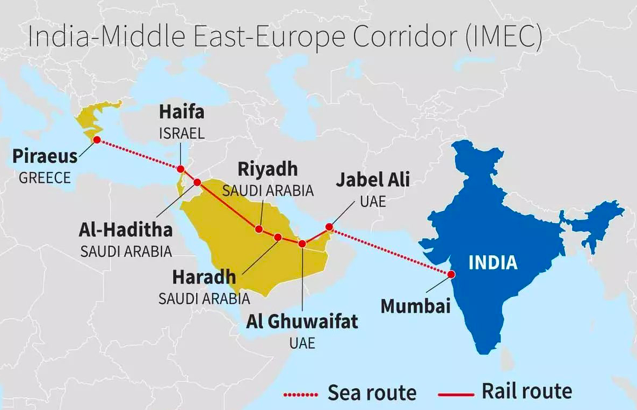
IMEC aims to connect India with Europe through the Middle East using a combination of sea routes, railways and modern logistics infrastructure. Officially announced during the G20 Summit on September 09, 2023, the project aims to connect India with Europe through the Middle East using a combination of sea and land routes.
The corridor consists of two interconnected segments. The Eastern Corridor Links Indian ports with the United Arab Emirates through maritime transport across the Arabian Sea. The Northern Corridor extends from the Gulf through Saudi Arabia and Jordan to Israel’s Mediterranean port of Haifa, from where goods would continue to European destinations.
Unlike traditional shipping routes that rely almost entirely on maritime transportation, IMEC combines ports, railways and logistics hubs into a multimodal network. This design is intended to reduce transit times, improve efficiency, and create more resilient supply chains capable of responding to disruptions.
More importantly, IMEC is not limited to transportation alone. It also includes several complementary components. These include electricity transmission networks, green hydrogen pipelines, digital connectivity through submarine communication cables, and modern logistics infrastructure. Such integration reflects a broader vision that extends beyond moving cargo and seeks to create an interconnected economic ecosystem across three continents.
The participating countries signed a Memorandum of Understanding (MoU) to promote cooperation in planning, financing, and implementing the corridor. Although construction responsibilities remain distributed among individual countries, its success will depend on how effectively governments, private investors, and international financial institutions work together.
Why IMEC Matters
At first glance, IMEC may appear to be another transport corridor, but its significance goes much further than reducing shipping time. It represents a strategic response to changing patterns in global trade, growing geopolitical uncertainty, and increasing concerns regarding supply chain security.
One of the strongest arguments in favor of IMEC is the growing need to diversify global trade routes. Recent years have repeatedly demonstrated the vulnerability of existing maritime corridors. The blockage of the Suez Canal in March 2021 disrupted approximately 12 percent of global trade, while attacks on commercial shipping in the Red Sea during 2023 and 2024 forced vessels to take much longer routes around the Cape of Good Hope. These disruptions increased transportation costs, delayed deliveries, and highlighted the risks of relying excessively on a limited number of maritime chokepoints.
For India, the corridor offers an opportunity to strengthen connectivity with Europe, reduce logistical dependence on vulnerable maritime routes and support its long-term manufacturing ambitions.
For Europe, the corridor supports efforts to diversify supply chains at a time when geopolitical tensions increasingly influence international commerce. Strengthening economic links with India and the Gulf also aligns with Europe’s broader objective of reducing overdependence on single production centers.
The Gulf countries also stand to benefit significantly. Saudi Arabia and the United Arab Emirates have invested heavily in transforming themselves into global logistics, manufacturing and technology centers. IMEC complements national programmes such as Saudi Vision 2030 and the United Arab Emirates’ Operation 300bn, both of which seek to diversify economic activity beyond oil exports.
Rather than serving merely as transit countries, Gulf states aim to create industrial ecosystems around logistics hubs, manufacturing clusters, renewable energy projects and digital infrastructure. IMEC therefore supports their transition from hydrocarbon-dependent economies towards diversified economic models.
IMEC and China’s Belt and Road Initiative
Since its announcement, IMEC has frequently been compared with China’s Belt and Road Initiative (BRI). Although many observers initially described IMEC as a direct response to the BRI, such comparisons oversimplify the nature of both initiatives.
China launched the Belt and Road Initiative in 2013 with the objective of improving connectivity across Asia, Europe and Africa through large-scale infrastructure investment. Over the past decade, China has invested more than US$1.3 trillion across numerous transport, energy and infrastructure projects.
IMEC differs significantly in both structure and philosophy. While the Belt and Road Initiative has primarily relied upon bilateral financing led by Chinese state institutions, IMEC is designed as a multilateral partnership involving democratic economies, regional powers and international institutions.
The emphasis also differs. Rather than focusing solely on infrastructure construction, IMEC seeks to integrate sustainable development, transparent financing, digital connectivity, and clean energy cooperation into its overall framework. Supporters argue that these principles may make the corridor more financially sustainable and politically acceptable over the long term.
At the same time, many participating countries reject the idea that IMEC should be viewed purely as an anti-China initiative. Instead, they present it as an additional connectivity option that complements rather than replaces existing trade routes.
Yet, geopolitical competition cannot be ignored. As connectivity increasingly becomes a tool of international influence, both IMEC and the Belt and Road Initiative reflect broader efforts by major powers to shape the future architecture of global commerce.
Economic Opportunities Offered by IMEC
If implemented as planned, IMEC has the potential to reshape trade flows across Asia, the Middle East, and Europe. According to several feasibility assessments, the corridor could reduce cargo transit time between India and Europe by as much as 40 percent, while significantly lowering logistics costs. Faster transportation would improve supply chain efficiency, reduce inventory costs, and enhance the competitiveness of exporters across participating countries.
For India, the corridor supports the government’s ambition of becoming a major global manufacturing hub. As global companies diversify production away from concentrated supply chains, efficient connectivity with Europe and West Asia could make Indian manufacturing more attractive for foreign investment. The corridor also complements initiatives such as Make in India and the National Logistics Policy, both of which seek to improve India’s export competitiveness.
The Gulf countries also expect substantial economic gains. Saudi Arabia and the United Arab Emirates no longer view themselves solely as oil exporters. Through programmes such as Saudi Vision 2030 and the United Arab Emirates’ Operation 300bn, both countries aim to develop advanced manufacturing, logistics, renewable energy and digital industries. IMEC supports these ambitions by positioning the Gulf as a global logistics hub connecting three continents.
Europe could also benefit from greater supply chain resilience. The European Union has increasingly recognised the importance of reducing excessive dependence on limited transport corridors and single production centres. By improving connectivity with India, Europe gains access to one of the world’s fastest-growing major economies while strengthening trade links with the Gulf region.
Beyond trade, IMEC also includes digital infrastructure, electricity transmission, and green hydrogen pipelines. These additional components transform the corridor from a transport project into a broader economic partnership capable of supporting future technological and energy cooperation.
Challenges That Could Delay IMEC
Despite its enormous potential, IMEC faces multiple obstacles that raise questions regarding its long-term feasibility.
Perhaps the greatest challenge facing IMEC today is the political instability across West Asia. Much of the corridor passes through one of the world’s most politically sensitive regions. The conflict in Gaza significantly slowed discussions surrounding IMEC, while continuing tensions involving Israel have complicated planning for the Northern Corridor.
Security concerns in the Red Sea have further highlighted the vulnerability of trade routes passing through West Asia. Attacks on commercial shipping increased transportation costs and demonstrated that geopolitical tensions can directly affect international commerce.
Another major concern involves infrastructure gaps. Although several participating countries already possess advanced ports, some important railway links remain incomplete. The proposed overland network connecting the Gulf to the Mediterranean still requires substantial investment before cargo can move seamlessly across the corridor.
Port capacity also presents challenges. While facilities such as Jebel Ali can handle extremely large cargo volumes, Mediterranean infrastructure particularly around Haifa requires further expansion if IMEC is to operate at scale.
Political coordination represents another obstacle. Unlike purely national infrastructure projects, IMEC requires sustained cooperation among numerous governments with differing political priorities, economic interests,and security concerns. Any deterioration in bilateral relations could slow down implementation.
Financing and Institutional Challenges
Large-scale infrastructure projects require not only political commitment but also long-term financial support. Financing remains one of IMEC’s biggest challenges.
Unlike China’s Belt and Road Initiative, which has largely relied upon financing from Chinese state-owned banks, IMEC seeks to attract investment from governments, sovereign wealth funds, multilateral institutions and private investors. While this diversified model may improve transparency and reduce debt concerns, it also makes decision-making more complex.
Private investors are unlikely to commit billions of dollars unless the region remains politically stable. Ongoing conflicts in West Asia increase investment risks and may discourage private participation, particularly for projects located near politically sensitive areas.
Several analysts have argued that IMEC’s success will depend upon innovative financing mechanisms combining public and private investment. Sovereign wealth funds such as Saudi Arabia’s Public Investment Fund (PIF), Mubadala Investment Company, and Abu Dhabi Developmental Holding Company (ADQ) could play an important role in supporting corridor development alongside international financial institutions.
Strong governance mechanisms will also be essential. Standardized customs procedures, digital documentation systems, and regulatory coordination across participating countries will determine whether the corridor operates efficiently once completed.
India’s Strategic Role
India occupies a central position within IMEC. As the eastern gateway of the corridor, India’s ports, manufacturing sector and logistics infrastructure will determine much of the project’s commercial success.
Since the corridor announcement, New Delhi has actively pursued diplomatic engagement with both Gulf and European partners. India signed an Intergovernmental Framework Agreement with the United Arab Emirates in February 2024, establishing mechanisms for customs cooperation, digital documentation and logistics coordination.
India has also strengthened cooperation with European partners. Discussions with France, Italy, Greece and Cyprus have focused on improving maritime connectivity and integrating European ports into the future corridor. These diplomatic efforts demonstrate that IMEC is viewed not merely as an infrastructure initiative but as a long-term geopolitical partnership.
Even so, India continues to emphasize that IMEC should not be interpreted as a confrontational project directed against any country. Instead, Indian policymakers present the corridor as an initiative designed to strengthen global connectivity while promoting resilient and diversified supply chains.
For India, IMEC is not only an economic project but also an opportunity to strengthen its strategic influence across West Asia and Europe. This suggests that the corridor has become an important part of India’s broader foreign policy and regional engagement.
Will IMEC Ever Fructify?
Whether IMEC succeeds will ultimately depend on political commitment, financing and regional stability rather than announcements alone. The economic rationale behind IMEC remains compelling. Global supply chains require diversification; businesses seek more reliable logistics networks, and participating countries share strong commercial incentives. These structural factors continue to support the corridor despite recent setbacks.
However, economic logic alone cannot guarantee success. Regional conflicts, changing political priorities and financing constraints have already demonstrated how vulnerable large connectivity projects can become. IMEC will require continuous diplomatic engagement, coordinated infrastructure development, and long-term financial commitment from all participating countries.
One encouraging development is the growing leadership shown by the Gulf countries. Sustained political stability will matter just as much as infrastructure investment if the corridor is to move beyond planning
Saudi Arabia and the United Arab Emirates have continued investing in logistics infrastructure, industrial development and digital connectivity even as broader geopolitical tensions persist. Their economic transformation strategies align naturally with IMEC’s objectives and could help sustain momentum during periods of political uncertainty.
Rather than expecting immediate completion, IMEC is likely to develop gradually through phased implementation. Initial progress may occur along politically stable segments before more complex components become operational. Such an incremental approach may prove more realistic than attempting simultaneous implementation across the entire corridor.
In many ways, IMEC’s future will depend upon whether participating countries continue viewing connectivity as a shared economic opportunity rather than a geopolitical competition.
Conclusion
The India–Middle East–Europe Economic Corridor (IMEC) has emerged as one of the most ambitious connectivity projects in recent years. By combining maritime transport, railways, digital infrastructure and energy networks, IMEC has the potential to reshape trade between Asia, the Middle East and Europe while improving supply chain resilience.
Its importance extends beyond economics. IMEC reflects changing geopolitical realities in which connectivity has become an instrument of strategic influence, economic security, and international cooperation. For India, the corridor strengthens its position within global value chains. For the Gulf countries, it supports long-term economic diversification. For Europe, it provides greater resilience against future supply chain disruptions.
Despite its potential, several challenges remain. Political instability, regional conflicts, infrastructure deficiencies, financing requirements, and regulatory coordination continue to slow implementation. The project’s success will ultimately depend upon sustained political commitment rather than initial enthusiasm.
In my view, IMEC is unlikely to become fully operational in the immediate future but describing it as a failed initiative would also be premature. Large international infrastructure projects typically evolve over many years, adapting to changing political and economic circumstances. Although progress has been slower than many had expected, the diplomatic engagement and infrastructure planning seen so far indicate that participating countries still view IMEC as a long-term strategic project.
In my opinion, IMEC’s future will depend less on ambitious announcements and more on whether participating countries can maintain political cooperation and deliver on their infrastructure commitments over the coming years.



