
By : Bhavika Bhartiya, Research Analyst, GSDN
Introduction
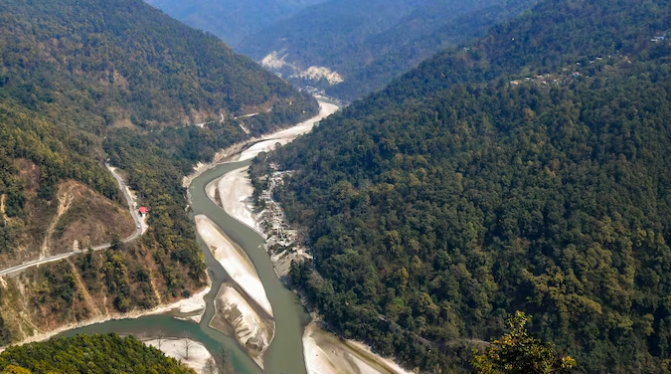
The Teesta, a transboundary river that originates in the Indian state of Sikkim and flows through the northern districts of West Bengal before entering Bangladesh, has for decades been at the centre of one of South Asia’s most stubborn water disputes. Bangladesh depends on the river’s flow during the dry season to irrigate roughly 55,000 hectares of farmland spread across six districts, while northern West Bengal similarly depends on it for irrigation and drinking water. Successive Indian and Bangladeshi governments have tried and failed to conclude a formal water-sharing arrangement, most notably a draft agreement that was due to be signed during then Indian Prime Minister Manmohan Singh’s visit to Dhaka in September 2011, but which collapsed at the last moment.
Into that vacuum has stepped the People’s Republic of China, whose state-owned engineering conglomerate, the Power Construction Corporation of China, commonly known as Power China, first proposed an alternative, comprehensive river management plan for the Teesta in 2016. That Chinese proposal has resurfaced repeatedly over the following decade, gaining considerable momentum since the fall of the Sheikh Hasina government on August 5, 2024, and advancing further still after Bangladesh Prime Minister Tarique Rahman’s visit to Beijing in June 2026. This article traces how the China-Bangladesh understanding on the Teesta has evolved, assesses precisely what has and has not been agreed so far, and examines why the project, despite still being at a preparatory stage, has become a matter of considerable strategic concern for India.
The Unresolved Bilateral Question
The Teesta dispute has a long and largely unsuccessful negotiating history. An interim, ad hoc arrangement reached in 1983 allocated 36 per cent of the river’s dry-season flow to Bangladesh and 39 per cent to India, leaving the remaining 25 per cent undetermined; this arrangement was never formally ratified nor consistently implemented. A more ambitious agreement, offering Bangladesh 37.5 per cent of the river’s flow against India’s 42.5 per cent, was negotiated during Manmohan Singh’s tenure and scheduled to be signed on September 6, 2011. It was called off at the last moment after West Bengal Chief Minister Mamata Banerjee objected, arguing that reduced flow would damage agriculture and drinking-water availability in north Bengal districts such as Jalpaiguri and Cooch Behar. In the years since, New Delhi has repeatedly had to reconcile the Centre’s foreign-policy interest in a settlement with West Bengal’s domestic political and agricultural concerns, but no consensus has emerged. Bangladesh, meanwhile, has continued to experience the river’s two extremes: destructive monsoon flooding and riverbank erosion on one hand, and an almost dry riverbed for extended stretches during winter and early summer on the other. Frustrated by the prolonged impasse, Dhaka signed a non-binding memorandum of understanding, commonly abbreviated as MoU, with Power China in 2016 to jointly explore a Chinese-financed and Chinese-engineered river restoration plan, an initiative that eventually acquired the formal title of the Teesta River Comprehensive Management and Restoration Project, commonly abbreviated as TRCMRP.
A Reordering of Priorities in Dhaka
For much of the following period, the TRCMRP remained largely dormant, in part because the Sheikh Hasina government, seen as closer to India, chose in June 2024 to formally hand India’s technical team responsibility for assessing the project rather than China’s. That balance shifted dramatically after Hasina’s government fell on August 5, 2024, amid a mass uprising, and she went into exile in India. An interim administration led by Nobel laureate Muhammad Yunus took charge and moved quickly to widen Dhaka’s foreign-policy options beyond India. Yunus undertook his first major bilateral visit as chief adviser to China from March 26, 2025, to March 29, 2025, attending the Boao Forum for Asia in Hainan before holding bilateral talks with Chinese President Xi Jinping in Beijing on March 28, 2025.
The two sides signed nine agreements covering economic and technical cooperation, and, notably, Bangladesh formally welcomed Chinese company participation in the TRCMRP, alongside discussion of Chinese involvement in the modernization of Mongla Port and the Chattogram China Economic and Industrial Park. Bangladesh held its first general election since the 2024 uprising on February 12, 2026, in which the Bangladesh Nationalist Party, commonly abbreviated as BNP, led by Tarique Rahman, won a landslide majority. Rahman was sworn in as prime minister on February 17, 2026, ending an interim period of roughly eighteen months. Rather than reversing Dhaka’s China outreach, the new BNP government has continued and, in some respects, accelerated it, suggesting that Bangladesh’s tilt towards Beijing on infrastructure and water issues reflects a broader, cross-party recalibration rather than the preference of any single administration.
What Has Actually Been Agreed
Two related but distinct tracks have advanced since early 2025. On January 29, 2026, the Bangladesh Water Development Board and Power China signed an extension of their earlier memorandum of understanding, under which Power China committed to preparing a concept paper by December 2026 and conducting a feasibility study for the TRCMRP during the same year, with the project itself expected to be finalized only once that study is complete. Bangladeshi officials have indicated that the first phase of the project is estimated to cost approximately US$750 million, of which Dhaka has formally requested US$550 million as a loan from China, with the remainder to be met from the national exchequer; work is expected to begin in 2026 and conclude by 2029.
The second track advanced further during Prime Minister Tarique Rahman’s four-day visit to China, which began with stops in Malaysia before he arrived in Dalian on the night of June 22, 2026. Rahman held bilateral talks with Chinese President Xi Jinping at the Great Hall of the People in Beijing on June 26, 2026, and separately met Chinese Premier Li Qiang. The visit produced two agreements and thirteen MoUs, spanning the Teesta Master Plan, the China-Bangladesh Mongla Port Economic Zone, the Chinese Economic and Industrial Zone at Anwara in Chattogram, electric vehicles, renewable energy, and a US$220 million garment factory investment, along with reported discussion of the purchase of Chinese J-10CE multirole combat aircraft and a proposed China-Myanmar-Bangladesh economic corridor. It is worth being precise about what this amount to no financing agreement for the Teesta project has yet been finalised, no construction has begun, and China’s own foreign ministry has stated publicly that its cooperation with Bangladesh is not directed at any third country. What exists, as of mid-2026, is a feasibility and planning framework, backed by clear political intent on both sides, rather than a completed infrastructure project.
Proximity to the Siliguri Corridor
India’s concern with the TRCMRP has comparatively little to do with the water-sharing percentages that have dominated the bilateral dispute for decades, and a great deal to do with geography. The project’s proposed works are located in Bangladesh’s Nilphamari and Rangpur districts, directly across the border from India’s Jalpaiguri district and immediately adjacent to the Siliguri Corridor, a narrow strip of Indian territory, at points barely 20 to 22 kilometres wide, that forms the sole land connection between the Indian mainland and its seven northeastern states of Assam, Arunachal Pradesh, Meghalaya, Manipur, Mizoram, Nagaland and Tripura, often referred to informally as the Chicken’s Neck. A sustained Chinese engineering and technical presence so close to this corridor, even one presented purely as a civilian river-restoration exercise, revives a concern familiar from Chinese infrastructure financing elsewhere in South Asia and beyond, namely that large-scale economic engagement can, over time, translate into a durable presence of personnel, equipment and institutional relationships in strategically sensitive terrain.
Two additional factors sharpen this concern for Indian planners. First, PowerChina is a state-owned enterprise whose wider operations are commonly associated with Beijing’s military-civil fusion approach, under which nominally civilian infrastructure projects can also serve broader strategic purposes. Second, the Teesta project does not stand in isolation. It forms one point of a wider pattern of Chinese engagement in Bangladesh that also includes the expansion of Mongla Port in the Sundarbans region and the Chattogram economic zone, leading some Indian security analysts to describe an emerging pincer-like configuration around the Siliguri Corridor, comparable to China’s broader pattern of port investments across the Indian Ocean rim, including Gwadar in Pakistan and Hambantota in Sri Lanka, often described as a String of Pearls. Reports of Bangladesh’s interest in Chinese J-10CE fighter aircraft and a proposed China-Myanmar-Bangladesh economic corridor, discussed during Rahman’s June 2026 visit, add a further layer to these concerns, even though none of these initiatives has yet moved beyond preliminary discussion.
It would nonetheless be inaccurate to characterize the present situation as a fait accompli. No Chinese personnel are yet deployed on the ground in any significant capacity, the TRCMRP remains at the concept and feasibility stage, and India’s own conduct complicates a purely one-sided reading of events. New Delhi itself offered to finance the same project in June 2024 and dispatched a technical team for further studies, and it was the subsequent political transition in Dhaka, rather than any Bangladeshi rejection of India, that left the opening for Beijing.
A Calibrated Response from New Delhi
India’s public response has so far been measured. Ministry of External Affairs spokesperson Randhir Jaiswal, addressing the weekly media briefing in New Delhi on July 3, 2026, stated that India’s development assistance to Bangladesh operates on a mutually agreed roadmap that is regularly reviewed, that India’s views on the Teesta project have already been conveyed to Dhaka, and that New Delhi will factor all related developments into its overall approach to the Teesta issue. When asked separately about reports of Bangladesh’s interest in Chinese J-10CE fighter jets and the proposed China-Myanmar-Bangladesh economic corridor, Jaiswal said only that India closely follows all such developments in its neighborhood and takes appropriate measures as required. This calibrated public posture is consistent with the existing structured bilateral mechanisms through which India and Bangladesh already discuss all fifty-four rivers that the two countries share, and it reflects an evident preference in New Delhi for continued, quiet diplomatic engagement over public confrontation, even as India’s security establishment reportedly monitors the pace of any Chinese personnel deployment near the corridor with greater attention than public statements suggest.
An Unfinished Project with Long-Term Stakes
The Teesta understanding between China and Bangladesh, as it stands in mid-2026, remains a feasibility-stage engineering and diplomatic arrangement rather than a completed strategic fait accompli. Its final shape, financing and timeline are still to be determined, and both Dhaka and Beijing have stressed the project’s civilian, livelihood-oriented character. Nonetheless, its precise location beside the Siliguri Corridor ensures that it will remain a closely watched issue for India regardless of how the feasibility study eventually concludes.
The episode also illustrates a recurring pattern in India’s immediate neighborhood: wherever domestic political friction, in this case between the Centre and the West Bengal government, has delayed New Delhi’s own initiatives, China has generally proven willing and able to step into the resulting gap with financing, technical expertise and sustained diplomatic attention. For India, a durable response is unlikely to rest on carefully worded statements alone. It will depend on reconciling central and state positions on Teesta water-sharing, offering Dhaka a timely and credible financing alternative, and continuing to strengthen monitoring, connectivity and border infrastructure around the Siliguri Corridor, so that a river management project in northern Bangladesh does not, over time, become the point at which a long-standing water dispute is transformed into an enduring strategic vulnerability.



