
By: Khushbu Ahlawat, Consulting Editor, GSDN
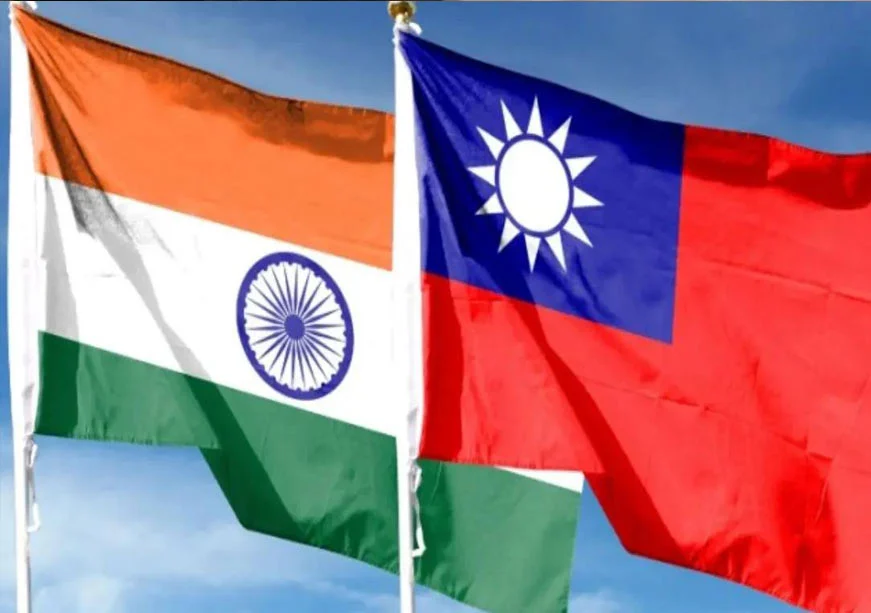
Introduction
At a Taipei trade fair in 2026, Indian firms quietly did something more consequential than close a few deals — they demonstrated that a country can build real influence without ever needing an embassy to do it. Walk the exhibition floor of COMPUTEX Taipei in any recent year and you will find the usual suspects: American chip giants, Japanese robotics firms, South Korean display manufacturers. At the 2026 edition, though, something had shifted. Indian companies — among them Sahasra and Zoho — were not peripheral visitors but active participants, pitching partnerships in artificial intelligence, semiconductors and electronics manufacturing to an audience that included more than 1,500 exhibitors and upward of 111,000 visitors from over 150 countries and regions, in a show that spanned AI computing, robotics, intelligent mobility, next-generation communications and advanced semiconductor technology. None of this happened through an Indian embassy in Taipei, because no such embassy exists, nor will one anytime soon. And that, more than the specific deals struck on the floor, is the real story.
India has no formal diplomatic relations with Taiwan. It never has, and under the One China policy New Delhi has long maintained, it is unlikely to anytime soon. Yet the two have been building something substantial anyway — in trade, in technology, in labour mobility, even in science and public health — entirely outside the traditional architecture of embassies, ambassadors and state visits. What is happening between New Delhi and Taipei is a useful case study in a broader shift taking place in how international influence actually gets built in the twenty-first century: not only through flags and formal recognition, but through the far less visible work of becoming indispensable to the systems the world runs on.
Why Technology Now Buys What Diplomacy Used To
For most of the post-war era, a country’s global standing was measured in fairly conventional terms: the size of its military, the breadth of its economy, the number of embassies carrying its flag. That calculus has not disappeared, but it has been joined, and in some domains overtaken, by a different kind of leverage — participation in the technological architectures, innovation ecosystems and supply chains that now underpin the global economy. The United States still leads in advanced technology and innovation networks broadly. China brings manufacturing scale and a fast-closing technological gap. Taiwan sits at the centre of global semiconductor production. South Korea anchors electronics and digital technology. Japan leads in advanced manufacturing and industrial innovation. Each of these positions functions, in effect, as a form of geopolitical currency, independent of how many countries formally recognise the state that holds it.
Taiwan is perhaps the starkest illustration of this dynamic anywhere in the world. Since the People’s Republic of China took over the UN seat in 1971, Taiwan has been locked out of the vast majority of formal international institutions — it cannot sit as a full member at the UN, and most countries, including India, maintain no official diplomatic ties with it. And yet Taiwan is almost impossible for the global technology economy to ignore. The island is home to the Taiwan Semiconductor Manufacturing Company, the firm that fabricates the overwhelming majority of the world’s most advanced chips, the kind that power everything from smartphones to the data centres training the latest AI models. TSMC alone accounted for roughly two-thirds of the global contract chipmaking market by revenue in recent years, and its most cutting-edge nodes are produced almost nowhere else at comparable scale. That single fact gives Taiwan a seat at the table in forums that have nothing to do with formal diplomatic recognition: it participates in APEC under the awkward but functional label “Chinese Taipei,” engages the WTO’s Information Technology Agreement, and works through industry-driven bodies like the World Semiconductor Council and the Government/Authorities Meeting on Semiconductors, which brings together the world’s leading chip-producing economies. Taiwan’s own semiconductor trade association plugs into standard-setting bodies like SEMI and JEDEC and the World Semiconductor Trade Statistics organisation, shaping the technical rules that govern global chip markets from the inside, without ever needing a UN vote to do it. Taiwan’s experience captures a genuinely broader truth in modern international politics: marginalisation in formal diplomacy does not equal strategic irrelevance, when a state holds an irreplaceable role in the technological processes everyone else depends on.
What Each Side Actually Brings to the Table
The India-Taiwan relationship works, to the extent it does, because the two sides bring strikingly complementary rather than overlapping strengths. Taiwan’s trade is heavily concentrated among a handful of major economies — in 2024, nearly a third of its merchandise trade ran through China and Hong Kong, more than 23 percent through the United States, and upward of 13 percent through Japan and South Korea combined, a pattern of deep integration that extends Taiwan’s economic weight well beyond its own geography but also leaves it structurally exposed to concentration risk and to the political volatility of its relationship with Beijing. India, by contrast, offers something Taiwan is chronically short of: market size, broad diplomatic legitimacy, and growing institutional standing across the international system’s main multilateral bodies, even if its own advanced manufacturing and technology base is still catching up.
That asymmetry, rather than being an obstacle, is exactly what makes the partnership useful to both sides. Bilateral trade crossed US$1 billion in 2024 by some counts, and other tallies put the relationship considerably higher — earlier figures show trade climbing from just over US$1 billion in 2001 to roughly US$7.7 billion by 2021 and US$8.5 billion by 2022. That trajectory has seen some recent softening, with a 2.7 percent dip in India’s FY2023-24 trade with Taiwan, but it still marks India out as one of Taiwan’s more significant partners across South and East Asia. In July 2023, the two sides concluded a Mutual Recognition Agreement covering each other’s organic agricultural products, opening a modest but symbolically useful channel for Indian agri-exports like tea and sesame seed into the Taiwanese market — an area officials on both sides see as having real room to grow.
The more consequential development, though, has been in labour mobility. After roughly two years of on-and-off negotiation that resumed in earnest after the pandemic, Taiwan and India signed a memorandum of understanding on migration and mobility on 16 February 2024, concluded not through embassies but through each side’s representative offices — the Taipei Economic and Cultural Center in India, and the India-Taipei Association in Taiwan — the de facto diplomatic channel both countries rely on in the absence of formal ties. The deal was squarely about addressing Taiwan’s demographic crunch: an ageing population and falling birth rate have left the island with persistent labour shortages across agriculture, construction, manufacturing and the care sector, and Taiwanese officials have been particularly interested in recruiting workers from India’s northeastern states, citing closer cultural and culinary affinities as easing the transition. It followed, and built on, Taipei’s 2023 decision to open a third Taiwanese representative office in India, this one in Mumbai, to handle visa services and consular-style assistance across Maharashtra, Goa, Gujarat and Madhya Pradesh — an expansion of functional diplomatic infrastructure that China’s foreign ministry has criticised, with Beijing arguing that any country maintaining formal ties with the mainland while hosting a Taiwanese representative office undermines the One China principle, a charge India has effectively brushed aside while continuing not to alter its formal diplomatic posture toward Taipei in any way.
Building Multilateral Influence Without a Multilateral Seat
The deeper argument emerging from this relationship is that India and Taiwan do not need to resolve the recognition question to build something that functions like multilateral engagement. Three areas illustrate where that functional cooperation can go further.The first is international standard-setting, an unglamorous but genuinely consequential layer of global governance that determines how technologies actually get built and traded across borders — the technical specifications, interoperability requirements and industry norms that quietly shape entire markets long before any treaty or diplomatic summit gets involved. India and Taiwan could work together here precisely because standard-setting bodies routinely operate on technical merit and industry participation rather than sovereign recognition, giving Taiwan a route to influence it cannot access through conventional diplomacy and giving India a chance to shape rules in a sector where its own capacity is still developing.
The second is supply chain resilience, a priority that has moved from a niche policy concern to a central preoccupation of governments worldwide since the COVID-19 pandemic exposed just how fragile and concentrated global production networks for critical goods, semiconductors chief among them, had become. Taiwan’s dominance in advanced chip manufacturing is both an asset and a vulnerability — a vulnerability sharpened by the geopolitical risk inherent in cross-strait tensions — and India’s push to build its own semiconductor and electronics manufacturing base, through incentive schemes aimed at attracting fabrication and packaging investment, gives the two countries an obvious area of mutual interest in diversifying where and how critical technology components get made.
The third is sector-specific coalitions — informal groupings built around a shared technical or industrial interest that, over time, can acquire real institutional weight even without ever being chartered as a formal treaty body. Cooperation on semiconductor resilience, trusted technology ecosystems, critical infrastructure protection and digital security all offer India and Taiwan ways to shape governance outcomes together, incrementally, without India needing to extend anything resembling diplomatic recognition to do it.
Conclusion
The India-Taiwan relationship will likely never look like a conventional bilateral partnership, and that is, in a sense, the point. Neither Mumbai’s new Taiwanese representative office, nor the labour mobility pact negotiated through back-channel diplomatic proxies, nor a cluster of Indian tech firms working a trade-show floor in Taipei amounts to the kind of relationship that shows up on a traditional map of alliances. But each of these, taken together, demonstrates something genuinely significant about how influence is accumulating in a world where technological capability increasingly rivals, and sometimes outweighs, formal political status. Taiwan’s own experience — locked out of the UN for over half a century yet indispensable to the chips inside nearly every modern device on earth — is the clearest possible proof that systemic relevance and diplomatic recognition have become two separate currencies, convertible into each other only partially and under very specific conditions. For India, deepening ties with Taiwan offers a low-cost, low-friction way to gain a foothold in critical technology ecosystems without disturbing its broader China policy. For Taiwan, India offers scale, legitimacy and a market large enough to matter, at a moment when diversifying away from overconcentration in a handful of partners has become a genuine strategic necessity. What the relationship ultimately illustrates is a template other states without full diplomatic access to key partners might study closely: in a world increasingly organised around technological indispensability, functional multilateralism — built quietly, sector by sector, through labour pacts, trade fairs and standard-setting tables rather than embassies — may turn out to be one of the more durable forms of influence available to states operating outside the conventional diplomatic order.



