
By: Lt Col JS Sodhi (Retd), Editor, GSDN
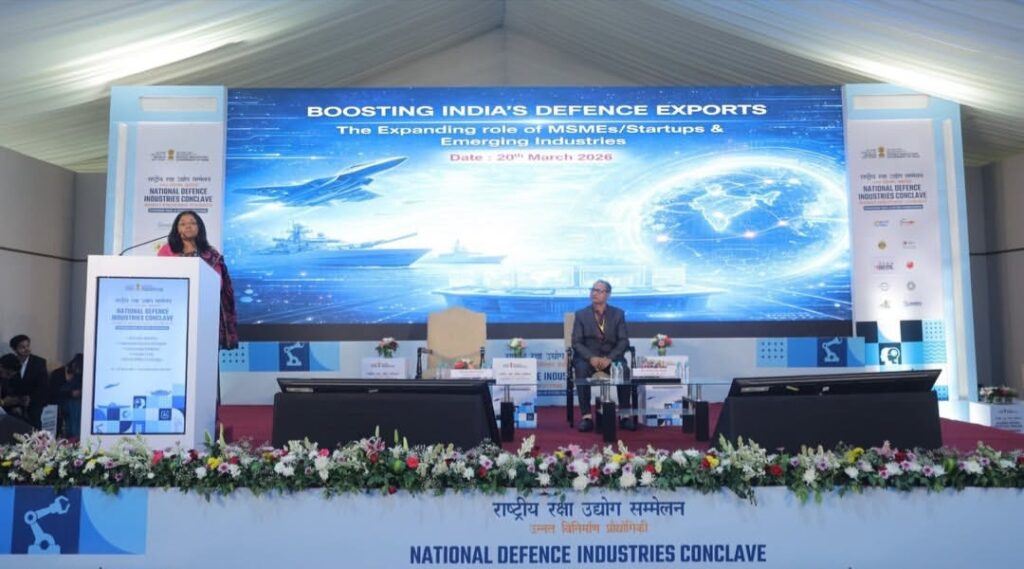
The Department of Defence Production (DDP), Ministry of Defence, Government of India, organized a two-day National Defence Industries Conclave with the theme Advanced Manufacturing Technologies on March 19-20. 2026 at Manekshaw Centre, New Delhi. The conclave aimed to integrate Micro, Small and Medium Enterprises (MSMEs) into the defence manufacturing ecosystem and to enhance awareness regarding the role of advanced technologies in the sector, in line with the Government’s vision of Atmanirbharata in defence production.
The conclave was conceived as a focused platform to bring together MSMEs, startups, Defence Public Sector Undertakings (DPSUs), services, private industry, academia, and R&D institutions. It aimed to facilitate interaction among stakeholders, create awareness about opportunities in defence manufacturing, and familiarize participants with emerging technological requirements and capabilities.
The event witnessed wide participation from MSMEs across the country, along with representatives from DPSUs, services, private industries, Original Equipment Manufacturers (OEMs), academia, and R&D institutes. The strong participation reflected the growing interest of industry in defence manufacturing and advanced technology domains.
The conclave comprised thematic and interactive sessions on various defence domains, advanced manufacturing technologies, and on DDP initiatives, along with an exhibition. The thematic sessions covered major domains of defence manufacturing including aviation, naval systems, arms and ammunition, materials and metallurgy, electronic warfare, and Maintenance, Repair and Overhaul (MRO). The advanced technology sessions highlighted emerging technologies such as Artificial Intelligence, additive manufacturing, quantum technologies, digital twin & simulation, Industry 4.0 and semiconductors, showing their relevance for defence applications. Sessions on DDP initiatives explained indigenisation, export promotion, ease of licensing, iDEX schemes, and procurement processes. These sessions were led by Indian and international academicians and industry experts, providing useful insights into opportunities, challenges, and future directions in defence manufacturing.
An exhibition was organized alongside the sessions to provide practical exposure to participants. Stalls were set up by all 16 DPSUs such as HAL, BEL, MDL, MIL, and AVNL, along with private Indian companies including Tata, L&T, BrahMos, Bharat Forge, Kirloskar group, Indo-MIM, Jyoti CNC and LMW Ltd, and prominent foreign companies such as Dassault systems of France, Carl Zeiss AG of Germany, Renishaw plc of UK, and Thermwood corporation of USA. The exhibition showcased a wide range of products, technologies, and capabilities, and enabled MSMEs and other participants to understand industry requirements and explore potential collaborations through direct interaction.
The conclave also saw active participation from academia and students, who gained exposure to developments in defence manufacturing and emerging technology areas. This engagement is expected to support innovation, research, and skill development in the sector.
The conclave provided MSMEs with opportunities to learn about emerging technologies, various areas of defence manufacturing, and key government initiatives. By attending the sessions and interacting with DPSUs, and large private companies, MSMEs could understand industry standards, technology requirements, and potential market opportunities. This engagement helps MSMEs enhance their capabilities, adopt modern manufacturing practices, improve competitiveness to participate effectively in the defence supply chain.
Large companies benefitted from direct engagement with MSMEs, which can strengthen their supply chains and support indigenisation efforts. The sessions offered insights into emerging technologies, innovation, and collaboration opportunities with startups, R&D institutions, and academic partners. Such interactions help these companies improve production efficiency, integrate new technologies, reduce import dependence, and enhance competitiveness in the defence sector.
The armed forces stand to gain from the improved capabilities of domestic industry. Greater participation of MSMEs and private companies, along with adoption of advanced technologies, ensures availability of high-quality, modern, and reliable defence equipment. This supports operational readiness, modernization of forces, and timely access to state-of-the-art defence solutions.
The conclave contributed in building a cohesive defence manufacturing ecosystem by connecting MSMEs, DPSUs, services, private industry, startups, academia, and R&D institutions. It encouraged knowledge sharing, adoption of modern technologies, and promotion of indigenisation. By strengthening partnerships and collaboration, the conclave helps create a self-reliant, competitive, and globally aligned defence manufacturing sector capable of meeting both domestic requirements and international demand.
The event received an encouraging response from all stakeholders, including MSMEs, startups, industry representatives, and academic institutions. It facilitated meaningful interactions, enhanced awareness about opportunities in the sector, and encouraged greater participation of MSMEs in defence manufacturing.
The conclave forms part of the Department’s ongoing efforts to strengthen outreach to MSMEs across the country, including through organization of MSME conclaves in different regions. These efforts are aimed at increasing participation of MSMEs, promoting indigenisation, and supporting the development of a robust and self-reliant defence manufacturing ecosystem.
About the Author
Lt Col JS Sodhi (Retd) is the Founder-Editor, Global Strategic & Defence News and has authored the book “China’s War Clouds: The Great Chinese Checkmate”. He tweets at @JassiSodhi24.



