
By : Simar Kaur, Research Analyst, GSDN
Introduction
Since the start of the new millennium, the People’s Republic of China has gone from having a fledgling military-based space program to being among the most extensive and advanced national space programs in existence. As of June 2026, China finds itself a peer space power to the United States and in leading positions on several key issues, such as lunar exploration, the operation of space stations, and satellite navigation technology. In this paper, we will examine China’s evolution as a space power, including its history, structure, achievements, goals, and impact on the issue of international space governance.
Historical Evolution and Institutional Framework
China’s ventures into outer space started during the Cold War era, out of security considerations. The launch of the Dong Fang Hong 1 satellite on April 24, 1970, was the first step towards becoming a member of space powers. For thirty years, however, China’s space program remained scattered and primitive. But everything changed on November 20, 1999, when the Shenzhou 1 space vehicle was launched, and China confirmed the viability of its human spaceflight program. The establishment of the CNSA, or China National Space Administration, in 1993 was a move towards creating a civilian face for this project, although the true backbone of the program continues to be the PLA or the People’s Liberation Army, specifically its Strategic Support Force, which is now called the PLA Aerospace Force since 2024. The Chinese space policy is expressed in a series of five-year plans and through official space white papers. The 2021 document entitled “China’s Space Program: A 2021 Perspective” made a connection between space exploration and national rejuvenation, scientific research, and economic expansion. The latest five-year plan, for 2026 to 2030, announced in March 2026, focuses on the use of AI-based autonomy, orbit servicing, and establishing a manned presence on the moon by 2032. While Western space exploration is characterized by heavy dependence on PPPs, Chinese efforts in this area are more government oriented. In particular, the prime contractor in China’s space program is CASC. However, a budding commercial space industry, exemplified by such companies as Galactic Energy and iSpace, has started to launch small satellites and supply missions to outer space.
Major Strategic Assets and Achievements
Four cornerstones underpin China’s space power, including human spaceflight, lunar and deep space exploration, satellite navigation, and space science.
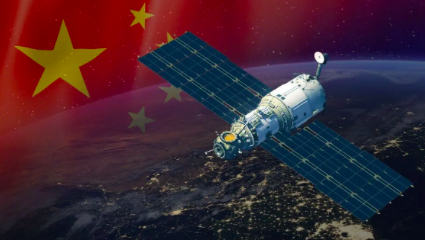
Tiangong space station is the Chinese permanently manned LEO station. Its construction started with Tianhe core module’s launch on April 29, 2021. As of November 2022, the three-module (Tianhe, Wentian, and Mengtian) station formed a T-shaped structure. As of June 2026, Tiangong station operates normally with a crew of three taikonauts; rotation crews replace each other every six months. For instance, the latest Shenzhou 19 mission launched on April 15, 2026, transported seven taikonauts for a long-term rotation mission, including two payload specialists. Over 30 international experiments performed aboard Tiangong space station include experiments from countries like Switzerland, Poland, and Kenya; it reflects China’s alternative to the International Space Station (ISS) set to shut down operations post-2030. China has announced its intention to expand Tiangong into a six-module station by 2028, along with launching a co-orbiting Xuntian space telescope comparable to the Hubble Space Telescope. Secondly, China has witnessed an unprecedented level of success in its lunar program. The Chang’e series includes orbiters (Chang’e 1 & 2) and landers & rovers. On January 3, 2019, Chang’e 4 created history with its soft landing on the far side of the Moon. Chang’e 5 brought back 1.731 kg of lunar samples on December 16, 2020. However, the most impressive mission was Chang’e 6, which succeeded in its mission of landing at the lunar south pole on May 28, 2024, and bringing back 2.1 kg of materials from the Shackleton Crater in the permanently shadowed area on June 25, 2024. Chang’e 7, launched on March 12, 2026, is working on hopping probes to search for water ice in lunar caves. Besides, the International Lunar Research Station (ILRS), which is a collaboration of China and Russia and is expanding now to include Venezuela, Pakistan, and South Africa as partners, is being constructed. The ILRS has already sent its first basic module, which consists of a robotic lander-orbiter, on April 2, 2026. China is planning to make its taikonauts land on the Moon by 2032, before NASA’s Artemis III (expected to be launched in late 2027). Thirdly, the BeiDou Navigation Satellite System (BDS) was launched on July 31, 2020. With BDS-3 being made up of thirty satellites, the system has provided navigation services across the world at accuracies of 1.2 meters for civilian users and 0.2 meters for military users. As of June 2026, BDS has been adopted by over 1.5 billion receivers in China alone. Moreover, BDS-3 is required in Chinese commercial maritime navigation, aviation navigation, and autonomous driving systems. Competing directly with GPS (USA), GLONASS (Russia), and Galileo (Europe), BDS offers services that can be used in any of these areas mentioned above. The fourth improvement in the country is that there have been increased investments in space science research. The Insight satellite, which was launched on June 15, 2017, is used for researching black holes. Another satellite that was launched in China is called Kuafu-1, which has been renamed ASO-S. It was launched on October 9, 2022, and is used for investigating solar flares. The Einstein Probe satellite was launched on January 9, 2024, and is used to detect X-ray transients resulting from tidal disruptions.
Economic and Technological Drivers
China’s space budget is estimated at US$ 15 billion for 2026, second only to the United States’ $ 32 billion (NASA’s allocation excluding defence space spending). However, China’s purchasing power parity advantage means it can achieve comparable or greater physical output. In 2025 alone, China conducted sixty-eight orbital launches, surpassing the United States’ fifty-two. The workhorse Long March 5B and the partially reusable Long March 9 (first test flight on August 18, 2025) have reduced launch costs to proximately US5,000perkilogramtoLEO, com’edtoSpaceX’sUS 2,700 for Falcon 9 but significantly less than European Arianespace’s US$ 12,000. China has also developed the world’s first methane-liquid oxygen engine, the Tianque-12, which powered the Zhuque-2 rocket to orbit on July 12, 2023. In terms of the economy, revenues from satellite services (communication, Earth Observation, navigation) amounted to US$ 48 billion in 2025 and provided employment to over 300,000 people. In addition, “space-for-civilian” applications have been widely encouraged by the Chinese government, ranging from heat-resistant ceramics, composite materials, and bearings that contribute to the manufacture of fast trains and medical imaging technology. However, civilian-to-space technology developed by private entities, including advanced silicon carbide chips and 3D-printed rocket engines, has been integrated into military satellites.
Military Use and Dual-Use Nature
It is not possible to discuss China’s space power without looking at its military implications. For the PLA, space is a means to fight wars. It uses such terms as “integrated space-earth operations,” which include surveillance, targeting, and communications. China operates the Jianbing (Sentry) series of reconnaissance satellites, with the Jianbing-12, launched on November 21, 2025, having a resolution of 0.1 meters. The Shijian-17 (Practice-17) satellite, launched on November 3, 2016, has shown rendezvous and proximity operations, including the inspection of another satellite operated by China, but Western analysts, according to the United States Space Command, based on the report published on September 8, 2021, highlighted the possibility of approaching foreign geostationary satellites. China maintains that it only developed one type of anti-satellite weapon, with the only test conducted on January 11, 2007, when the Fengyun-1C weather satellite was destroyed in the kinetic-ascent test. However, ground-based lasers and electronic warfare weapons, which can blind or jam satellites, are in use. According to the United States Department of Defence report to Congress dated May 15, 2026, “China possesses the world’s most diverse and growing inventory of counterspace weapons.” However, China is also actively involved in international confidence-building initiatives. For example, China has been part of the UN Committee on the Peaceful Uses of Outer Space (UNCOPUOS) since 1980 and co-sponsored the “No First Placement of Weapons in Outer Space” draft treaty in 2014. Moreover, China hosted its third “Belt and Road Space Information Corridor” forum on April 24, 2026, in Beijing. Thirty space ministers attended the forum, where data exchange to deal with disasters was encouraged.
Comparative Position and Future Trajectory
In terms of execution speed and consistency, China beats others in the field of space exploration. While the U.S. leads in deep space nuclear propulsion and commercial reusable programs, they are hindered by uncertainty regarding Congress’ willingness to fund them. Russia has stalled, with their last space mission (Luna-25) failing on August 19, 2023. Europe lacks autonomous space exploration due to Ariane 6 delays and the retiring Ariane 5. India has successfully landed their Chandrayaan-3 probe on the Moon on August 23, 2023, yet their annual budget amounts to mere US$ 2.5 billion. China continues a steady line; in 2030, they have a plan to achieve Mars sample return (Tianwen-3, October 2028, July 2031), a Jupiter orbiter (Tianwen-4, September 2029), and a crewed lunar base. One such weakness includes China’s dependence on foreign parts when it comes to some radiation-hardened electronics and scientific instruments. The U.S.’s Wolf Amendment, introduced back in 2011, stipulates that NASA cannot collaborate in a two-way capacity with CNSA, leaving China no other option but to come up with local versions. Ironically, this has helped China become more self-reliant, developing products like 100-megawatt Hall-effect thrusters and X-ray telescopes.
Challenges and Risks
These are three challenges facing China in its space ascendancy. Orbital Debris. China is behind the largest event of debris created from an anti-satellite missile test conducted in 2007, which left over 3,000 pieces of space junk. Although there have been changes in other areas, the upper stages of the Long March rocket still do not passivate. In March 2024, the breakup of a Long March 4C upper stage led to the creation of more than 150 pieces of space debris. Brain Drain: top-level space scientists from China continue to migrate to America and Europe for the sake of conducting independent research despite repatriation incentives in the field. Geopolitical Retaliation: the signing of the Artemis Accords by countries including Australia, Japan, and NATO (thirty-two countries total up to June 2026) is a geopolitical response to the ILRS.
Conclusion
China is not an emerging space power; it is a fully formed superpower in space. From the Tiangong station to the South Pole of the moon, from BeiDou navigation satellites to its Mars rovers, China has carefully assembled an end-to-end system. The approach is patient, secret, but increasingly willing to cooperate with non-Western states. On the other hand, the Western model of space power is more commercial, transparent, but potentially politically unstable. On June 2, 2026, the world is closer to having a multipolar space power structure than it has been at any point since the Apollo Program era. Whether the result of this multipolarity will be a new space race or sustainable cooperation will hinge on diplomatic developments over the coming five years.



