
By : Andey Vivaan, Research Analyst, GSDN
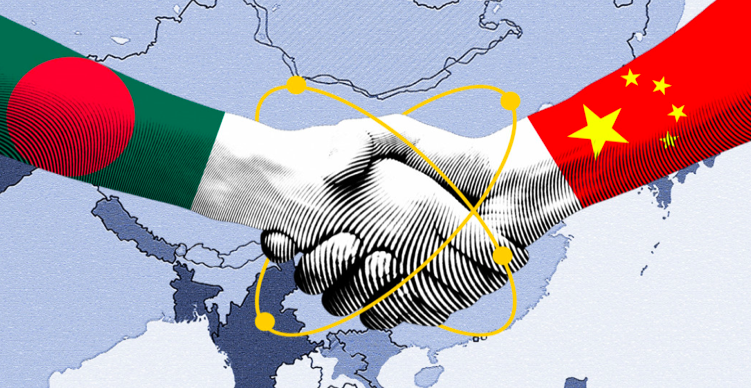
China-Bangladesh Relations : Source Internet
Introduction
India and Bangladesh have shared close ties for several decades because of their common history, geography and economic links. In recent years however, Bangladesh’s growing engagement with China has attracted increasing attention in India. While Dhaka describes these ties as part of its development strategy, they have also raised important strategic questions for New Delhi.
China’s involvement in Bangladesh now extends beyond trade and investment to infrastructure, defence cooperation, technology, and connectivity projects. Prime Minister Tarique Rahman’s visit to China in June 2026 further strengthened bilateral ties through agreements on infrastructure, industrial investment, the proposed China-Myanmar-Bangladesh Economic Corridor (CMBC), the Teesta River project, and broader economic cooperation.
These developments have drawn close attention to New Delhi. While Bangladesh maintains that its cooperation with China is based on economic interests rather than alignment against any country, India’s strategic community remains concerned about China’s expanding influence near its eastern borders, growing defence cooperation with Dhaka, and increased presence in the Bay of Bengal.
This article examines the evolution of China-Bangladesh relations and analyses why China’s expanding role in Bangladesh is increasingly viewed as a strategic challenge for India’s security and regional interests.
Historical Background
China-Bangladesh relations have changed considerably over the past few decades. Immediately after Bangladesh’s independence in 1971, political relations remained limited due to the Cold War dynamics and China’s close ties with Pakistan. Over the years, both countries gradually expanded their diplomatic and economic relations.
One major change came during the early 2000s when China became Bangladesh’s largest trading partner replacing India. Bangladesh’s rapidly growing textile industry increasingly depended on Chinese raw materials, machinery, and industrial products. Economic cooperation soon expanded beyond trade into infrastructure development, manufacturing, and energy projects.
Another important development came in 2016 when Chinese President Xi Jinping visited Bangladesh. During the visit, the two countries upgraded their relationship to a Strategic Cooperative Partnership, opening the door for greater Chinese investments in transport, ports, industrial zones, and energy infrastructure. Bangladesh also became the first South Asian country to formally join China’s Belt and Road Initiative (BRI), reflecting Dhaka’s interest in attracting large-scale infrastructure financing.
Despite strengthening ties with Beijing, Bangladesh under former Prime Minister Sheikh Hasina largely maintained a careful balance between India and China. While China became Bangladesh’s largest trading partner and defence supplier, Dhaka continued close political and security cooperation with New Delhi.
The political changes that followed the fall of Sheikh Hasina’s government in August 2024 introduced new dynamics into regional politics. The interim administration under Muhammad Yunus adopted a more China-friendly foreign policy, while the election of Prime Minister Tarique Rahman in 2026 further accelerated high-level engagement with Beijing. Rahman’s first major state visit to China signaled Bangladesh’s willingness to diversify its strategic partnerships while pursuing greater economic opportunities.
Although Bangladeshi leaders continue to emphasize that their foreign policy is based on national interest rather than alignment with any power, the growing frequency of high-level exchanges with China has naturally generated strategic debate within India.
Growing Economic Partnership
Economic ties are now the most important aspect of relationships. China is now Bangladesh’s largest trading partner and one of its most important sources of foreign investment. Chinese companies are actively involved in sectors such as transport, manufacturing, telecommunications, renewable energy, power generation, and industrial development.
During Prime Minister Tarique Rahman’s visit to Beijing in June 2026, Bangladesh secured fresh Chinese commitments for infrastructure financing and industrial investment. Several memoranda of understanding were signed covering industrial zones, renewable energy, electric vehicles, logistics, and manufacturing. Reports also suggested that Dhaka sought nearly US$6 billion in Chinese financial support for various development projects.
One of the most notable agreements involved the China-Bangladesh Mongla Port Economic Zone, which will be developed with the participation of the China Civil Engineering Construction Corporation. The project replaced an earlier proposal involving an Indian developer that had failed to progress within the agreed timeframe. The agreement highlighted China’s growing role in Bangladesh’s port infrastructure and industrial development.
Chinese companies have also invested in roads, bridges, railways, power plants, and special economic zones across Bangladesh. Industrial parks supported by Chinese financing aim to increase Bangladesh’s manufacturing capacity while attracting foreign investment and creating employment opportunities.
For Bangladesh, Chinese investment offers access to large-scale capital, technology, and infrastructure development at a time when the country seeks to sustain rapid economic growth. Chinese financing is often accompanied by relatively quick implementation compared to some traditional development partners.
China also benefits from these investments because Bangladesh occupies an important location between South Asia and Southeast Asia. Strong economic relations with Dhaka complement China’s wider objective of improving connectivity under the Belt and Road Initiative while expanding access to the Bay of Bengal.
However, China’s expanding economic presence has also generated debate regarding long-term strategic dependence, debt sustainability, and the geopolitical implications of major infrastructure investments.
Infrastructure, Connectivity and the Belt and Road Initiative
Infrastructure projects have become an important part of China-Bangladesh relations. China views improved connectivity as essential for expanding regional trade while simultaneously increasing its strategic access to the Indian Ocean.
One of the most closely watched proposals is the revival of the China-Myanmar-Bangladesh Economic Corridor (CMBC). During Prime Minister Tarique Rahman’s June 2026 visit to China, Chinese officials proposed extending the existing China-Myanmar Economic Corridor westward into Bangladesh. The proposed route would connect China’s Yunnan Province with Bangladeshi ports through Myanmar.
Although Bangladesh has not formally approved the proposal and has stated that further examination is required, the initiative has attracted significant attention in New Delhi. Indian officials have acknowledged that they are closely monitoring developments while assessing their strategic implications.
If this project is completed in the future, it could improve regional connectivity and give China easier access to the Bay of Bengal. This is one reason why Indian analysts are watching the proposal carefully.
Such connectivity could strengthen China’s commercial presence while also increasing its long-term strategic influence in the region.
The security situation in Myanmar, particularly in Rakhine State, remains one of the largest obstacles to the corridor’s implementation. Continued instability has delayed several Chinese infrastructure projects, including the Kyaukphyu deep-sea port, highlighting the practical challenges associated with regional connectivity initiatives.
Another important area of cooperation involves the Teesta River Comprehensive Management and Restoration Project. China has agreed to provide technical assistance and feasibility studies for the project while repeatedly emphasizing that the initiative is not directed against any third country. Nevertheless, because the Teesta River originates in India and remains central to long-standing water-sharing negotiations between India and Bangladesh, Chinese involvement has generated considerable strategic discussion in New Delhi.
China’s role in Bangladesh is no longer limited to trade and investment. Its involvement now includes ports, transport networks, industrial zones, and river management projects. This shows how broad the relationship has become over the past decade. It increasingly reflects Beijing’s broader geopolitical objective of expanding connectivity, strengthening regional influence, and integrating South Asia into its wider economic network
Defence and Security Cooperation
Defence cooperation has also grown over the last two decades. China has become Bangladesh’s largest supplier of military equipment, accounting for a significant share of the country’s defence imports. Chinese-made fighter aircraft, tanks, naval vessels, missile systems, air defence platforms and surveillance equipment now form an important part of Bangladesh’s military inventory.
An important development took place in December 2016, when Bangladesh inducted two Chinese-built Type 035G Ming-class submarines into its navy. The acquisition marked Bangladesh’s entry into submarine operations and highlighted the growing depth of defence ties between the two countries. Since then, cooperation has expanded through military training, technical assistance, and defence exchanges.
Recent reports indicate that Bangladesh is also considering the acquisition of 24 Chinese J-10CE multirole fighter aircraft along with advanced drone technology. Although no final agreement has been announced, these discussions demonstrate the increasing level of trust between Beijing and Dhaka in defence matters.
China’s involvement goes beyond supplying military equipment. Chinese military institutions have also increased training opportunities for Bangladeshi officers, while cooperation has expanded in areas such as maintenance, logistics and military education. As Bangladesh continues to modernize its armed forces under the “Forces Goal 2030” programme, China remains one of its most important defence partners.
In my view, both countries benefit from this cooperation. Bangladesh receives relatively affordable military equipment, while China strengthens its long-term presence in South Asia.
Why It Raises Concerns for India
India’s concerns regarding China-Bangladesh relations extend far beyond normal diplomatic engagement. The issue is not whether Bangladesh should maintain relations with China, but whether China’s growing strategic presence could alter the regional balance of powe
One of the biggest concerns is the Siliguri Corridor, commonly known as the Chicken’s Neck. This narrow strip of land, measuring roughly 20–22 kilometres at its narrowest point, connects mainland India with its eight northeastern states. Any increase in Chinese infrastructure or military presence near Bangladesh’s northern districts naturally attracts the attention of Indian security planners.
The proposed Chinese involvement in the Teesta River Comprehensive Management and Restoration Project has therefore generated considerable debate. While China describes the project as technical cooperation aimed at river management, several Indian analysts argue that the presence of Chinese state-owned companies close to India’s sensitive eastern frontier could create long-term strategic implications.
Another area of concern is the development of Mongla Port and the continued Chinese interest in Chattogram Port. These projects are frequently discussed within the broader context of China’s String of Pearls strategy, under which Beijing has invested in ports and maritime infrastructure across the Indian Ocean. Although China insists these investments are commercial, Indian strategic analysts remain cautious about their possible futuremilitary utility.
At present there is no evidence that these ports will be used for military purposes, but many Indian analysts believe their future strategic value cannot be ignored.
Reports regarding possible Chinese interest in the Lalmonirhat airbase, located near India’s border, have further intensified security discussions. Even though no formal military agreement has been announced, any Chinese role in upgrading infrastructure close to India’s eastern frontier would inevitably attract close monitoring from New Delhi.
The proposed China-Myanmar-Bangladesh Economic Corridor (CMBC) also carries strategic significance. If eventually completed, it would provide China with improved overland access to the Bay of Bengal through Bangladesh. Such connectivity would reduce Beijing’s dependence on the Strait of Malacca, one of the world’s busiest maritime trade routes, while simultaneously increasing Chinese logistical access to the Indian Ocean.
Taken together, these developments explain why India increasingly views China-Bangladesh relations through both economic and security lenses.
India’s Strategic Response
India has largely responded by strengthening its own relationship with Bangladesh instead of directly opposing China’s growing presence.
The Ministry of External Affairs has repeatedly stated that India is closely monitoring developments in Bangladesh and will take appropriate measures whenever necessary. At the same time, New Delhi has emphasizedthat its relationship with Bangladesh remains based on mutual trust, shared interests and long-term cooperation.
Rather than asking Bangladesh to choose between India and China, New Delhi has continued to strengthen bilateral cooperation in connectivity, trade, energy, border management and cultural exchanges. The reopening of tourist visas for Bangladeshi citizens and continued operation of projects such as the Bangladesh–India Friendship Pipeline demonstrate India’s effort to preserve positive relations despite occasional political differences.
India has also accelerated infrastructure development in its eastern region while strengthening military preparedness near the Siliguri Corridor. Enhanced border infrastructure, improved logistics and closer coordination among security agencies reflect New Delhi’s determination to safeguard its strategic interests.
India also needs to address unresolved bilateral issues, particularly water sharing. The long-pending Teesta Water Sharing Agreement remains one of the most sensitive aspects of India-Bangladesh relations. Many analysts argue that timely progress on this issue would reduce opportunities for external powers to expand their influence.
Ultimately, India’s strategy appears to focus on remaining Bangladesh’s most reliable long-term partner while avoiding unnecessary escalation with either Dhaka or Beijing.
Future Outlook
China-Bangladesh relations are expected to continue expanding over the coming years. Bangladesh requires substantial investment to sustain economic growth, improve infrastructure and modernise its industrial base. China has the financial resources and technical expertise to support many of Bangladesh’s development goals.
However, geography ensures that Bangladesh cannot ignore India. The two countries share a border of more than 4,000 kilometers, dozens of transboundary rivers, extensive trade links, and deep historical and cultural connections. Border management, water sharing, migration, and regional security require constant cooperation between New Delhi and Dhaka regardless of their relations with other countries.
In my opinion, Bangladesh is unlikely to choose either India or China completely. It is more likely to continue balancing its relations with both countries because each offers different advantages. While China provides investment and infrastructure, India remains Bangladesh’s closest neighbour with deep historical, cultural and economic ties.
Conclusion
In recent years, China-Bangladesh relations have entered a new phase with growing cooperation in trade, infrastructure, defence and connectivity. High-level political exchanges, growing Chinese investments and discussions surrounding projects such as the China-Myanmar-Bangladesh Economic Corridor, the Mongla Port Economic Zone and the Teesta River Comprehensive Management and Restoration Project demonstrateBeijing’s increasing strategic interest in Bangladesh.
For India, these developments represent more than ordinary diplomatic engagement. Chinese involvement near the Bay of Bengal, expanding defence cooperation, investments close to the Siliguri Corridor, and growing influence in Bangladesh’s infrastructure sector collectively raise important strategic questions. While none of these developments individually threatens India’s security, together they indicate a gradual shift in the regional geopolitical landscape.
At the same time, it would be inaccurate to view Bangladesh as choosing China over India. Bangladesh continues to maintain strong economic, cultural and geographical ties with India, while repeatedly emphasizing that its cooperation with China is not directed against any third country. As several analysts have noted, Bangladesh’s long-term interests are best served by maintaining productive relations with both Asian powers.
In my view, India’s response should focus less on viewing every Chinese investment as a strategic setback and more on strengthening its own partnership with Bangladesh through timely project implementation, enhanced connectivity, economic cooperation and diplomatic engagement. Geography ensures that India and Bangladesh will remain indispensable partners regardless of changing regional dynamics.
To conclude, China-Bangladesh relations are likely to continue expanding in the coming years. This does not necessarily mean that India is losing its influence, but it does mean that regional competition is becoming more complex. In my opinion, India should focus on strengthening its own partnership with Bangladesh by delivering projects on time, increasing economic cooperation and maintaining regular diplomatic dialogue. As a student of diplomacy, I believe strong regional relationships are built not only through strategic competition but also through trust and consistent engagement.



