
By : Prachi Kushwah, Research Analyst, GSDN
Introduction
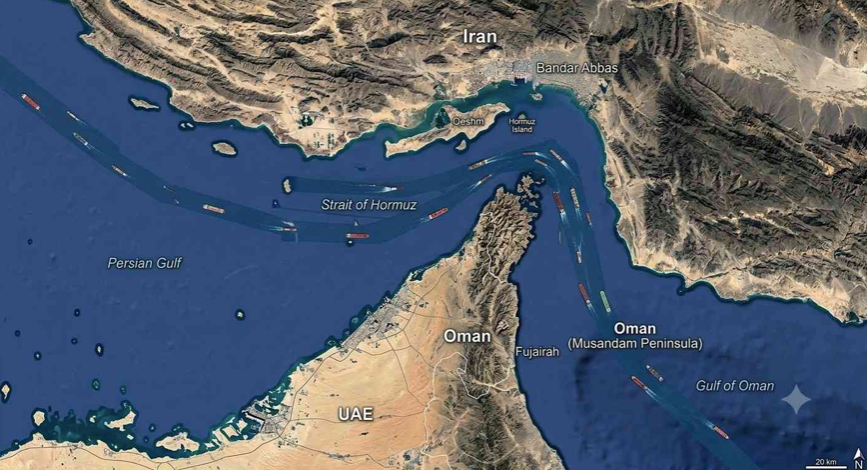
The Strait of Hormuz has become a focal point of the international system’s vulnerability to geopolitical shocks. This narrow passage between Iran and Oman connects the Persian Gulf with the Gulf of Oman and the Arabian Sea. In 2025, close to 20 million barrels of oil per day moved through the strait, representing about one-quarter of global seaborne oil trade. Around one-fifth of global liquefied natural gas (LNG) trade also passed through this route. The concentration of energy flows through a single corridor means that insecurity in the Gulf can quickly become a global economic problem.
The crisis intensified after military operations against Iran began on February 28, 2026, followed by actions and threats affecting commercial shipping. By October 2026, attacks on vessels and energy infrastructure continued to undermine confidence in a durable recovery. The International Energy Agency (IEA) warned that disruption had created an extraordinary threat to global energy security, while governments and markets managed shortages, higher transport costs, and price volatility.
This is not simply a dispute over waterways. It reflects regional rivalries, military deterrence, sanctions, energy dependence, international law, and competition among major powers. The crisis exposes the limits of a global economic model in which essential commodities depend on concentrated transport routes. Hormuz is therefore a case study in how regional conflict can test the resilience of globalization and the credibility of international institutions.
The Strategic Geography of an Energy Chokepoint
The Strait of Hormuz is approximately 39 kilometers wide at its narrowest point, with designated inbound and outbound shipping channels. Its navigable space makes commercial traffic vulnerable to mines, missiles, drones, seizures, and military confrontation. A complete physical closure is not necessary to impose substantial costs: intermittent attacks can raise insurance premiums, delay voyages and persuade shipowners to avoid the area.
The strait serves exporters including Iran, Iraq, Kuwait, Qatar, Bahrain, Saudi Arabia and the United Arab Emirates (UAE). Much of the oil travelling through it is destined for Asian economies. China, India, Japan and South Korea are major destinations, while Qatar’s LNG exports make the route especially important to global gas markets. The consequences are uneven: Asian importers face supply and freight shocks, while producers risk losing export revenues and customers.
Alternative routes provide only partial protection. Saudi Arabia’s East-West pipeline and the UAE’s pipeline to Fujairah can divert some crude oil away from the strait, but their available capacity is far below normal Hormuz flows. Pipelines cannot substitute for every oil grade, refined product or gas shipment. LNG is particularly difficult to reroute because it depends on specialised liquefaction facilities, carriers, and receiving terminals. Resilience therefore depends not merely on whether an alternative exists, but on its capacity, reliability, and ability to function during a wider regional conflict.
The 2026 Crisis and Its Immediate Effects
The conflict that began on February 28, 2026, transformed a persistent strategic vulnerability into an immediate supply shock. Attacks and threats against commercial vessels made passage increasingly risky, while military escalation raised the possibility of further restrictions. Reuters reported on October 8, 2026, that crude shipments through the strait had fallen to around 10.1 million barrels per day, approximately 74 per cent of pre-war levels, following a short-lived recovery. On October 23, 2026, Reuters reported that October had become the worst month on record for attacks on commercial shipping in the strait and surrounding waterways, according to maritime analysts.
These figures require caution. Vessel-tracking systems may miss ships whose signals are disabled, and incident reports can differ across governments, maritime agencies and commercial intelligence providers. Nevertheless, even when some oil flows recover, security uncertainty can prevent markets from returning to normal. Shipowners may demand higher freight rates; insurers may increase war-risk premiums, and cargo owners may pay longer routes, extra security or ship-to-ship transfers.
Oil prices reflect both actual supply and expectations about future disruption. On October 27, 2026, Brent crude settled at US$113.88 per barrel as diplomatic hopes eased some concerns, while the conflict continued to support a risk premium. On October 28, 2026, prices rose again after reports of an attack on a major Saudi refinery renewed fears about regional supply. Markets respond not only to barrels already lost, but also to the probability and potential scale of future disruption.
Energy Security Beyond Crude Oil
The crisis shows that energy security is broader than crude oil availability. Refined products, particularly diesel, have faced tight market conditions because supply chains depend on refinery operations, inventories, shipping, and regional distribution. Diesel is essential to freight, agriculture, construction, mining, and backup power. A shortage can therefore raise the cost of moving food and industrial goods even in countries that do not directly import much Gulf crude.
Natural gas is another critical dimension. In 2025, roughly one-fifth of global LNG trade passed through Hormuz, largely from Qatar. Disruption can tighten competition for cargoes, increase spot prices, and expose import-dependent economies to volatility in electricity and industrial production. Fertilizer and other industrial supply chains can also be affected by higher energy prices and shipping delays.
The IEA coordinated an emergency response after the crisis began. On October 15, 2026, its Governing Board reported that approximately 330 million barrels had been released under the collective action announced in March, with around 100 million barrels of planned releases remaining. It also highlighted the need to accelerate diesel stock releases and encourage countries with spare production and refining capacity to increase supply. Strategic stocks can cushion immediate shortages but cannot indefinitely replace disrupted production and transport.
Energy security therefore requires multiple layers: diversified suppliers, strategic reserves, resilient infrastructure, flexible demand, reliable shipping and diplomacy. A country may have adequate national stocks yet to remain vulnerable to global price increases. Physical availability and affordability are related but distinct dimensions of security.
Geopolitical Rivalry and the Logic of Coercion
Hormuz is a strategic instrument because disruption can impose costs far beyond the immediate theatre of conflict. Iran’s geographical position gives it the ability to threaten shipping and increase uncertainty without maintaining a complete blockade. Such actions can be used as leverage against military pressure, sanctions, or diplomatic isolation. Yet this leverage is costly and unpredictable: it can alienate neighboring states, damage Iran’s export prospects and encourage external powers to intensify military operations or develop alternative routes.
For the United States and its partners, protecting navigation intersects with deterrence, regional alliances and the credibility of security commitments. Naval escorts, surveillance and mine countermeasures may reduce some risks, but cannot guarantee safety when attacks can originate from multiple platforms. Military protection can also create a security dilemma: deployments intended to reassure commercial shipping may be perceived by an adversary as preparation for escalation, prompting retaliation.
Gulf governments need secure access to markets but also have incentives to avoid becoming launchpads for a wider conflict. Oman has historically supported regional dialogue, while other states have pursued mediation or called for de-escalation. Major importers such as China and India have strong reasons to support predictable shipping, even as they balance relationships with Gulf producers, Washington and Tehran. The crisis can encourage tactical cooperation on energy markets, but it can also sharpen competition for discounted cargoes, secure corridors, and preferential access to supplies.
International Law and the Fragility of Global Governance
The crisis raises fundamental questions about freedom of navigation and the rules governing international waterways. The United Nations Convention on the Law of the Sea provides a framework for transit passage through straits used for international navigation. The Strait of Hormuz is bordered by Iranian and Omani territorial waters, making the conduct of coastal states particularly significant. Commercial vessels depend on predictable rules and the ability to transit without unlawful interference.
The United Nations Secretary-General has repeatedly called for de-escalation and the restoration of navigational rights and freedoms. On July 15, 2026, the Secretary-General’s spokesperson reiterated that these rights in and around the strait must be respected in accordance with international law. The principle is clear: a critical global route cannot be treated as an unrestricted instrument of coercion without consequences for international stability.
Yet legal rules do not enforce themselves. Their practical effect depends on state compliance, diplomatic pressure, monitoring, and the willingness of influential powers to avoid selective interpretations. When military action, sanctions, and retaliation interact, legal disputes become entangled with competing claims of self-defence, sovereignty, and security. A durable settlement must therefore combine respect for navigation with broader security arrangements. Reopening the strait without addressing the underlying conflict may offer only temporary relief; negotiations over regional security cannot succeed while commercial shipping remains vulnerable.
Consequences for India and Other Import-Dependent Economies
India is exposed because its economic growth relies heavily on imported energy, while its population and industrial base make fuel affordability important. Disruption in Hormuz can increase the land cost of crude oil, LNG, and petroleum products. Higher freight and insurance charges add to these costs, while global price volatility complicates planning for refiners, airlines, transport operators and public finances.
The effects extend beyond fuel bills. Higher energy costs can contribute to inflation, increase the cost of fertilizers and logistics, and place pressure on household budgets. If the import bill rises faster than export earnings, the current account can come under pressure, and the currency may face volatility. The impact depends on contract structures, inventories, supplier diversity, domestic refining capacity, and the duration of disruption.
India’s response should combine immediate risk management with long-term resilience. Refiners and importers can diversify suppliers and routes, evaluate delivered-cost contracts, and maintain contingency plans for cargo delays. Public authorities can improve coordination among energy companies, shipping operators, and financial regulators, while monitoring diesel, liquefied petroleum gas, and other essential products. Strategic petroleum reserves are valuable, but their scale, location and release procedures must be considered alongside commercial inventories and refinery requirements.
Longer-term investment in renewable electricity, storage, grid reliability, energy efficiency, public transport, and electrification can reduce exposure to imported fossil fuels. These measures cannot quickly eliminate oil dependence in aviation, shipping, petrochemicals, and heavy industry. They can, however, reduce the amount of demand exposed to geopolitical chokepoints. For India and other import-dependent economies, diversification is both an economic-stability strategy and a national-security priority.
The Global Economic and Human Costs
The consequences of a maritime crisis spread through interconnected markets. Higher crude and gas prices increase production costs, while more expensive freight and insurance raise the price of traded goods. Businesses may delay investment because input costs and delivery schedules become uncertain. Governments face difficult choices between allowing price increases to pass through, subsidizing consumers, or redirecting public spending. These choices have distributional consequences, particularly for lower-income households that devote a larger share of their budgets to energy, transport, and food.
The burdens are uneven. Energy exporters may receive higher prices for cargoes that reach the market, but lose revenue when exports are blocked or infrastructure is damaged. Importing countries with stronger fiscal positions can absorb shocks more easily than poorer economies. Small island states, low-income countries and economies dependent on imported diesel may face disproportionate pressure on electricity, food distribution and public services. The crisis is therefore also a question of global inequality.
Human costs within the region matter just as much. Seafarers face direct danger, while attacks on infrastructure can threaten civilian livelihoods. Prolonged confrontation can divert resources from development, reconstruction, and climate adaptation. An analysis focused solely on oil prices would miss these consequences, including reduced employment, displacement, and lasting damage to public trust.
Policy Priorities: From Crisis Management to Resilience
First, governments should prioritize de-escalation and structured diplomacy. Direct communication channels between military forces and maritime authorities can reduce miscalculation. Regional dialogue should include coastal states, major importing countries, and relevant international organizations, with practical arrangements for incident reporting and emergency coordination.
Second, states should strengthen maritime risk management without treating military escalation as the only solution. Shared information, transparent navigation advisories, search-and-rescue coordination, and consistent reporting can help shipping operators make informed decisions. Security operations should protect civilian shipping while avoiding actions that unnecessarily widen the conflict.
Third, emergency energy measures should be coordinated and temporary. Strategic stock releases can bridge short-term gaps, while countries with spare production or refining capacity can ease shortages. Governments should communicate clearly about inventories, risks, and policy decisions to reduce panic and misinformation. Planning must recognize that diesel and other refined products may face tighter constraints than crude oil.
Fourth, longer-term planning should focus on diversification and redundancy. Alternative pipelines, storage, ports and supply contracts can lower exposure to a single chokepoint, although they require investment and cannot replace Hormuz completely. Energy efficiency, renewable power, electrification, and demand response can reduce structural dependence on imported fuels. Resilience should be assessed through stress tests that consider simultaneous disruptions to shipping, infrastructure, finance, and communications.
Finally, the international community should reaffirm consistent application of international law. Freedom of navigation, civilian protection, and respect for sovereignty must not be applied selectively. A credible global order depends on predictable rules and mechanisms that can operate even when powerful states disagree.
Conclusion
The Strait of Hormuz crisis demonstrates how a narrow maritime passage can become a fault line in the global order. Its importance lies not only in the volume of oil and gas it carries, but also in the way energy dependence intersects with military power, international law, economic inequality, and strategic competition. A partial reduction in shipping can increase prices, raise insurance costs and unsettle markets far beyond the Gulf.
Emergency reserves and alternative routes can buy time, but they cannot fully substitute for secure navigation and political stability. Nor can naval protection alone resolve a conflict whose drivers extend beyond maritime access. A sustainable response requires diplomacy, credible rules, regional dialogue, diversified energy systems, and protection for civilian commerce.
The deeper lesson is that globalization depends on infrastructure often taken for granted until it fails. The resilience of the international system will be measured by whether states manage shared vulnerabilities collectively rather than weaponizing them. Securing the Strait of Hormuz is therefore not only an energy challenge; it is a test of whether geopolitical rivalry can be constrained by cooperation, law, and a common interest in global stability.


