
By: Khushbu Ahlawat, Consulting Editor, GSDN
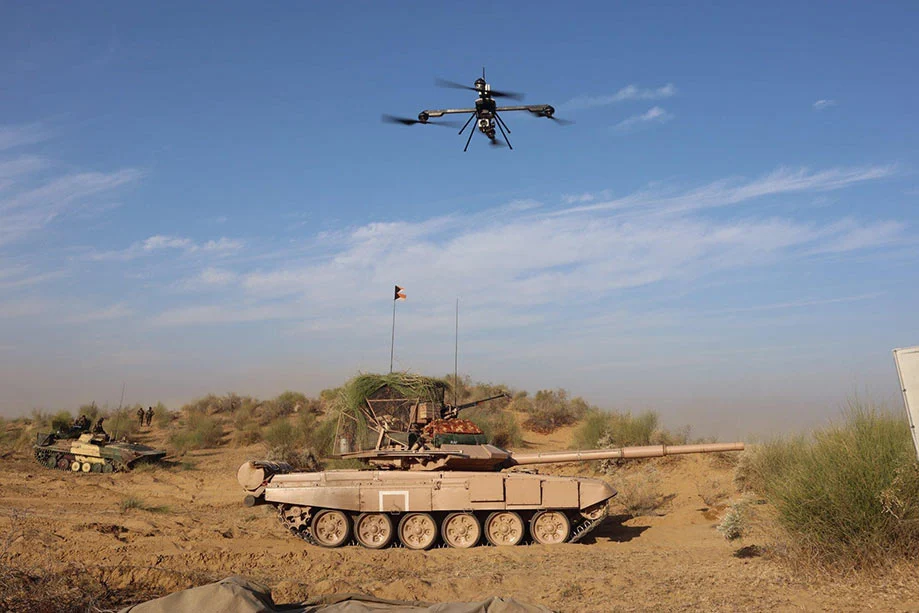
As the Indian Army builds Integrated Battle Groups meant to fight and win fast, two-front wars, the Rubicon Centre’s troubled expansion in Russia offers a warning that hardware alone will not decide the outcome.There is a simplicity to modern drone warfare as it is usually described: cheap unmanned aircraft, mass-produced and mass-deployed, overwhelming expensive armour and artillery through sheer volume. Ukraine’s battlefields have made that image familiar to anyone following the war, and it has understandably shaped how militaries elsewhere, India included, are rethinking their force structures. But an inconvenient detail keeps surfacing in the most serious accounts of Russia’s own drone build-up: the bottleneck was never really the hardware. It was people — specifically, the difficulty of finding, training and retaining enough skilled operators fast enough to keep pace with the units being raised on paper. That detail matters enormously for India, because the Indian Army is in the middle of reshaping its own force structure around exactly this kind of technology-heavy, high-tempo formation: the Integrated Battle Group, or IBG.
From Cold Start to Integrated Battle Groups
The IBG concept did not emerge overnight. Its lineage traces back to the aftermath of the 2001 Parliament attack, when India’s massive but slow military mobilisation under Operation Parakram gave Pakistan weeks to reposition forces and seek international diplomatic cover, blunting whatever coercive value the mobilisation was meant to have. That experience pushed the Army toward what became known as the Cold Start doctrine, formulated around 2004 and aimed at enabling rapid, limited, proactive strikes without the weeks of build-up that had undercut Parakram — though the doctrine’s existence was officially denied for years until then-Army chief General Bipin Rawat acknowledged it publicly in 2017.
Integrated Battle Groups are the organisational form that doctrine eventually took. An IBG is a self-sufficient, brigade-to-division-sized formation — typically fielding somewhere in the range of 4,000 to 5,000 troops, larger than a conventional brigade but smaller than a division — that fuses infantry, armoured regiments, artillery, engineers, signals and unmanned aerial systems into a single command structure under a major general or brigadier, rather than having each arm operate as a separate silo coordinated only at a higher headquarters. The design philosophy rests on what Army planners call the “3T” principle — Threat, Terrain and Task — meaning an IBG deployed against Pakistan in the deserts of Rajasthan looks materially different from one postured against China in the high Himalayas, with the former weighted toward tanks and mechanised elements and the latter toward light infantry and mobility. IBGs were first field-tested by IX Corps in Yol, Himachal Pradesh, and later by XVII Mountain Strike Corps, and the concept has continued to evolve since.
What has changed the urgency behind this reorganisation is the 2025 conflict period around Operation Sindoor, India’s response to a major terror attack, which appears to have accelerated structural reform across the Army. In January 2026, Army Chief General Upendra Dwivedi confirmed that New Delhi had formally greenlit the IBG reorganisation, following the clearance of 31 separate sanction letters for structural reforms over the preceding fourteen to fifteen months — approvals covering not just the IBGs themselves but new aviation brigades and the resumption, after a five-year gap, of Territorial Army reserve recruitment. Alongside the IBGs, the Army has begun converting existing single-arm brigades into what it calls Rudra All-Arms Brigades, integrated formations combining infantry, tanks, artillery, engineers, UAVs and special forces tailored to specific operational roles, and has announced plans to raise 40 to 50 new Bhairav Light Commando Battalions — agile, lightly equipped units built for rapid, high-mobility border operations, trained around modern drones and lightweight gadgetry, meant to supplement existing Para-Special Forces and Para (Airborne) units. On the fires side, new ‘Shaktibaan’ artillery regiments are being raised with dedicated ‘Divyadrishti’ surveillance and loitering-munitions batteries for precision strike, and more than 400 infantry battalions are slated to receive dedicated drone platoons as part of a broader UAV-integration push across the force. This is, in other words, a genuinely serious reorganisation, not a rebranding exercise. And it is precisely because the ambition is real that the question of what will actually sustain it — beyond procurement budgets and doctrine documents — deserves close scrutiny.
The Concept of “Persistent Robotic Overwatch”
That question is what a recent strand of Indian strategic commentary has tried to address through the idea of Persistent Robotic Overwatch, or PRO — a layered, drone-based protective bubble meant to shield armoured formations from the kind of saturation attacks that have proven devastatingly effective against crewed tanks in Ukraine. The logic is straightforward once stated plainly: a main battle tank’s passive protection, whether traditional armour plating or Active Protection Systems designed to intercept incoming projectiles, works only up to a point. Piling on more armour makes a tank slower and less mobile; APS can only handle so many simultaneous threats. Against a saturated attack from cheap, mass-produced drones — exactly the kind both China and Pakistan are capable of fielding in large numbers — a tank’s organic defences reach their limits quickly. PRO is proposed as the answer: a persistent overhead and forward screen of India’s own unmanned systems, providing early warning, interception and disruption of incoming threats, while simultaneously supporting the tank’s offensive tempo by feeding it targeting data and suppressing enemy positions ahead of an advance. The template most often invoked for this kind of capability is Russia’s Rubicon Centre, and it is here that the more sobering lessons begin.
Inside Russia’s Rubicon Experiment
The Rubicon Centre was established in 2024–25 as a centralised Russian organisation with an unusually broad mandate: research, procurement, training and the operational deployment of unmanned systems, alongside doctrinal development covering the tactics, techniques and procedures that govern how drones are actually used in combat. Its stated purpose was to make Russian drone production and deployment more scalable and more tightly linked to what was happening on the battlefield, integrating a wide array of platforms — first-person-view quadcopters, reconnaissance drones like the Orlan-10 and Supercam, counter-UAV teams and electronic warfare squads — into a single, coordinated structure rather than leaving each type of capability fragmented across different commands.
The numbers tell the real story, though. In March 2025, Rubicon had roughly 1,450 personnel against a sanctioned strength of 2,500. By the first quarter of 2026, it had grown to approximately 9,000 personnel — a roughly sixfold expansion in under a year. That growth did not come from nowhere. Rubicon drew heavily on experienced unmanned-systems teams pulled out of Russia’s conventional formations, which depleted those units’ own intelligence, surveillance and reconnaissance capacity and fire support at exactly the moment those capabilities were most needed elsewhere on the front. Rubicon was also competing internally for talent with the 50th Unmanned Systems Brigade, which was itself expanding from 1,300 to 7,000 personnel over the same period, and both were competing against the backdrop of Russia’s broader Unmanned Systems Forces, which stood at roughly 87,000 personnel with a stated ambition of reaching 165,000 by the end of 2026.
That is an enormous, and enormously expensive, human-capital demand, and Russia has struggled to meet it. Reporting indicates Russia has been unable to hit its monthly recruitment targets for these units, and the response has been to lower recruitment standards to fill quotas rather than slow the pace of expansion. The predictable consequence is a force that looks large on an organisational chart but is thinner in actual skill than its numbers suggest — and because trained UAS and counter-UAS operators are difficult and slow to replace, the attrition these units have suffered in combat has not been easily made good. Notably, Ukraine encountered a version of the same problem when it expanded its own drone-line regiments and brigades too rapidly, temporarily degrading their effectiveness even as their nominal size grew. The lesson that emerges from both sides of that war is consistent: standing up large unmanned-systems formations quickly is organisationally achievable, but building the deep bench of trained, experienced operators needed to make those formations effective in sustained combat is a much slower and harder problem — one that outpacing your own training pipeline does not solve, it just defers.
What This Means for India’s Two-Front Problem
India’s strategic situation differs from Russia’s in one crucial respect that makes this lesson even more pointed rather than less: New Delhi cannot assume it will fight only one adversary, on a timeline of its own choosing. Any IBG-based PRO capability has to be built with the explicit possibility of a two-front contingency involving both China’s PLA Ground Force and the Pakistan Army in mind, and importantly, escalation control will not rest solely with India. If either adversary chooses to expand the conflict’s geographic scope or duration, the length and intensity of the fighting — and therefore the demand placed on India’s drone operators, counter-UAS teams and electronic warfare personnel — will be determined as much by the enemy’s choices as by India’s own planning assumptions. Russia’s experience in Ukraine, where the war has run for years longer than Moscow’s initial planning apparently assumed, is a direct illustration of how quickly manpower demands for sustained unmanned-systems operations can outstrip any peacetime recruitment and training pipeline.
The demands will also not be uniform across IBG missions. Defensive IBG operations — holding ground, absorbing an attack, maintaining a reserve capability to plug gaps — tend to place comparatively lighter demands on a PRO bubble, partly because defence is generally the stronger form of war and partly because defensive formations can rely more heavily on prepared positions and shorter supply lines. Offensive, armour-intensive manoeuvre operations are a different matter entirely. Securing a meaningful territorial gain — the kind of quid pro quo the Indian Army achieved in select sectors during the 1965 war with Pakistan — requires sustained offensive tempo, and that tempo generates far greater attrition among both personnel and equipment, which in turn generates far greater demand for the PRO capability to protect and enable it. If India’s IBGs are meant to be genuinely offensive-capable formations, and not merely defensive reserves, the manpower investment required to sustain that capability through a protracted engagement will be substantial, not incremental.
Conclusion: Building the Bench, Not Just the Bubble
None of this argues against the PRO concept or against the broader IBG reorganisation under way. The logic connecting unmanned systems to survivability and offensive tempo on a modern battlefield is sound, and the Indian Army’s parallel investments — Rudra brigades, Bhairav battalions, Shaktibaan artillery regiments, drone platoons pushed down to the battalion level — suggest a genuinely serious institutional effort to internalise the lessons of recent conflicts rather than simply procuring impressive-looking hardware. What Russia’s Rubicon experience adds to this picture is a specific and somewhat uncomfortable caveat: the constraint that will most likely determine whether India’s PRO bubble actually works in a sustained, two-front conflict is not going to be the availability of drones, sensors or even funding. It will be whether India can recruit, train and retain enough genuinely skilled operators, electronic warfare specialists and counter-UAS crews to keep those systems flying and fighting effectively for as long as an adversary chooses to keep the conflict going — without hollowing out the ISR and fire-support capacity of India’s conventional formations in the process, exactly the trade-off Rubicon’s rapid expansion forced on the rest of the Russian army. Magazine depth and AI-augmented drone manufacturing will matter. But the harder, slower, less glamorous work of building a deep bench of qualified personnel — matched in both quality and quantity to India’s actual military objectives against China and Pakistan — is what will ultimately decide whether the IBGs’ PRO capability is a genuine force multiplier or an impressive-looking structure that thins out under the pressure of a real, sustained fight.



