
By: Khushbu Ahlawat, Consulting Editor, GSDN
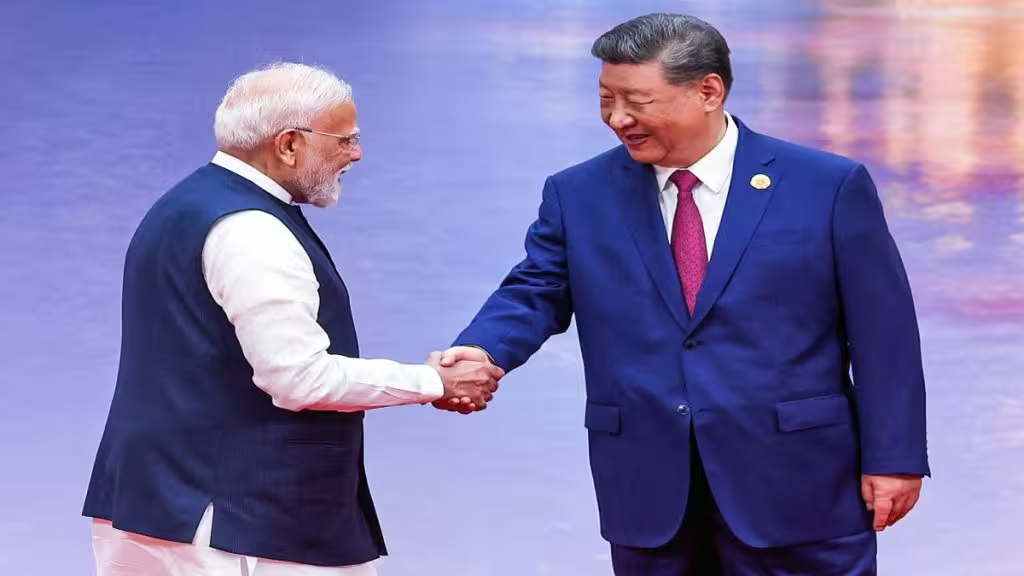
A cautious embrace at the BRICS table conceals a deeper disagreement over what comes first — border stability or economic re-engagement
When Chinese President Xi Jinping touched down in New Delhi on September 12, 2026, to attend the 18th BRICS Summit, the optics were unmistakable: his first visit to India in nearly seven years, arriving at Prime Minister Narendra Modi’s invitation, for a gathering marking two decades of the BRICS grouping. Xi’s delegation included Wang Yi, China’s foreign minister, and Cai Qi, a Politburo Standing Committee member and one of Xi’s closest lieutenants — a lineup that signalled Beijing was treating the visit as more than ceremonial. On the sidelines, Modi and Xi held their third consecutive annual meeting, following earlier encounters in Kazan and Tianjin, and India’s foreign ministry confirmed afterward that both leaders had reaffirmed a commitment to resolving the long-contested boundary dispute.
That single fact — three leader-level meetings in three years, after a five-year freeze — is itself a measure of how far the relationship has travelled since the 2020 Galwan Valley clash brought Indian and Chinese troops into their deadliest confrontation in decades. But beneath the choreography of summit diplomacy lies a harder truth: New Delhi and Beijing are not walking toward normalisation along the same path, at the same pace, or for the same reasons. Understanding that divergence — not the handshake itself — is the key to reading where this relationship goes next.
From Doklam to Galwan to Détente: A Short Memory of a Long Border
India and China share a roughly 3,500-kilometre frontier that has never been formally demarcated, a legacy of colonial-era cartography and the unresolved aftermath of the 1962 war. The current thaw is not the first attempt at reconciliation. A similar cycle played out in 2017, when a 73-day military stand-off at Doklam — on the India-China-Bhutan trijunction — was defused just days before Modi travelled to Xiamen for that year’s BRICS summit and met Xi on the sidelines. That episode established a pattern that has repeated since: crisis, disengagement, summit diplomacy, incremental normalisation.
The 2020 Galwan clash broke that pattern more severely than Doklam had. Twenty Indian soldiers and an unconfirmed number of Chinese personnel died in hand-to-hand fighting in the Galwan river valley — the first fatalities on the border in over four decades — and New Delhi responded by freezing high-level political contact, banning dozens of Chinese mobile applications, and tightening scrutiny of Chinese investment under an amended foreign direct investment policy. It took until the Modi-Xi meeting on the margins of the 2024 BRICS summit in Kazan, Russia, for the ice to begin cracking, followed by a patrolling arrangement along the Line of Actual Control (LAC) and the restoration of direct flights between Indian and Chinese cities. A further meeting in Tianjin in August 2025, on the sidelines of the Shanghai Cooperation Organisation summit, kept the momentum going, with Xi speaking of deeper strategic communication and Modi pressing for a relationship anchored in what New Delhi calls the “three mutuals” — mutual respect, mutual sensitivity, and mutual interest.
The institutional architecture built around this thaw is worth noting, because it is where the real, unglamorous work of de-escalation happens, away from summit photo-ops. Special Representative-level talks on the boundary question, dormant for five years, resumed in December 2024. At their August 2025 round, the two sides agreed to set up an Expert Group and a Working Group under the existing Working Mechanism for Consultation and Coordination on India-China Border Affairs, tasked respectively with pursuing an “early harvest” on delimitation and building a firmer border-management framework. A further Senior Highest Military Commander-level mechanism was proposed for the Eastern and Middle Sectors of the border, mirroring one that already exists in the west. By August 2026, that groundwork had advanced to the point where both sides were reportedly finalising new military hotlines and additional venues for commander-level talks in those sectors — plumbing-level detail, but the kind that actually reduces the odds of a patrol-level scuffle spiralling into a Galwan repeat.
Two Capitals, Two Sequences
It is tempting to read the frequency of Modi-Xi meetings as proof that the relationship is simply “improving.” A closer look at what each side is actually asking for suggests something more like a negotiated standoff over sequencing.
New Delhi’s position, articulated consistently since the Kazan meeting, is that the pace of economic and diplomatic normalisation should track the pace of border stabilisation — not run ahead of it. This is why Indian officials keep returning to the language of “peace and tranquillity” along the LAC as a precondition, not a parallel process. Beijing’s position, expressed by figures like Ambassador Xu Feihong and Foreign Minister Wang Yi, is closer to the opposite: that the border issue should be “properly handled” so that it does not become a permanent hostage to the broader relationship, and that economic ties in particular should move forward “without stagnation or backsliding,” in Wang’s phrase. China’s own vocabulary for this is the “dual-track” approach — shuāngguǐ — advancing the border talks and the wider relationship simultaneously, rather than making one contingent on the other.
The gap between these two sequencing logics shows up starkly in the economic data. India’s trade deficit with China — already the largest bilateral trade imbalance India runs with any single partner — has continued to widen through the mid-2020s, driven by India’s near-total dependence on Chinese suppliers for a long list of intermediate and finished goods: solar panels, active pharmaceutical ingredients, lithium-ion battery components, laptops, viscose yarn and specialised machinery among them. Government trade-policy think-tanks have noted that the great majority of what India imports from China falls in the low-to-medium technology band — bearings, motors, valves, moulds, fasteners — items that are not, in principle, beyond India’s industrial capacity to substitute, but which decades of import dependence have made cheaper to buy than to build.
That dependence became a live political issue in 2025, when Beijing tightened export licensing on seven categories of rare-earth elements and the permanent magnets made from them — materials indispensable to electric-vehicle motors, wind turbines, precision-guided munitions, and consumer electronics. China controls upward of 90 percent of global rare-earth processing capacity, and the licensing regime it imposed required Chinese exporters to secure end-use certificates co-signed by both the Indian foreign ministry and the Chinese embassy, ostensibly to guarantee the materials would not reach defence applications or be re-exported to the United States, which was itself locked in a parallel tariff standoff with Beijing. Indian automakers, who had built their electric and hybrid vehicle supply chains on the assumption of steady Chinese input, found themselves staring at production slowdowns within weeks, with industry bodies publicly warning that the vulnerability extended well beyond magnets to antibiotics, active pharmaceutical ingredients and other critical inputs. Even after diplomatic engagement eased some of the licensing bottleneck, Indian firms reported that clearances remained inconsistent — a reminder, for New Delhi, of exactly the kind of leverage it does not want dangling over a relationship it is trying to stabilise.
This is the economic backdrop against which India has, cautiously, begun to loosen some of its post-Galwan investment restrictions — mandating faster clearance timelines for Chinese capital proposals in sectors like capital goods, electronic components, polysilicon and ingot wafers, and permitting select Chinese-linked manufacturing units to bid for government power-sector tenders, with the explicit caveat that this was not to be read as a precedent. The approved joint venture between India’s Dixon Technologies and China’s Vivo, with Dixon retaining a majority 51 percent stake, is often cited as a template India would like to see replicated: Chinese capital and technology entering Indian manufacturing on terms that keep control, and the associated intellectual property and supply-chain benefits, substantially in Indian hands.
What the September 2026 Meeting Actually Changed
Set against this longer arc, the September 2026 Modi-Xi meeting was less a breakthrough than a checkpoint. The joint signals from both capitals — India’s readout referencing a “fair, reasonable and mutually acceptable resolution” to the boundary question and continued attention to trade imbalances, supply-chain fragility and market access; China’s emphasis on the dual-track approach and on tighter coordination within BRICS, the G20, the SCO and the United Nations — essentially restated each side’s existing position rather than resolving the gap between them. Modi’s own remarks at the summit’s open plenary on September 13 kept the focus on what New Delhi still considers unfinished business: the “weaponisation” of critical minerals and technology, a barely-veiled reference to the rare-earth episode.
What the summit did do was create institutional cover for the border-management mechanisms — the new hotlines, the additional commander-level venues, the Expert and Working Groups — to keep operating with political backing from the top, even as the harder economic questions remain unresolved. A trans-river cooperation meeting, expected around the same period, was set to address hydrological data-sharing arrangements on rivers that originate in Tibet and flow into India, another quietly consequential thread in the relationship that rarely makes headlines but carries real stakes for water security in India’s northeast.
The Road Ahead
Three things are worth watching as this relationship moves past the September summit. First, whether the Expert Group and Working Group under the WMCC can actually agree on a “terms of reference” for boundary delimitation — a bureaucratic-sounding hurdle that has, in practice, stalled every prior attempt at a substantive settlement since talks began in the 1980s. Second, whether Beijing’s rhetorical commitment to smoother economic engagement translates into predictable, rules-based licensing for the critical inputs India depends on, rather than case-by-case discretion that can be tightened whenever Beijing’s broader relationship with Washington sours. Third, and perhaps most tellingly, whether India uses this period of relative calm to accelerate the diversification and import-substitution strategies that officials and industry bodies have been urging since the rare-earth shock — because a bilateral relationship this asymmetric in economic leverage will keep reproducing the same vulnerability at the next point of friction, however the border talks proceed.
None of this means the optimism around the Xi-Modi meeting is misplaced. Restored military hotlines, functioning expert groups and a third consecutive year of leader-level dialogue represent genuine, hard-won progress over the post-Galwan nadir. But normalisation built on two different sequencing logics — India’s border-first caution and China’s parallel-track urgency — is inherently fragile. The test of this relationship will not be measured in summit statements or ceremonial tree-plantings, but in whether the two sides can agree on which comes first: trust on the ground, or trade at the table. Until that question is settled, the India-China relationship will likely continue to move the way it has since 2020 — forward, but only ever by increments, and always with one eye on the mountains.
The View From Outside
The India-China recalibration is not unfolding in a vacuum, and neither capital is treating it that way. For Washington, a warmer Delhi-Beijing channel complicates the assumption — implicit in much of the Quad’s architecture — that India’s threat perception of China would keep it firmly anchored to the US-led Indo-Pacific coalition. New Delhi has been careful to signal that this is not a realignment away from the Quad or from its deepening defence and technology partnerships with the United States, Japan and Australia, but rather an exercise in what Indian officials frequently describe as strategic autonomy: managing an unresolved rivalry with China without being permanently hostage to it, while keeping other partnerships intact. Beijing, for its part, has its own external calculus — a prolonged tariff confrontation with Washington gives China every incentive to stabilise its periphery, India included, so it is not simultaneously managing friction on multiple fronts.
For countries like Russia, which has courted both New Delhi and Beijing as anchors of a multipolar order, and for the wider BRICS grouping now entering its third decade, a functional India-China relationship is almost a precondition for the bloc’s coherence — it is difficult to build shared institutions with two founding members who cannot manage their own border. That broader context may explain some of the urgency behind the 2026 summit diplomacy: both Modi and Xi have reasons, distinct but overlapping, to be seen managing this relationship responsibly, even if the harder questions of sequencing remain, for now, unresolved.
Author



