
By : Andey Vivaan, Research Analyst, GSDN
Introduction
Data has become one of the most important strategic resources of the twenty-first century. Every online purchase, digital payment, social-media interaction, satellite image, factory sensor, mobile application and artificial intelligence system generates information. When these enormous volumes of information are collected and analysed, they are commonly described as Big Data.
For many years, discussions about global power were largely centred on military strength, natural resources, population and economic size. These factors remain important, but technological power has added another dimension. Countries that can generate, store, process and effectively use enormous quantities of data gain advantages in artificial intelligence, economic planning, scientific research, national security and technological innovation.
This has created an important question: which country actually leads the world in Big Data?
There is no simple answer because leadership in Big Data cannot be measured only by the amount of information a country produces. China has developed an extraordinary advantage in the volume of data generated by its huge population, digital economy and industrial systems. The United States, meanwhile, remains extremely powerful because of its technology companies, cloud-computing infrastructure, advanced semiconductors and artificial intelligence ecosystem.
Therefore, the emerging competition over Big Data is increasingly centred on China and the United States. India and the European Union are also becoming important players, although through different models.
Understanding this competition matters because data is no longer simply information stored on computers. It is becoming an important source of economic, technological and geopolitical power.
Understanding Big Data
Big Data refers to extremely large and complex collections of information that cannot easily be processed using traditional methods. Its importance comes not simply from the amount of information available but from the ability to analyse it and discover useful patterns.
Modern economies generate data continuously. Smartphones produce location and behavioural information. Banks generate financial transaction records. Hospitals create medical data. Factories collect information through sensors and connected machinery. Governments maintain large databases relating to taxation, transportation and public services.
Artificial intelligence has increased the importance of these resources even further.
AI systems require enormous quantities of information for training and operation. Data allows algorithms to identify patterns, understand languages, recognise images and make predictions. In this sense, data has become one of the basic inputs of the artificial intelligence economy.
However, simply possessing large amounts of information does not automatically produce technological power. Countries also require data centres, computing infrastructure, skilled workers, advanced algorithms, electricity and an effective regulatory environment.
This distinction is essential when determining which country leads the world.
China’s Massive Data Advantage
China has perhaps the strongest claim to leadership when Big Data is measured through the sheer volume of information generated.
According to China’s National Data Administration, the country produced approximately 52.26 zettabytes of data during 2025. This represented about 27.44 percent of global data production. The figure also represented an increase of more than 27 percent compared with the previous year.
Several factors explain China’s enormous data resources.
First is population. China has more than a billion people, hundreds of millions of whom regularly use smartphones, digital-payment platforms, e-commerce services and social-media applications.
Second is the scale of China’s digital economy. Online shopping, food delivery, transportation applications, mobile payments and other digital services have become deeply integrated into everyday life.
Third is industrialisation. China is the world’s largest manufacturing economy and has increasingly introduced connected machinery, robotics, industrial sensors and artificial intelligence into factories.
This means that China’s data advantage does not come only from consumers. Manufacturing, transportation, logistics and industrial systems are also producing enormous quantities of information.
Chinese enterprises have become particularly important contributors. Business-generated data accounted for the overwhelming majority of the increase in China’s data production in 2025.
The combination of population, digital services and industrial activity therefore provides China with one of the world’s largest pools of usable information.
China’s Big Data Strategy
China has also recognised that data has strategic value.
Rather than treating information simply as a by-product of economic activity, Beijing has increasingly attempted to develop systems through which data can be organised and used as an economic resource.
This approach fits China’s broader ambitions in artificial intelligence, advanced manufacturing, smart cities and technological self-reliance.
China’s development of smart-city infrastructure provides one example. Cameras, transportation networks, digital payment systems and connected public services generate enormous quantities of information that can be analysed to improve traffic management, urban planning and government services.
Industrial data is equally important. Information collected from factories can help companies predict equipment failures, optimise production and improve supply chains.
China’s scale creates a powerful cycle. More digital activity produces more information. More information can improve algorithms and services. Better digital services attract greater use, generating even more information.
This is particularly significant in artificial intelligence.
During 2025, data generated through system software and artificial intelligence in China reached approximately 26.92 zettabytes. The amount of data used for AI training and inference also expanded rapidly.
China therefore possesses not only a huge consumer market but also an increasingly sophisticated industrial and artificial intelligence data ecosystem.
The United States: Turning Data into Technological Power
If China has an advantage in data volume, the United States possesses another crucial advantage: its ability to transform data into commercially and technologically powerful products.
The United States is home to many of the companies that created the modern digital economy. American firms dominate important parts of cloud computing, internet services, software, semiconductor design and artificial intelligence.
This matters because Big Data requires infrastructure.
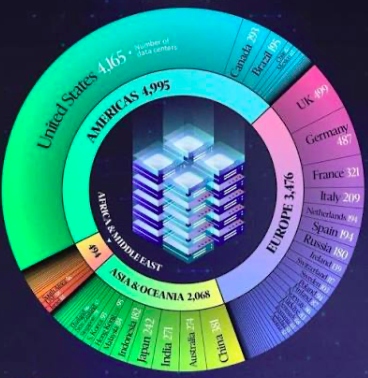
Information needs to be stored in data centres, processed using advanced computing systems and analysed through sophisticated software. The United States has built an enormous ecosystem around these activities.
American companies operate some of the world’s largest cloud-computing networks. These systems provide businesses and governments with the ability to store and process enormous quantities of information without constructing their own infrastructure.
The United States also remains particularly strong in advanced AI computing.
A 2025 study examining hundreds of AI supercomputers estimated that the United States accounted for around three-quarters of the total computing performance in its dataset, compared with China’s approximately 15 percent.
This illustrates an important distinction.
China may generate enormous quantities of data, but the United States retains a major advantage in the computing infrastructure required to develop some of the world’s most advanced artificial intelligence systems.
American Technology Companies and the Data Economy
Another major advantage for the United States comes from its technology corporations.
Companies including Google, Microsoft, Amazon and Meta operate digital services used by billions of people around the world. Their influence means that America’s data ecosystem extends far beyond the geographical boundaries of the United States.
American companies operate search engines, cloud platforms, social networks, operating systems and digital advertising networks across multiple continents.
This gives the United States an unusual form of technological influence.
A country’s population determines how much domestic information it can generate, but global technology platforms can collect and process information produced by users across numerous countries.
American companies also dominate important sections of the global cloud market. Cloud infrastructure has become essential for Big Data because companies increasingly store and analyse information remotely rather than maintaining their own servers.
Therefore, America’s advantage lies not necessarily in generating the greatest volume of domestic data but in controlling many of the technologies through which global information is stored, processed and converted into economic value.
Artificial Intelligence Changes the Competition
The rapid development of artificial intelligence has made the competition over Big Data even more important.
Large AI models require huge datasets and enormous computing resources. Countries with strong data ecosystems can therefore gain advantages in developing AI systems for healthcare, defence, finance, manufacturing and scientific research.
China’s large domestic population and industrial economy provide enormous amounts of information that can potentially support AI development.
The United States possesses another advantage through advanced computing infrastructure, leading technology companies and access to sophisticated semiconductor technologies.
This creates an interesting competition.
China has extraordinary scale. The United States has extraordinary processing capability and a powerful private technology sector.
The future leader in Big Data may therefore not necessarily be the country producing the most information. Leadership may depend on which country can most effectively transform information into artificial intelligence capabilities, productivity and strategic power.
Big Data and National Security
Big Data also has enormous implications for national security.
Modern militaries depend increasingly on information. Satellites generate images of military movements. Drones collect battlefield intelligence. Cybersecurity systems monitor networks for suspicious activity. Intelligence agencies analyse communications and other information to identify threats.
Artificial intelligence can process these enormous datasets much faster than human analysts.
For example, algorithms can examine thousands of satellite images to identify unusual military deployments. AI systems can also analyse patterns in cyber activity and detect possible attacks.
As a result, data is becoming an important component of military competition.
The country that can combine satellite networks, surveillance systems, artificial intelligence and computing infrastructure may gain significant advantages in intelligence and military decision-making.
This is one reason why governments increasingly view control over data infrastructure as a national-security issue rather than merely an economic question.
Economic Power and the Value of Data
Big Data is equally important for economic competition.
Companies can use information to understand consumer behaviour, predict market demand and improve supply chains. Banks use data to identify financial risks and detect fraud. Healthcare companies analyse medical information to develop treatments. Manufacturers use industrial data to improve productivity.
Countries with advanced data economies can therefore improve efficiency across multiple sectors.
This is particularly important because the economic value of information increases when different datasets can be combined.
For example, transportation information can be combined with weather and consumer-demand data to improve logistics. Medical information can be combined with genetic research to support new treatments.
The ability to use information effectively therefore becomes a source of productivity.
China and the United States both recognise this opportunity, although their economic systems approach it differently. China’s model involves considerable state direction and coordination, while America’s system relies heavily on private technology companies and market-driven innovation.
The European Union: Competing Through Regulation
The European Union represents a different model of Big Data power.
Europe does not generate data on China’s scale and does not possess technology companies comparable in global reach to America’s largest digital corporations. Instead, the European Union has attempted to influence the global data economy through regulation.
The European Union’s Data Act, which became applicable in September 2025, aims to establish rules governing access to and use of information generated by connected devices and industrial equipment.
This reflects Europe’s broader emphasis on privacy, consumer rights and competition.
The European approach demonstrates that Big Data leadership is not simply about controlling information. The ability to establish international standards governing how information can be collected and used can itself become a form of geopolitical influence.
As companies operating globally adapt their practices to comply with European regulations, European standards can indirectly influence digital governance outside Europe.
India’s Growing Data Power
India is another country that could become increasingly important in the global Big Data landscape.
Its enormous population, rapidly expanding internet usage and digital public infrastructure are creating massive amounts of information.
Digital payments, online government services and smartphone adoption have transformed India’s digital economy. Systems such as Aadhaar and the Unified Payments Interface demonstrate India’s ability to build digital infrastructure operating at population scale.
India also possesses a large information-technology workforce and an expanding data-centre industry.
However, India still faces important challenges. Data-centre capacity, advanced computing infrastructure and semiconductor capabilities remain behind those of the United States and China.
Nevertheless, India’s demographic scale and rapidly expanding digital economy mean that its importance in global data competition is likely to grow significantly.
Rather than simply copying either the Chinese or American model, India has an opportunity to develop a model combining digital public infrastructure, private innovation and democratic governance.
The Question of Data Sovereignty
The growing importance of Big Data has created another geopolitical debate: who actually controls a country’s information?
Data generated in one country may be stored in infrastructure operated by a company headquartered somewhere else.
This has encouraged governments to develop policies around data localisation and digital sovereignty.
The issue is particularly important because controlling physical data centres does not necessarily guarantee complete technological independence. Cloud platforms, software systems and computing hardware may still depend on foreign companies.
Countries therefore increasingly view digital infrastructure in the same way they once viewed ports, telecommunications networks and energy systems.
Dependence on foreign digital infrastructure can create economic and national-security vulnerabilities.
This competition will probably intensify as artificial intelligence increases the strategic value of both data and computing power.
So, Which Country Leads?
If leadership is measured purely by the amount of data generated, China currently has one of the strongest claims to the title. Its 2025 data production represented more than one-quarter of the estimated global total, supported by its enormous population, manufacturing sector and rapidly expanding artificial intelligence ecosystem.
However, if leadership is measured through the ability to process information and convert it into advanced artificial intelligence and globally dominant digital services, the United States remains extremely powerful.
American technology companies operate global cloud infrastructure and digital platforms, while the United States retains a major advantage in frontier AI computing.
Therefore, it would be misleading to declare either country the undisputed leader across every dimension.
China can be described as a leader in data generation and industrial-scale deployment, while the United States remains a leader in advanced computing, cloud infrastructure and commercial technological innovation.
The global Big Data competition is therefore increasingly a contest between China’s scale and America’s technological ecosystem.
Why It Matters
The outcome of this competition will influence far more than the technology industry.
Big Data will shape artificial intelligence, military intelligence, healthcare, manufacturing, financial systems, scientific research and international trade.
Countries that control the infrastructure required to store and analyse information may also gain influence over international technological standards.
There are serious risks as well.
Governments and corporations possessing enormous quantities of personal information can potentially use it for surveillance, manipulation or discrimination. Cyberattacks against major databases could expose sensitive information belonging to millions of people.
Therefore, the future of Big Data is not simply about who possesses the most information. It is also about how responsibly and securely that information is used.
Conclusion
Big Data has become an important element of global power. Just as industrial capacity shaped international politics during the twentieth century, the ability to generate and process information is increasingly influencing power in the twenty-first century.
China currently possesses an extraordinary advantage in the scale of data production. Its huge digital population, manufacturing economy, smart infrastructure and expanding artificial intelligence industry generate enormous quantities of information.
The United States, however, retains major advantages in cloud computing, advanced AI infrastructure, semiconductor technology and globally influential technology companies. Its strength lies in its ability to transform data into commercially valuable and strategically powerful technologies.
Other actors are also emerging. The European Union is attempting to shape global rules for the data economy, while India is becoming an increasingly important digital power because of its population and digital public infrastructure.
In my view, there is therefore no single undisputed leader in every dimension of Big Data. China currently holds a strong advantage in the volume and scale of data generation, while the United States remains ahead in several of the technologies required to turn data into advanced computing and artificial intelligence capabilities.
The country that ultimately leads the Big Data era will not necessarily be the one that collects the most information. It will be the country that can store it securely, process it efficiently, transform it into innovation and use it without destroying public trust.
This is why the Big Data competition matters. Data is becoming more than an economic resource. It is increasingly connected to technological independence, national security and geopolitical influence. As artificial intelligence becomes more deeply integrated into governments, economies and militaries, control over data and the infrastructure surrounding it will become one of the defining elements of global power in the twenty-first century.



