
By: Khushbu Ahlawat, Consulting Editor, GSDN
Introduction
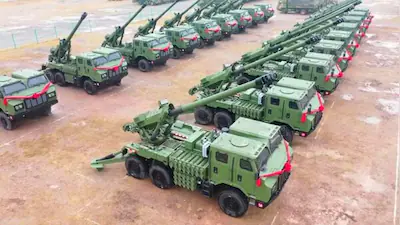
For much of the past decade, the China-Pakistan defence relationship was discussed largely in terms of individual platforms — the SH-15 truck-mounted howitzer, the JF-17 Thunder fighter, or the VT-4 main battle tank. That framing is now outdated. What is unfolding between Beijing and Islamabad in 2026 is not a series of transactional arms sales but the construction of an integrated, multi-domain military ecosystem: submarines built and commissioned on Chinese soil, a stealth fighter programme that could make Pakistan the first foreign operator of a fifth-generation Chinese jet, an air-defence architecture designed to blunt Indian standoff weapons, expanding naval access along the Arabian Sea, and a training and doctrine relationship deepened by the first real combat test of Chinese arms in decades. Taken together, these threads describe something more consequential than an arms-supplier relationship — a strategic dependency that is reshaping South Asia’s military balance and giving Beijing a growing say in how Pakistan fights, trains, and postures itself in the region.
This article examines the scope of that footprint across five dimensions: naval power projection, airpower and stealth aviation, air and missile defence, joint exercises and interoperability, and the deeper economic-security nexus anchored in the China-Pakistan Economic Corridor (CPEC). It also considers what the landmark India-Pakistan clash of May 2025 revealed about the reliability of this partnership — and what it means for India and the wider region going forward.
The Numbers Behind the Relationship
The scale of dependency is striking. According to the Stockholm International Peace Research Institute (SIPRI), Chinese arms made up 81 percent of Pakistan’s weapons imports in the five years to 2024, up from 74 percent in the preceding five-year period. Other assessments put the figure even higher, with more than 80 percent of Pakistan’s arms imports between 2021 and 2024 originating in China. The relationship is not one-directional in importance either: Pakistan alone accounted for 63 percent of China’s total arms exports over that period, worth roughly US$5.28 billion. In effect, Pakistan is not just China’s largest arms client — it is close to being China’s default demonstration platform for what Chinese military technology can do in a real shooting war.
This asymmetric dependence carries strategic costs. As one recent assessment for the Takshashila Institution has noted, China’s arms exports have expanded faster than its ability to guarantee long-term reliability and after-sales support, with documented problems ranging from thermal and metallurgical issues in VT-4 tanks used by other buyers to crashes and groundings involving CH-4B drones operated elsewhere. Yet the same dependence gives Beijing significant leverage: the deeper Pakistan’s reliance on Chinese arms, finance and infrastructure becomes, the harder it is for Islamabad to resist Beijing’s geopolitical preferences, since any pushback risks financial penalties, diplomatic friction or curtailed military cooperation.
Beneath the Waves: The Hangor-Class Submarine Programme
Perhaps the most consequential — and least discussed — element of China’s military footprint in Pakistan is unfolding underwater. Under a 2015 agreement worth roughly US$5 billion, described as Beijing’s largest-ever arms export deal, Pakistan is due to receive eight Hangor-class submarines, an export variant of the PLA Navy’s Type 039B Yuan-class boats. Four are being built in China and four domestically at Karachi Shipyard & Engineering Works under technology transfer arrangements.
The programme reached a symbolic milestone on 30 April 2026, when the first boat, PNS Hangor, was formally commissioned at a ceremony in Sanya, China, attended by President Asif Ali Zardari and Naval Chief Admiral Naveed Ashraf. Notably, Sanya is not an arbitrary port of convenience —it hosts a major PLA Navy submarine base, underscoring how tightly integrated the programme is with China’s own naval infrastructure. The submarine subsequently sailed home, arriving in Karachi in June 2026 to a formal reception.
Once complete, the fleet will field the nuclear-capable Babur-3 submarine-launched cruise missile with a range of roughly 450 km, giving Pakistan a credible deep-strike and potential second-strike capability. Combined with Pakistan’s existing Agosta-class and midget submarines, the country will operate a fleet of around 16 submarines — a force that, as one Indian defence outlet observed, will represent a dramatic expansion of sea-denial capability in the Arabian Sea, complicating India’s anti-submarine warfare posture, especially as India’s own Project 75(I) submarine programme with Germany’s ThyssenKrupp remains stalled and unlikely to deliver before 2032.
The submarines are not without controversy over their propulsion. The Chinese-made CHD620 diesel engine at the heart of the Hangor’s air-independent propulsion system previously drew scrutiny during delays to Thailand’s related S26T submarine programme, after Germany blocked export of MTU engines to China under EU arms restrictions — though Thailand later concluded the Chinese engine met or exceeded the original specification.
Gwadar: From Commercial Port to Contested Military Question
No discussion of China’s footprint in Pakistan is complete without Gwadar, the deep-water port on the Makran coast developed as the flagship node of the US$62 billion CPEC. For years, analysts debated whether Gwadar would evolve into a full PLA Navy base along the lines of China’s Djibouti facility. The debate has shifted markedly in recent months. Reporting in 2026 indicates that leaked documents suggest Pakistan’s military-backed government has privately signalled to Beijing a willingness to grant a Chinese military presence at Gwadar, offered partly as a hedge against Pakistan’s mounting debt exposure to Chinese lenders, in exchange for expanded economic and military assistance. Analysts characterise this not as China simply building a base outright, but as Pakistan being guided toward constructing one itself, on terms that guarantee Chinese naval access while bypassing public accountability.
The implications for regional security planners are significant. Should formalised PLA Navy access materialise, it would give Chinese naval forces the ability to sustain longer and more capable patrols in the northern Arabian Sea — waters directly relevant to Indian maritime security, energy supply routes and shipping through the Strait of Hormuz — prompting India to accelerate naval modernisation and deepen partnerships with the US and Gulf states.
This is a continuation of a longer trajectory. Security of the port and the broader CPEC corridor has always rested on a hybrid arrangement: Pakistan raised a dedicated Special Security Division of roughly 15,000 troops to guard Chinese assets, while China has periodically transferred hardware directly to Pakistani forces for this purpose, including patrol vessels handed over specifically to secure Gwadar port and the CPEC’s maritime routes in the Arabian Sea. Whether or not PLA personnel maintain a permanent, formally acknowledged garrison at Gwadar, the trajectory of Chinese security involvement along Pakistan’s coast has moved steadily from protecting workers and infrastructure toward something resembling forward naval access.
Into the Fifth Generation: The J-35 Stealth Fighter
If the submarine programme represents the maturation of an existing partnership, the prospective sale of the Shenyang J-35 stealth fighter represents its next frontier. Reporting through 2025 and 2026 has converged on a broad picture: Pakistan is negotiating a package that could include up to 40 J-35 fighters bundled with KJ-500 airborne early-warning aircraft and HQ-19 surface-to-air missile systems — effectively an integrated, networked air-defence package rather than a standalone jet purchase
Officials in Islamabad have moved from speculation toward acknowledgment. In May 2026, the Pakistan Air Force confirmed it had signed an “initial collaborative agreement” for acquisition of the J-35, with expectations that Pakistan could take delivery of an initial batch before the end of the year and become the first country outside China to operate the aircraft. Estimates of programme cost run to roughly USD 5–6 billion, with individual unit costs estimated at USD 80–100 million — significantly undercutting Western fifth-generation alternatives such as the F-35.
Caution remains warranted. As one detailed analysis noted, neither Beijing nor Islamabad has published a signed, itemised contract, and delivery timelines have shifted repeatedly across various reports. But the broader trajectory is unambiguous: Pakistan, having flown American F-16s since the 1980s before US arms restrictions pushed it toward Beijing, is now positioned to become the flagship export customer for China’s most advanced combat aircraft — a status that would carry significant symbolic and commercial weight for China’s defence industry well beyond South Asia.
The May 2025 Crucible: Combat-Testing the Relationship
The most important recent inflection point in this story is not a procurement announcement but a war. The four-day India-Pakistan clash of May 2025 — triggered by Indian strikes following the Pahalgam attack — became, in the words of multiple defence analysts, an unplanned real-world test of Chinese military technology. Pakistani J-10C fighters, armed with PL-15 air-to-air missiles, engaged Indian aircraft in a long-range air battle on the night of 6-7 May, with independent analysts assessing that a J-10C using a PL-15E likely shot down an Indian Rafale.
Beijing’s own reaction was telling: officials avoided direct comment, with a Chinese Defence Ministry spokesperson declining to address the performance of weapons supplied to Pakistan and downplaying reports that India had recovered an unexploded PL-15E missile. Pakistan, meanwhile, deployed its Chinese-origin HQ-9 air defence batteries against Indian missile strikes, and paired J-10Cs, JF-17 Block III jets and Chinese-origin Wing Loong II drones in a coordinated response. A subsequent US congressional report on the episode noted that Pakistan’s Chinese-origin HQ-9 batteries intercepted a number of incoming Indian threats, while J-10C fighters armed with PL-15 missiles — with ranges exceeding 200 km — allowed Pakistani pilots to engage from standoff distances beyond the reach of many Indian platforms.
Whatever the precise combat record — and Indian sources dispute elements of Pakistan’s claims — the episode had an immediate commercial effect. Reporting on Chengdu Aircraft Corporation’s financial results noted a nearly 80 percent surge in first-quarter 2026 sales, suggesting the effects of the conflict were not a transient publicity spike but had become structurally embedded in China’s export procurement pipeline. The same US congressional assessment observed that China moved quickly after the clash to offer Pakistan an expanded package including the J-35 stealth fighters, KJ-500 AEW&C aircraft and enhanced ballistic missile defence coverage — treating the conflict as validation to accelerate, rather than merely sustain, the relationship.
Interoperability by Design: Joint Exercises and Doctrine
Beyond hardware, China and Pakistan have built a dense architecture of recurring joint exercises that steadily deepen interoperability between the two militaries. These fall into three main tracks: the army-to-army “Warrior” counterterrorism series, the air force “Shaheen” series, and the naval “Sea Guardian” series. In December 2025, the two militaries convened the ninth edition of exercise Warrior at the National Counter Terrorism Center in Nowshera, focused on counterterrorism interoperability between the Pakistan Army and the PLA. On the maritime front, the two navies concluded the fourth iteration of exercise Sea Guardian in the North Arabian Sea in early April 2026, involving Chinese frigate Daqing and Pakistan’s Taimur-class vessels, with drills covering anti-submarine warfare, gunnery, and coordinated patrols.
Analysts note that this exercise architecture has been leveraged for a purpose beyond bilateral training. It increasingly positions Pakistan as an intermediary that helps China’s weapons systems gain acceptance among third countries, particularly across the Gulf. As one recent analysis put it, the Pakistani army works to coordinate interoperability between Gulf and Chinese forces through multilateral exercises, developing military protocols that blend Eastern and Western training methods to smooth their eventual integration into regional security structures. This “broker” role has become especially visible since Pakistan’s September 2025 mutual defence pact with Saudi Arabia, with Islamabad’s demonstrated familiarity with Chinese platforms — from the JF-17 to air-defence systems — helping normalise Chinese hardware for Gulf militaries historically oriented toward Western and Russian suppliers.
The Strategic Calculus: Dependency, Leverage, and Regional Response
Taken as a whole, these developments point to a relationship that has moved well past simple arms sales into something closer to strategic fusion. China gains a reliable, combat-tested showcase for its defence exports, a friendly littoral partner astride the Arabian Sea and the approaches to the Strait of Hormuz, and a diplomatic vehicle for expanding influence into the Middle East. Pakistan gains access to increasingly advanced capabilities — submarines, prospective stealth aircraft, integrated air defence — at a fraction of Western prices and without the political conditions that constrained its earlier relationship with Washington.
But the relationship is not without friction points. Chinese nationals working on CPEC and related projects have repeatedly been targeted by militant and separatist groups in Balochistan and elsewhere, forcing Beijing to press Islamabad continually on security guarantees — a dynamic that has itself driven the expansion of Chinese-linked security infrastructure in Gwadar and along CPEC routes. Questions also persist about the reliability and life-cycle support of Chinese platforms once exported, an issue that could resurface as Pakistan’s Hangor submarines and prospective J-35 fleet move from ceremony to sustained operational service.
For India, the cumulative effect of these developments is a steadily more complex two-front military planning problem: a western neighbour whose submarine fleet, airpower and air-defence architecture are increasingly interoperable with — and backed by — the People’s Liberation Army. New Delhi’s response has been to accelerate its own naval modernisation, deepen partnerships with the United States and Gulf states, and invest in maritime surveillance along the Makran coast. Whether these steps can keep pace with a Sino-Pakistani military relationship that is expanding across every domain — undersea, air, and increasingly the space and electronic-warfare domains — will be one of the defining strategic questions for South Asia over the remainder of this decade.
Conclusion
The SH-15 howitzer, once a symbol of routine Sino-Pakistani defence trade, now looks like a modest opening chapter in a much larger story. From submarines commissioned on Chinese soil to the prospect of Pakistan flying China’s first exported stealth fighter, from expanding naval access at Gwadar to a combat record burnished in the skies over Kashmir in May 2025, China’s military footprint in Pakistan has evolved from transactional supply into structural integration. For policymakers across South Asia and the wider Indo-Pacific, understanding this shift — not platform by platform, but as an interlocking system — is essential to grasping where the region’s military balance is headed next.

About the Author
Khushbu Ahlawat is a research analyst with a strong academic background in International Relations and Political Science. She has undertaken research projects at Jawaharlal Nehru University, contributing to analytical work on international and regional security issues. Alongside her research experience, she has professional exposure to Human Resources, with involvement in talent acquisition and organizational operations. She holds a Master’s degree in International Relations from Christ University, Bangalore, and a Bachelor’s degree in Political Science from the University of Delhi.
Author



