
By : Simar Kaur, Research Analyst, GSDN
Introduction
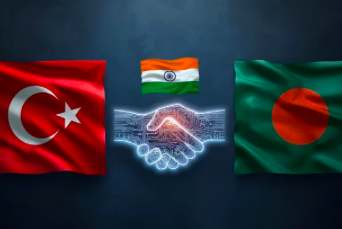
The complex South Asian geopolitics sees the changing equation between Bangladesh and Türkiye as one of the important variables that could affect the prevailing power equilibrium in the region. The emerging relationship based on the intersection of economic and defence cooperation and political coordination on some global issues has seen a major development over the past few years. Up until July 2026, it seems that the path that this bilateral equation takes is now from being one of merely exchanging good intentions to becoming one of strategic collaboration. In terms of India, whose “Neighborhood First” policy includes Bangladesh as an integral part of it, there is the possibility that this growing closeness between Dhaka and Ankara might prove to be a diplomatic hurdle.
The Geopolitical Context: From Distant Acquaintance to Strategic Powers
Conventionally, Bangladesh and Türkiye had been enjoying friendly, yet rather subdued ties based upon their common Islamic majority and past links that go back to the assistance provided by the Turks during the 1971 Liberation War. But the situation has changed dramatically since 2020 because of active diplomatic expansion by Türkiye, headed by its President Recep Tayyip Erdogan and the desire of Bangladesh to develop varied foreign ties outside its immediate neighborhood. The change of the paradigm became obvious after the political changes occurred in Dhaka in August 2024. This approach is underlined by the concept of “Asia Anew” that has been developed by Türkiye as an overarching strategy for this interaction. It is important to understand that Bangladesh has become not just a country receiving development assistance but also the key link through which Turkey can gain access to markets in Southeast Asia and the Indian Ocean. In 2025, there was a rapid escalation of activities.
Economic and Defence Convergence: Tangible Pillars of Partnership
One of the essential pillars of the developing partnership is defence cooperation, which has created the biggest concerns among regional analysts. Türkiye has established itself as a leading defence equipment provider to Bangladesh, leaving behind its traditional partners. Starting from 2022, Bangladesh has made purchases of various military hardware from Turkey, ranging from armored vehicles to unmanned aerial vehicles and naval patrol boats. Talks in early 2026 on the possibility of purchasing Turkish corvettes and long-range artillery systems demonstrate further development in the area. Technology transfer and joint production initiatives offered by Turkish defence corporations, such as Baykar and Aselsan, present an attractive option for Bangladesh to expand its sources of defence hardware. Economically, the tie-up has been cemented through substantial investments made by the Turks in the Bangladeshi infrastructure and readymade garments industries. Turkish construction firms have won tenders to construct bridges and build power plants. The Turkish brands in the retail and textile sector have begun importing from Bangladeshi factories. The ratification of a Preferential Trade Agreement in March 2026 has brought down the duties on certain export products. On the cultural front, the Turkish Maarif Foundation runs some schools in the major Bangladeshi cities of Dhaka and Chittagong.
Diplomatic Alignment and the “Ankara Effect”
Besides economics and security, there is another aspect of the diplomatic partnership between Dhaka and Ankara that makes India’s strategic environment even more complicated. Turkey has been actively supporting Bangladesh in its Rohingya refugee crisis and providing humanitarian and political assistance in international organizations. On the other hand, Bangladesh has demonstrated readiness to support the diplomatic positions of Turkey concerning issues connected with the Muslim world at international institutions such as the OIC and the UN. The alignment also exists in maritime security, with Turkiye’s presence in the Indian Ocean and its strategic base in Somalia providing an existing basis for maritime cooperation in the form of patrols of the Bay of Bengal. This cooperation, however, is still in its early stages, indicating that Dhaka wishes to diversify its security cooperation that has long depended solely on India. Turkey’s plan to open a consulate in the city of Chittagong, which was announced in October 2025, shows the importance Turkey attaches to its ties with Bangladesh’s economic and maritime capital.
Implication for India: Strategic Challenges and Diplomatic Pressure
For India, however, there are many layers of challenges associated with rising relations between Türkiye and Bangladesh. First and foremost, it marks the dilution of India’s traditionally enjoyed predominance in both economic and security terms in relation to Bangladesh. India has always been the largest trading partner of Bangladesh within South Asia, although now it seems that Bangladesh has actively sought out new ties. Secondly, the defence-deal factor becomes especially sensitive for India, since it has always played an important role in Bangladesh’s military buildup. Thirdly, there might also be an opportunity in this partnership for Bangladesh to gain greater leverage in the international sphere. In previous negotiations involving bilateral issues like sharing river water and border management, India has used its economic and security links to tilt the balance. With a Bangladesh that has alternative relationships, it would likely have to mount stiffer resistance when negotiating over unresolved matters. Lastly, in the event of tensions in the region, having a powerful Turkey present in the region would create a variable for the Indian Navy to consider in its maritime partnership with Bangladesh. It is crucial to place these developments in context. Bangladesh has India as an indispensable neighbor, and it is unlikely that the economic and geographic considerations of the region will be overtaken by that of a distant relationship. The official relationship that exists between India and Bangladesh, in spite of the current problems, still has deep institutional ties, particularly when it comes to infrastructural development and energy trade.
Conclusion
The emerging alliance of Bangladesh and Türkiye provides a great example of how power dynamics in the world continue to be restructured, where middle powers carve out their own spheres of influence. It marks the diplomatic success of the country, increasing its sovereignty and room for manoeuvre. For Türkiye, it is a way to establish itself in the Indo-Pacific region. For India, it means that it should approach this relationship with great caution and reconsider its engagement strategy with Bangladesh. Neglecting all signs of Dhaka’s increased strategic independence might cause serious miscalculations. A better approach on the part of New Delhi would consist of improving its value proposition to Bangladesh by increasing connectivity, collaborating in water management and responding to its economic needs. In the end, India’s long-term strength remains its geography and culture, but these can only prove useful in the case of proper statecraft.
Author



