
By: Khushbu Ahlawat, Consulting Editor, GSDN
Introduction
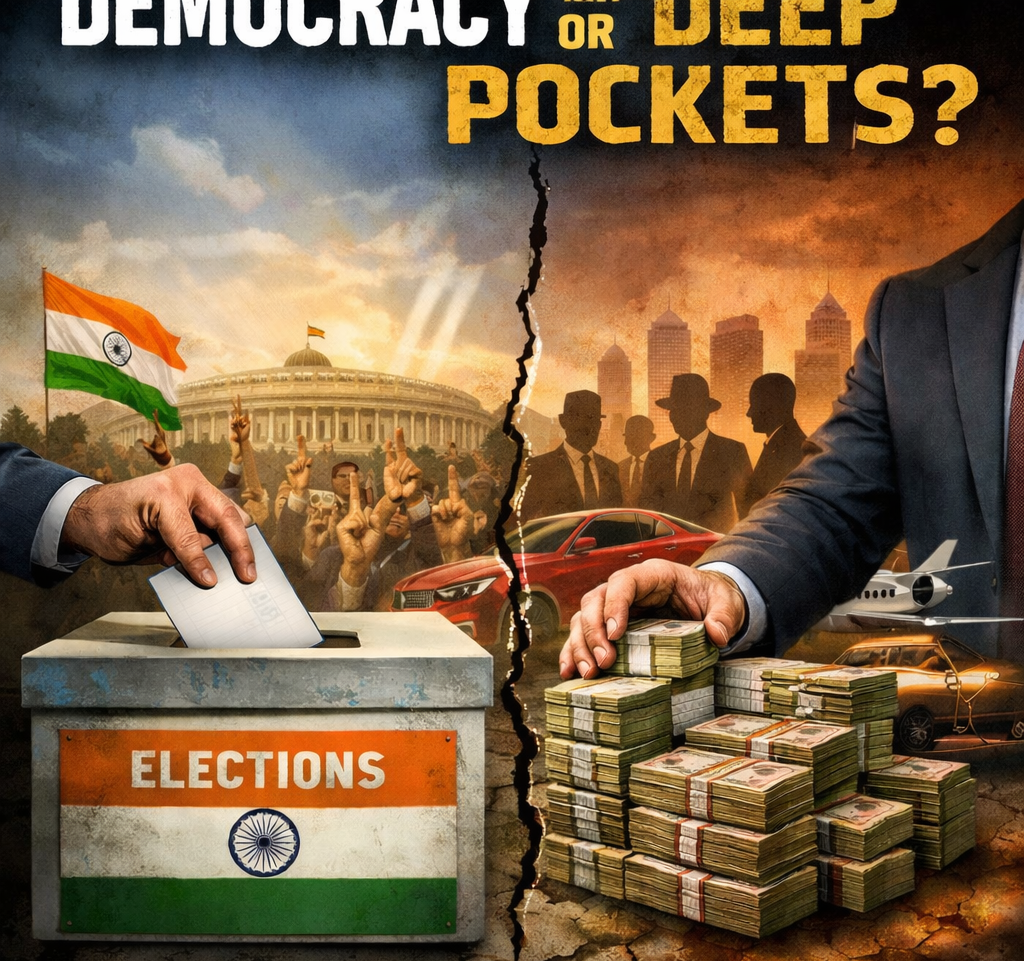
India, often celebrated as the world’s largest democracy, stands at a critical crossroads where the integrity of its electoral processes is increasingly being questioned. While elections remain vibrant, participatory, and fiercely contested, an underlying trend is raising serious concerns—the growing influence of money. From high-decibel campaigns to expansive political advertising, elections in India have become significantly more expensive over the years. This escalating cost of contestation has led many analysts to ask a pressing question: are Indian elections gradually becoming plutocratic, where financial power outweighs democratic representation?
Recent discussions around political funding, electoral bonds, and campaign expenditure reveal a complex reality. While institutions like the Election Commission of India attempt to regulate spending, the gap between prescribed limits and actual expenditure continues to widen. With nearly 93% of Members of Parliament reportedly being crorepatis, the link between wealth and political success appears stronger than ever. This raises concerns about equal opportunity, representation, and the health of democratic competition in India.
The Escalating Cost of Elections: A Barrier to Entry
Elections in India have become extraordinarily expensive, often far exceeding official limits. While the legal spending cap for a Lok Sabha candidate is around ₹95 lakh, ground realities suggest that actual expenditures run into several crores. Estimates indicate that candidates in some constituencies spend between ₹5 crore to ₹10 crore—or even more—on campaigning, mobilization, and outreach. This sharp rise in costs is driven by multiple factors: large constituency sizes, the need for extensive voter outreach, digital campaigning, media advertising, and logistical expenses. Additionally, the increasing professionalization of political campaigns—through consultants, data analytics, and targeted messaging—has further inflated costs.
The consequence of this trend is clear: elections are becoming less accessible to candidates without substantial financial backing. Independent candidates and smaller parties find it nearly impossible to compete with well-funded national and regional parties. This creates a structural imbalance, where financial strength often determines political viability, undermining the democratic ideal of equal opportunity. The rising financial barrier to electoral participation is also reflected in broader structural trends across India’s political landscape. According to data compiled by the Election Commission of India, the number of independent candidates contesting Lok Sabha elections has steadily declined in terms of electoral success, with very few managing to secure victories despite large participation on paper. This indicates that while the system remains formally open, it is increasingly difficult for candidates without strong financial or party backing to convert participation into electoral success. Additionally, reports suggest that campaign-related expenditures such as media advertising, voter outreach, and transportation costs have risen by over 40–50% in the past decade, further escalating the cost of contesting elections. The growing dependence on professional campaign management firms, data analytics teams, and digital outreach platforms has also added new layers of expenditure that were virtually non-existent two decades ago. As a result, electoral politics is gradually shifting from being a mass-based democratic exercise to a resource-intensive competition, where financial capacity often determines visibility, outreach, and ultimately, viability. This structural transformation raises critical concerns about inclusivity, as it systematically disadvantages grassroots leaders and reinforces the dominance of financially powerful candidates and parties.
The Role of Political Funding and Electoral Bonds
Political funding remains one of the most debated aspects of India’s electoral system. The now-scrutinized system of electoral bonds, introduced to enhance transparency, has instead been criticized for enabling opacity in political donations. While it allowed donors to contribute through banking channels, it did not mandate public disclosure of donor identities, raising concerns about accountability.
The scale and structure of political financing in India further reveal how deeply money has penetrated the electoral ecosystem. Data from the Association for Democratic Reforms (ADR) shows that over 90% of political donations to major national parties in recent years have come from corporate entities, with a significant portion routed through instruments like electoral bonds. For instance, between 2018 and 2024, thousands of crores worth of electoral bonds were purchased, with a disproportionately large share going to ruling parties at both the central and state levels. This concentration of funding raises concerns about competitive fairness, as parties with greater access to corporate donations are able to outspend their rivals significantly. Moreover, ADR reports indicate that in the 2019 general elections, the total declared expenditure by major political parties exceeded ₹20,000 crore, while independent estimates suggested that the actual figure could be nearly double when unaccounted spending is included.
A striking example of the role of money power can be observed in high-stakes state elections such as those in Tamil Nadu and Karnataka, where cash seizures by authorities during election periods have run into hundreds of crores. In the 2023 Karnataka Assembly elections alone, enforcement agencies reportedly seized over ₹375 crore in cash, liquor, drugs, and freebies, indicating the scale of inducement-based campaigning. Similarly, in Telangana and Andhra Pradesh, distribution of cash and gifts to voters has frequently been documented, reflecting how financial resources are directly used to influence voter behaviour.
Another dimension is the increasing reliance on digital campaigning and media dominance. Political parties now spend heavily on social media advertising, data analytics, and targeted messaging. Reports suggest that during recent elections, leading parties allocated hundreds of crores solely for digital outreach, hiring professional agencies to micro-target voters based on caste, region, and socio-economic profiles. This level of sophistication creates a significant disadvantage for smaller parties and independent candidates who lack comparable resources.
Furthermore, the asset profiles of elected representatives highlight the growing nexus between wealth and political success. According to ADR data, more than 90% of sitting MPs in the Lok Sabha are crorepatis, with average declared assets running into several crores per candidate. This trend has remained consistent across multiple election cycles, suggesting that financial strength is increasingly a prerequisite for electoral success.
Taken together, these figures and examples illustrate that the issue is not merely high spending, but the structural entrenchment of money in the electoral process. From funding sources to campaign execution and voter influence, financial power now operates at every stage of elections, raising critical questions about transparency, accountability, and the long-term health of India’s democracy.
The intervention of the Supreme Court of India in striking down aspects of the electoral bond scheme highlighted the judiciary’s concern over transparency in political financing. Critics argue that anonymous donations create a nexus between corporate interests and political power, potentially influencing policy decisions.
Data further underscores the scale of spending. In the 2024 general elections, major political parties reportedly spent thousands of crores collectively, with estimates suggesting that total election expenditure—by parties, candidates, and third parties—could range between ₹30,000 crore to ₹1 lakh crore. Such massive financial flows raise critical questions about the sources of funding and their implications for governance.
Uneven Playing Field: Impact on Democracy and Representation
The increasing role of money in elections has led to an uneven playing field, where wealthier candidates and parties enjoy a disproportionate advantage. This trend is particularly concerning in a first-past-the-post system like India’s, where even a small margin of votes can determine the winner. Candidates backed by strong financial resources can dominate media space, organize large-scale rallies, and ensure extensive ground-level mobilization. In contrast, candidates with limited funds struggle to reach voters effectively. This imbalance not only affects electoral outcomes but also discourages capable individuals from entering politics. Moreover, the dominance of money power has implications for governance. When elections become expensive, there is a risk that elected representatives may seek to recover campaign investments, leading to corruption and policy capture. This undermines public trust and weakens democratic institutions.
Reforming the System: Transparency, Regulation, and Political Will
Addressing the growing influence of money in elections requires comprehensive reforms. One of the key challenges is ensuring transparency in political funding. Mandatory disclosure of donations, stricter auditing of party finances, and real-time reporting of campaign expenditure can help improve accountability. Another potential reform is the introduction of caps on party-level spending, not just individual candidates. Currently, while candidates face expenditure limits, political parties can spend without a clearly defined ceiling, creating a loophole in the system. State funding of elections is also frequently discussed as a possible solution. By providing financial support to candidates or parties, the state can reduce dependence on private donations and level the playing field. However, implementing such a system in a country as large and diverse as India presents logistical and financial challenges. Additionally, reforms in electoral systems—such as proportional representation—have been suggested to improve inclusivity and reduce the dominance of money power. Strengthening institutions, empowering watchdog bodies, and fostering political will are essential to ensure that reforms are not just proposed but effectively implemented.
Conclusion
The question of whether elections in India are becoming plutocratic does not have a simple answer, but the trends are undeniably concerning. The rising cost of elections, coupled with opaque funding mechanisms and unequal access to resources, poses a significant challenge to the principles of democratic fairness and representation.
India’s democracy has demonstrated remarkable resilience over the decades, adapting to social, political, and economic changes. However, the growing influence of money threatens to erode this foundation if left unchecked. Ensuring free and fair elections requires not just institutional reforms but also a collective commitment from political parties, civil society, and voters.
The urgency of addressing money power in Indian elections becomes even more evident when viewed against global comparisons and long-term democratic indicators. India is often described as the world’s largest democracy, yet it is also among the most expensive in terms of electoral spending. According to estimates by the Centre for Media Studies (CMS), the 2019 Lok Sabha elections alone cost approximately ₹60,000 crore, making them one of the most expensive elections ever conducted globally—surpassing even the United States presidential elections in certain spending dimensions when adjusted for purchasing power. Projections for the 2024 general elections suggest that this figure may have crossed ₹1 lakh crore, reflecting an exponential rise in just a decade.
This surge in expenditure is not matched by proportional improvements in transparency. A significant portion of political funding in India still comes from “unknown sources,” with ADR data indicating that a large share of party income is not fully traceable to specific donors. This opacity weakens institutional accountability and creates avenues for quid pro quo arrangements between political actors and financial contributors. Moreover, international indices such as the Transparency International Corruption Perceptions Index have consistently highlighted concerns about political financing as a key vulnerability in India’s governance framework.
Another critical dimension is voter perception and behaviour. Survey-based studies suggest that while voters value development and governance, short-term inducements—such as cash transfers, gifts, or subsidies—continue to influence electoral choices in many regions. This creates a feedback loop where political parties justify high spending as a necessary investment for electoral success. Consequently, elections risk shifting from being platforms of policy debate to arenas of transactional politics.
Comparatively, several democracies have attempted to address similar challenges through strict campaign finance laws, public funding models, and real-time disclosure mechanisms. For instance, countries in Europe enforce stringent caps on both candidate and party spending, along with mandatory transparency in donations. While India’s scale and diversity make direct replication difficult, these examples demonstrate that institutional reforms can effectively curb the influence of money power when backed by political will.
Ultimately, the data underscores a structural challenge rather than a temporary distortion. The increasing monetisation of elections threatens to redefine political competition, privileging access to capital over ideological strength or grassroots connect. If left unaddressed, this trend could gradually erode the foundational principles of equality and representation that underpin democratic systems, making it imperative for policymakers, institutions, and citizens alike to confront the issue with urgency and resolve. Ultimately, democracy must remain a contest of ideas, not a competition of wealth. Preserving this ideal is essential for maintaining the legitimacy, inclusiveness, and strength of India’s democratic system in the years to come.

About the Author
Khushbu Ahlawat is a research analyst with a strong academic background in International Relations and Political Science. She has undertaken research projects at Jawaharlal Nehru University, contributing to analytical work on international and regional security issues. Alongside her research experience, she has professional exposure to Human Resources, with involvement in talent acquisition and organizational operations. She holds a Master’s degree in International Relations from Christ University, Bangalore, and a Bachelor’s degree in Political Science from the University of Delhi.



