
By: Khushbu Ahlawat, Consulting Editor, GSDN
Introduction
India’s textile sector, long celebrated as a pillar of employment and export growth, is currently experiencing a paradox. On one hand, global supply chain disruptions and geopolitical shifts have positioned India as an attractive alternative to manufacturing hubs like Bangladesh and China. On the other, this rapid expansion is unfolding against the backdrop of intensifying climate stress—particularly rising temperatures—which is quietly eroding productivity, worker welfare, and long-term sustainability. The intersection of industrial growth and environmental vulnerability has created a “thermal cost” that remains largely invisible in policy discourse but is increasingly evident on factory floors. As India seeks to consolidate its position in the global textile market, the failure to address heat-related challenges risks undermining both economic gains and human dignity.
The Productivity Crisis in a Warming Economy
India is among the countries most vulnerable to climate-induced productivity losses, particularly in labour-intensive sectors like textiles. Studies estimate that the country lost nearly 259 billion labour hours annually due to heat exposure, translating into economic losses exceeding $900 billion. In 2024 alone, losses were estimated at around $247 billion, highlighting the scale of the crisis.
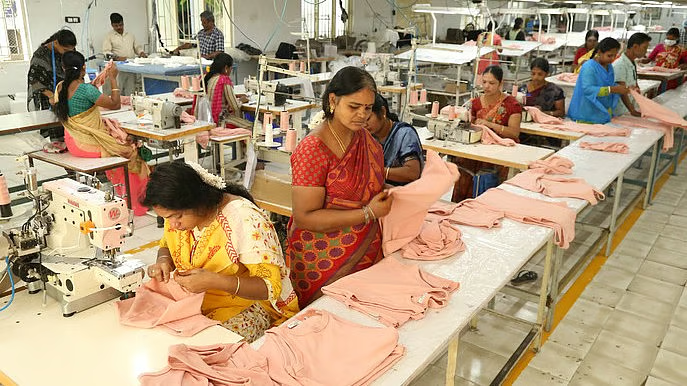
Textile hubs such as Tiruppur, Ludhiana, and parts of Maharashtra frequently experience temperatures exceeding 35–40°C, often breaching permissible industrial safety limits. Within poorly ventilated factories, indoor conditions can be even more extreme, sometimes crossing 40°C. At such levels, the human body struggles to maintain efficiency, leading to fatigue, dehydration, and increased risk of heatstroke. Research indicates that at temperatures above 33–34°C, worker productivity can decline significantly, affecting output consistency and quality.
This is not merely a theoretical concern—it is a structural economic issue. Reduced productivity leads to delayed orders, increased operational costs, and declining competitiveness in global markets. For an industry that relies heavily on tight deadlines and cost efficiency, even marginal losses in labour productivity can have cascading effects.
Climate Data, Heat Trends, and Industrial Exposure
India’s rising temperature profile is no longer a future projection—it is an unfolding reality with direct implications for labour-intensive industries. According to the India Meteorological Department (IMD), the frequency of heatwave days in India has increased by over 30% between 2010 and 2024, with 2024 and 2025 recording some of the hottest years in recent history. In major textile-producing states such as Tamil Nadu, Gujarat, and Maharashtra, peak summer temperatures have consistently crossed 40–45°C, with heatwave conditions extending beyond traditional summer months into early monsoon periods. This prolonged exposure has intensified the operational stress on factories that were never designed for such extreme climatic conditions.
The impact is particularly severe in industrial clusters like Tiruppur, which accounts for nearly 55% of India’s knitwear exports, and Surat, a major hub for synthetic textiles. In these regions, factories often rely on outdated infrastructure with minimal ventilation, leading to indoor “heat amplification” where temperatures exceed outdoor levels by 3–5°C. Studies suggest that under such conditions, the Wet Bulb Globe Temperature (WBGT)—a key indicator of heat stress—frequently crosses safe working thresholds set by international labour standards.
Moreover, India’s workforce remains highly exposed due to the nature of employment. Nearly 80–85% of textile workers operate in informal or semi-formal settings, where compliance with occupational safety norms is inconsistent. Unlike developed economies, where heat stress protocols are integrated into industrial regulations, India lacks a comprehensive, enforceable national framework addressing heat exposure in workplaces.
The economic implications are equally significant. A report by the International Labour Organization (ILO) estimates that by 2030, India could lose over 5.8% of total working hours due to heat stress, with the textile sector being among the hardest hit. This translates into billions of dollars in lost output annually, undermining India’s ambitions to scale up its manufacturing share in GDP from the current ~17% to 25%.
Crucially, climate change is also increasing unpredictability. Sudden heat spikes, erratic rainfall, and humidity fluctuations disrupt production cycles, damage raw materials like cotton, and increase energy costs for cooling. As a result, the textile industry is not just facing a labour crisis but a systemic climate risk that threatens its long-term viability.
Labour Vulnerability and Informal Burdens
The textile industry employs over 45 million workers in India, many of whom operate in informal or semi-formal conditions with limited labour protections. A significant proportion of these workers are migrants and women, who are particularly vulnerable to occupational hazards.
Heat stress exacerbates existing inequalities. Workers often endure long hours in high temperatures without adequate cooling, hydration facilities, or rest breaks. In many cases, payment structures tied to output mean that taking breaks directly reduces wages, forcing workers to choose between health and income. Reports suggest that in some factories, workers lose up to 20–40% of their effective working capacity during peak summer months.
Women workers face compounded challenges, including limited access to sanitation facilities and greater health risks. Additionally, the lack of formal contracts and weak enforcement of labour laws means that compensation for heat-related illnesses is virtually non-existent. This creates a silent crisis where the burden of climate change is disproportionately borne by those least equipped to handle it.
A critical but underemphasized dimension of the heat crisis in India’s textile sector is its intersection with public health and long-term human capital erosion. Prolonged exposure to extreme heat does not only reduce immediate productivity but also contributes to chronic health conditions such as cardiovascular stress, kidney disorders, and heat exhaustion syndromes. According to medical studies and labour health surveys, workers in high-temperature industrial environments are two to three times more likely to suffer from dehydration-related illnesses and long-term fatigue disorders, directly affecting their work consistency and employability. In regions like Tamil Nadu and Gujarat, local health reports have noted a seasonal spike in heat-related illnesses among factory workers, particularly between April and June. This creates a hidden economic burden where absenteeism increases and healthcare costs rise, often borne entirely by workers due to lack of insurance coverage. Furthermore, the loss of skilled labour due to deteriorating health conditions weakens the industry’s productivity base over time. India’s demographic dividend, often cited as a key advantage in labour-intensive manufacturing, risks being undermined if workforce health continues to decline under climate stress. The World Bank has warned that climate change could push over 45 million Indians into poverty by 2030, with heat stress being a significant contributing factor in labour-dependent sectors. Additionally, children in worker households are indirectly affected, as income instability forces compromises in education and nutrition, creating intergenerational impacts. Despite these risks, occupational health frameworks in India remain fragmented, with limited enforcement of heat-specific guidelines under existing labour laws. This gap highlights the urgent need for integrating climate resilience into public health policy, labour regulation, and industrial planning. Without such intervention, the textile sector’s growth story may come at the cost of a weakened workforce, rising inequality, and long-term socio-economic instability.
Supply Chain Pressures and Global Competitiveness
India’s textile surge is closely linked to global supply chain realignments. As brands diversify away from overdependence on single-country sourcing, India has emerged as a key beneficiary. However, this opportunity comes with intense pressure to meet international standards on cost, quality, and timelines.
Global brands often impose strict delivery schedules with financial penalties for delays. This creates a “supply chain trap” where factory owners, under pressure to fulfill orders, pass on the burden to workers through extended shifts and intensified workloads—even during extreme heat conditions. The result is a vicious cycle: heat reduces productivity, delays orders, and leads to further pressure on labour.
Comparatively, countries like Vietnam and Mexico are investing in climate-resilient infrastructure and technological upgrades, enabling them to maintain efficiency despite environmental challenges. If India fails to adapt, it risks losing its competitive edge despite current advantages.
Adapting to the Thermal Challenge: Policy and Industry Response
Addressing the thermal cost of industrial growth requires a multi-layered approach involving government policy, industry innovation, and global accountability. One key step is integrating heat stress into occupational safety standards, ensuring mandatory provisions for ventilation, cooling systems, rest breaks, and hydration. Investment in climate-resilient infrastructure—such as heat-resistant building materials, improved factory design, and energy-efficient cooling technologies—is essential. For instance, adopting passive cooling techniques and green roofing can significantly reduce indoor temperatures without excessive energy consumption. Financial mechanisms also play a critical role. Small and medium enterprises (SMEs), which dominate the textile sector, often lack the capital to invest in such upgrades. Targeted subsidies, concessional loans, and public-private partnerships can bridge this gap.
On the global front, international brands must share responsibility by incorporating climate risks into their sourcing strategies and providing financial support for adaptation measures. Ethical supply chain practices should extend beyond wages and working hours to include environmental and health considerations.
Global Comparisons and the Cost of Inaction
India’s challenge becomes even more pronounced when viewed in a comparative global context. Competing textile economies such as Vietnam, Bangladesh, and China are increasingly investing in climate-resilient manufacturing systems. Vietnam, for instance, has integrated green industrial parks and climate-adaptive factory designs, reducing indoor temperatures by up to 6–8°C through passive cooling and energy-efficient architecture. Similarly, Bangladesh—despite its own climate vulnerabilities—has made significant progress in factory compliance, with over 200 LEED-certified green garment factories, the highest in the world. In contrast, India’s adoption of climate-resilient practices remains uneven. While large export-oriented firms have begun investing in automation and cooling technologies, small and medium enterprises (SMEs)—which constitute over 70% of the textile sector—lag significantly behind due to financial and technological constraints. This creates a dual-speed industry where only a fraction of firms are equipped to handle future climate risks.
The cost of inaction is not merely domestic—it directly affects India’s global competitiveness. International buyers are increasingly incorporating Environmental, Social, and Governance (ESG) criteria into sourcing decisions. Brands are under pressure from consumers and regulators in Europe and North America to ensure sustainable and ethical production practices. Failure to address heat stress and worker welfare could lead to reputational risks, order cancellations, and reduced market access. Energy costs further complicate the scenario. As temperatures rise, the demand for cooling increases, leading to higher electricity consumption. India’s textile sector already accounts for a significant share of industrial energy use, and without efficient cooling solutions, this demand could surge by 20–30% over the next decade, increasing production costs and carbon emissions simultaneously. However, this challenge also presents an opportunity. By investing in climate-resilient infrastructure, India can position itself as a leader in sustainable manufacturing. Initiatives such as solar-powered cooling systems, water-efficient dyeing technologies, and heat-resilient labour policies can not only mitigate risks but also enhance productivity and brand value.
Ultimately, the global textile market is undergoing a transformation where sustainability is no longer optional—it is a competitive necessity. Countries that fail to adapt will face declining relevance, while those that innovate will capture the next wave of growth. For India, the choice is clear: adapt proactively or risk losing the very advantage its textile surge has created.
Conclusion
India’s textile boom presents a significant economic opportunity, but its sustainability hinges on addressing the hidden thermal costs that threaten both productivity and human welfare. Rising temperatures are not just an environmental concern—they are an economic and social challenge that directly impacts one of the country’s largest employment sectors. Ignoring this reality could erode the very advantages that position India as a global manufacturing hub. Conversely, proactive adaptation can transform this challenge into an opportunity, enabling India to lead not only in production but also in sustainable and equitable industrial practices. The future of India’s textile industry will depend not just on how much it produces, but on how responsibly it manages the conditions under which production occurs.
Looking ahead, integrating climate resilience into industrial policy is no longer optional but imperative. Without immediate intervention, rising heat stress could reverse employment gains, weaken export competitiveness, and strain public health systems, ultimately challenging India’s ambition to emerge as a sustainable global manufacturing powerhouse in the coming decade.

About the Author
Khushbu Ahlawat is a research analyst with a strong academic background in International Relations and Political Science. She has undertaken research projects at Jawaharlal Nehru University, contributing to analytical work on international and regional security issues. Alongside her research experience, she has professional exposure to Human Resources, with involvement in talent acquisition and organizational operations. She holds a Master’s degree in International Relations from Christ University, Bangalore, and a Bachelor’s degree in Political Science from the University of Delhi.



