
By: Khushbu Ahlawat, Consulting Editor, GSDN
Introduction
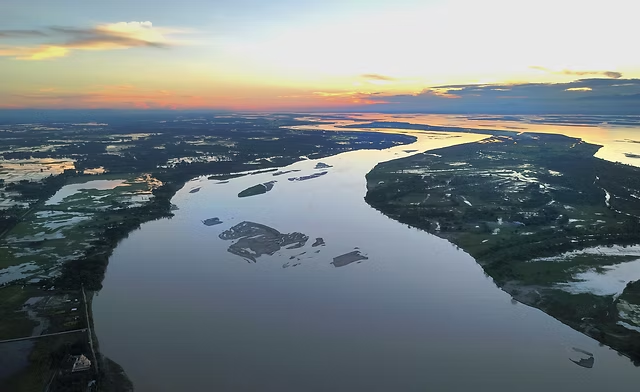
Northeast India, a region defined by its ecological richness and hydrological complexity, is emerging as a critical frontier in India’s geopolitical and economic strategy. Comprising eight states and interconnected by a dense network of rivers, the region serves as a natural bridge between South Asia and Southeast Asia. At the centre of this network lies the Brahmaputra River—a transboundary lifeline that sustains agriculture, hydropower, and livelihoods while shaping regional connectivity.
In recent years, India’s evolving Indo-Pacific vision and the Act East Policy have brought renewed focus to the Northeast as a strategic gateway. Legislative backing through the National Waterways Act 2016 has enabled the expansion of inland water transport (IWT) networks, positioning rivers as engines of economic integration. However, this transformation is occurring amid geopolitical shifts, including instability in Myanmar and recalibrating relations with Bangladesh.
Recent infrastructure push further reinforces this shift. The Government of India has earmarked approximately ₹5,000 crore for developing waterways in the Northeast, alongside plans for dozens of community jetties to boost local connectivity and trade ecosystems. In 2026, multiple inland waterway projects were inaugurated along the Brahmaputra, signaling a transition from policy intent to implementation. Simultaneously, strategic infrastructure such as the Kumar Bhaskar Varma Setu and the proposed Brahmaputra underwater tunnel highlight an integrated approach combining riverine and land connectivity. These developments collectively indicate that Northeast India is no longer peripheral but central to India’s Indo-Pacific vision. Revitalising its river systems is thus not merely developmental—it is geopolitical, economic, and strategic in equal measure.
River Systems as Strategic and Economic Arteries
The river systems of Northeast India have historically functioned as vital channels of trade and connectivity. Colonial-era networks linking Assam to Kolkata via river routes demonstrate the region’s long-standing integration into global commerce. Today, these waterways are being reimagined as cost-effective and sustainable transport corridors.
Recent policy initiatives have accelerated this transformation. National Waterway 2 (Brahmaputra) and National Waterway 16 (Barak) are witnessing increased cargo movement, supported by investments in terminals, vessels, and logistics infrastructure. The government is actively constructing modern river terminals, introducing mechanised cargo handling systems, and deploying new inland vessels to improve efficiency.An equally transformative dimension of revitalising Northeast India’s river systems lies in their potential to catalyse regional value chains and integrate local economies into global production networks. Beyond their traditional role as transport corridors, rivers such as the Brahmaputra River and Barak can serve as logistical backbones for emerging sectors including agro-processing, bamboo-based industries, fisheries, and eco-tourism. Recent policy emphasis on multimodal logistics parks, riverine cold storage systems, and last-mile connectivity infrastructure reflects a shift toward creating an ecosystem rather than isolated transport routes. For instance, integrating inland waterways with rail corridors and border trade points can enable seamless movement of goods from Northeast India to markets in Southeast Asia, particularly under frameworks aligned with India’s Act East Policy. Furthermore, the development of river ports as economic clusters—equipped with warehousing, customs clearance, and digital tracking systems—can attract private investment and generate employment in a region historically constrained by limited industrialisation. This approach also aligns with global trends toward sustainable logistics, as inland water transport offers a lower carbon footprint compared to road and rail alternatives. However, realising this vision will require addressing critical gaps in skill development, institutional coordination, and financing mechanisms. Encouraging public-private partnerships, fostering entrepreneurship, and integrating local communities into value chains will be essential for ensuring inclusive growth. In this sense, river revitalisation is not merely about enhancing connectivity but about reimagining Northeast India as a dynamic economic corridor—one that bridges local potential with regional and global opportunities while reinforcing its strategic relevance in the Indo-Pacific.
Moreover, new projects launched in 2026 aim to transform the Brahmaputra into a major logistics and tourism corridor, reflecting a dual-use strategy that integrates economic growth with regional development. The development of additional waterways—such as Dhansiri and Kopili—under the National Waterways framework further expands the network, creating a multi-nodal river transport system.
However, despite these advancements, challenges remain. Infrastructure gaps, seasonal navigability issues, and limited private sector participation constrain the full utilisation of these waterways. Addressing these bottlenecks will require sustained investment, technological innovation, and policy coordination. If successfully implemented, river systems can significantly reduce logistics costs, enhance trade competitiveness, and position Northeast India as a key economic corridor linking South Asia with Southeast Asia.
Transboundary Rivers and the Geopolitics of Water Diplomacy
Northeast India’s rivers are inherently transboundary, flowing across multiple countries and shaping regional geopolitics. The Brahmaputra basin, shared by China, India, and Bangladesh, exemplifies the strategic complexities of water governance. Issues such as upstream dam construction, data sharing, and seasonal flow variations are increasingly intertwined with broader geopolitical competition.A critical yet often underemphasised dimension of transboundary river governance is the growing impact of climate change on water security and regional stability. The Himalayan river systems, including the Brahmaputra River, are highly sensitive to glacial melt, erratic precipitation patterns, and extreme weather events, all of which are intensifying due to global warming. These environmental shifts are altering river flow regimes, increasing the frequency of floods in downstream regions such as Assam and Bangladesh, while also raising concerns about long-term water availability during dry seasons. Such variability complicates existing diplomatic arrangements, as traditional water-sharing frameworks are often based on historical flow data that may no longer be reliable. Moreover, climate-induced stress can exacerbate geopolitical tensions, particularly in regions where trust deficits already exist. In this context, integrating climate resilience into water diplomacy becomes imperative. This includes enhancing joint data-sharing mechanisms, investing in early warning systems, and developing adaptive river basin management strategies. By framing rivers not merely as resources to be divided but as shared ecosystems to be managed collectively, India can promote a more cooperative and forward-looking approach to regional water governance.
Recent developments highlight these concerns. India has unveiled a massive multi-billion-dollar hydropower and transmission plan to harness the Brahmaputra basin’s potential, partly in response to China’s upstream dam-building activities. This reflects the growing securitisation of water resources, where infrastructure development is linked to both energy security and strategic positioning. At the same time, unresolved issues such as the Teesta River water-sharing dispute continue to affect India–Bangladesh relations. Effective water diplomacy is therefore essential not only for resource management but also for maintaining regional stability. India has begun to adopt a more proactive approach, leveraging bilateral river agreements and transit frameworks to enhance connectivity and cooperation. However, long-term success will depend on institutionalising these mechanisms, ensuring transparency, and building trust among stakeholders. In an era of climate change and increasing water stress, cooperative river governance will be critical for preventing conflict and unlocking the full strategic potential of Northeast India’s waterways.
Connectivity Corridors and Strategic Alternatives to the Siliguri Corridor
The strategic vulnerability of the Siliguri Corridor has long constrained Northeast India’s connectivity. River-based and multimodal projects are now being developed to reduce this dependence and create alternative routes to the sea. The Kaladan Multi-Modal Transit Transport Project is central to this strategy. By linking Mizoram to Myanmar’s Sittwe port, it provides a direct maritime route that bypasses the Siliguri Corridor, significantly enhancing logistical resilience. The project is expected to become fully operational by 2027, further strengthening India’s Act East ambitions.Beyond economic and logistical considerations, the development of alternative connectivity corridors in Northeast India carries significant national security implications. The heavy reliance on the Siliguri Corridor—a narrow stretch connecting the region to mainland India—has long been viewed as a strategic vulnerability, particularly in the context of evolving regional security dynamics. River-based and multimodal connectivity projects, such as those linked to the Kaladan Multi-Modal Transit Transport Project, offer not only economic benefits but also critical redundancy in times of crisis. By creating multiple access routes to the Northeast, India can enhance its military mobility, ensure uninterrupted supply chains, and reduce the risks associated with potential disruptions along a single corridor. Additionally, improved connectivity to ports such as Sittwe strengthens India’s strategic outreach into the Bay of Bengal, aligning with its broader Indo-Pacific vision. However, the security dimension also necessitates robust border management, infrastructure protection, and coordination among defence and civilian agencies. Integrating these considerations into connectivity planning will be essential for ensuring that infrastructure development contributes not only to economic growth but also to long-term strategic resilience and national security preparedness.
Recent expansions include integrating river systems such as the Brahmaputra and Barak into a broader multimodal network, enhancing connectivity between Northeast India and Southeast Asia. Additionally, infrastructure projects like the proposed Brahmaputra underwater tunnel and new bridges aim to drastically reduce travel time and improve access to border regions. However, geopolitical uncertainties—particularly in Myanmar—pose significant challenges. India’s engagement with multiple stakeholders reflects the complexities of implementing infrastructure projects in politically volatile environments. Despite these challenges, the development of alternative corridors remains essential for ensuring economic integration and strategic autonomy. By diversifying connectivity routes, India can mitigate risks and enhance the resilience of its northeastern region.
From Vision to Reality: Bridging Policy Ambitions and Infrastructure Gaps in Northeast India
India’s policy approach toward Northeast connectivity has evolved from the Look East Policy to the more action-oriented Act East Policy. This shift reflects a growing recognition of the region’s strategic importance in the Indo-Pacific framework.An important factor that will determine the long-term success of Northeast India’s river revitalisation efforts is the role of institutional governance and inter-agency coordination. While multiple ministries—including shipping, water resources, environment, and external affairs—are involved in river development and connectivity projects, the absence of a unified institutional framework often leads to fragmented implementation and delays. Establishing a dedicated river basin authority or a Northeast-focused inland waterways coordination body could streamline decision-making, ensure policy coherence, and accelerate project execution. Additionally, aligning central initiatives with state-level priorities is essential, given the diverse socio-political and ecological contexts across the region. Strengthening institutional capacity at the local level—through training, technical expertise, and digital monitoring systems—can further enhance efficiency and accountability. International best practices, such as integrated river basin management models, offer useful lessons for India in balancing development with environmental sustainability. By prioritising governance reforms alongside infrastructure investments, India can ensure that its ambitious plans for river revitalisation are not only implemented effectively but also sustained over the long term, thereby reinforcing the Northeast’s role as a strategic and economic gateway to the Indo-Pacific.
Significant investments have been made in infrastructure, including dredging, port development, and multimodal connectivity projects. The government has committed substantial financial resources toward inland waterways, alongside ongoing projects nearing completion across Assam and neighbouring states. Innovative initiatives—such as developing inland water transport on smaller rivers and lakes in states like Nagaland, Mizoram, and Meghalaya—highlight efforts to expand connectivity beyond major waterways. These projects aim to integrate remote regions into the broader economic network, promoting inclusive and balanced development. However, challenges persist. Delays in key projects, limited coordination among agencies, and environmental concerns—such as riverbank erosion and flooding—continue to hinder progress. Recent large-scale anti-erosion and river management projects underscore the urgency of addressing these structural issues.
Moving forward, a comprehensive strategy is needed to align infrastructure development with environmental sustainability and geopolitical objectives. This includes leveraging digital technologies, enhancing public-private partnerships, and strengthening institutional capacity. Only through such an integrated approach can Northeast India realise its full potential as a strategic gateway to the Indo-Pacific.
Conclusion
Northeast India’s river systems represent a convergence of geography, economy, and geopolitics. From the Brahmaputra’s vast basin to emerging connectivity corridors, these waterways hold the key to transforming the region into a hub of trade and strategic influence. Recent developments—from large-scale investments and infrastructure projects to renewed policy focus—indicate that India is actively repositioning the Northeast within its Indo-Pacific strategy. The expansion of inland waterways, operationalisation of multimodal projects, and integration of river systems into regional supply chains reflect a comprehensive and forward-looking approach. However, the path ahead is not without challenges. Geopolitical uncertainties, environmental vulnerabilities, and infrastructural gaps must be addressed through sustained policy efforts and regional cooperation. Strengthening ties with Bangladesh and Myanmar, while diversifying connectivity options, will be critical for ensuring long-term resilience. Ultimately, the revitalisation of Northeast India’s rivers is about more than connectivity—it is about redefining India’s strategic geography. If effectively harnessed, these waterways can transform the Northeast from a peripheral region into a central node of Indo-Pacific engagement, shaping the future of regional trade, diplomacy, and security in the 21st century.

About the Author
Khushbu Ahlawat is a research analyst with a strong academic background in International Relations and Political Science. She has undertaken research projects at Jawaharlal Nehru University, contributing to analytical work on international and regional security issues. Alongside her research experience, she has professional exposure to Human Resources, with involvement in talent acquisition and organizational operations. She holds a Master’s degree in International Relations from Christ University, Bangalore, and a Bachelor’s degree in Political Science from the University of Delhi.
Author



