
By: Andey Vivaan, Research Analyst, GSDN
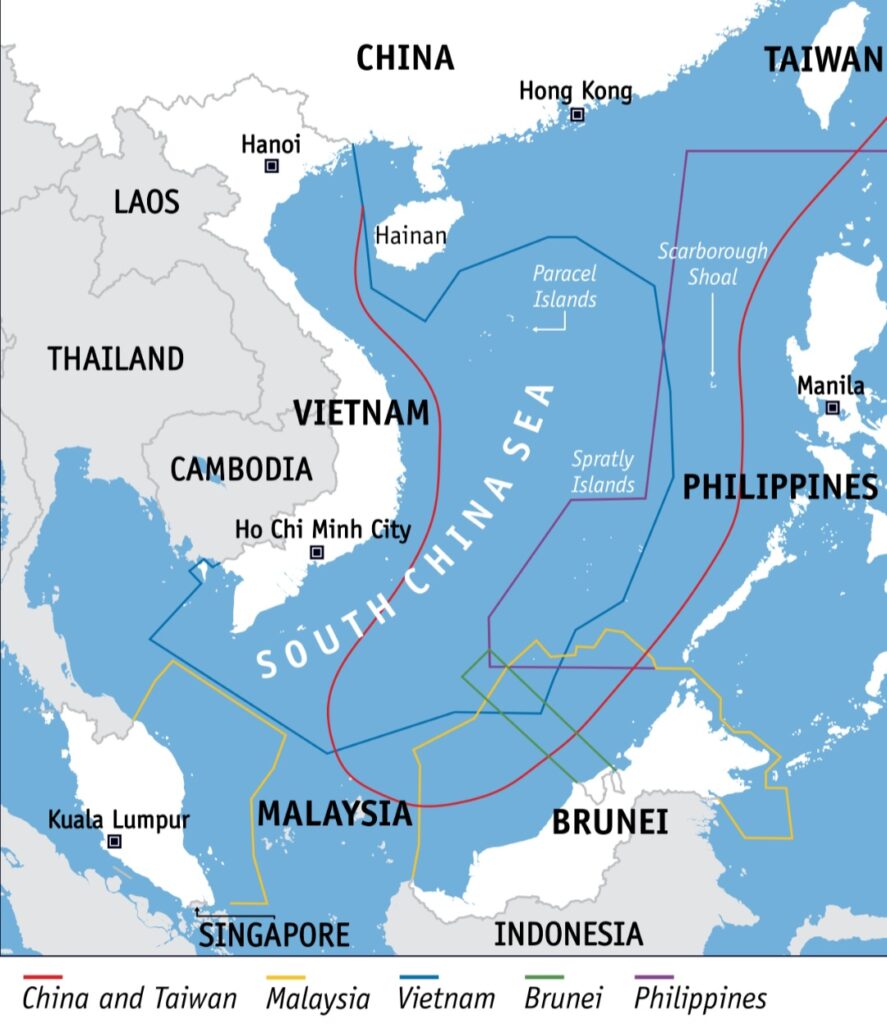
The Spratly Islands are a scattered collection of reefs, shoals, atolls, and small islands located in the South China Sea. It has become one of the most contested territories in contemporary international politics. At first glance, these remote and largely uninhabited islands may seem insignificant. However, below the surface lies a complex mix of history, national identity, economic interests, strategic competition and geopolitical rivalry. Many countries like China, Vietnam, the Philippines, Malaysia, Brunei and Taiwan have claimed all or parts of the Spratly Islands. Among these claimants China has emerged as the most assertive actor, investing heavily in infrastructure, military facilities and the artificial island construction to strengthen its presence in the region. Instead, their importance comes from the combination of strategic location, historical claims, valuable resources, and security concerns control over important maritime lanes, access to lucrative natural resources and much more general desires to become a dominant global force. China considers the islands to be an essential component of its maritime security strategy and a fundamental part of its own territory. However, some nations view China’s moves as an attempt to control the South China Sea and change of the balance of power in that region.
Tensions surrounding the Spratly Islands have escalated in the recent years. What was once a relatively unnoticed territorial conflict it has become a major international problem due to the creation of artificial islands, the deployment of military equipment and frequent confrontations between the Chinese and Philippine boats. The region’s strategic importance has been further enhanced by the participation of outside countries like the United States and Japan.
This article explores why the Spratly Islands matter so much to China. It examines the historical background of the dispute, the economic and the energy resources associated with the islands , their military and strategic importance and the broader implications for regional security and the international politics.
Understanding the Spratly Islands
The Spratly Islands are spread across a vast area of the South China Sea, covering approximately 409,000 square kilometres. Most of the features are small reefs, rocks and waves , many of which are submerged during high tide. Despite their limited land area the islands occupy a strategically important position between Vietnam, the Philippines and Malaysia.
The islands have not received much attention in the past. Because of its dangerous barrier reefs due to these traders and navigators frequently avoided the area while the fishermen occasionally came to fish and gather the turtle items.
Many countries started claiming sovereignty over the islands after Japan surrendered and renounced its territorial claims in the year 1951. Based on various historical and geographical justifications. Countries like China, Taiwan, Vietnam, and the Philippines all claimed the ownership. Over time, however, the dispute intensified as countries realized the region’s growing strategic and the economic value.
The Spratly Islands are special because their significance comes from their extensive oceanic zones and resources rather than their land size. Ownership of islands became associated with rights over nearby waterways and seafloor resources as international law developed especially with the passage of the United Nations Convention on the Law of the Sea (UNCLOS). As a result, even small islands gained significant strategic importance.
Historical Claims and China’s Perspective
China’s historical claim to the Spratly Islands is one of the primary reasons why they are important. Chinese officials often claim that the islands have been used for centuries by the Chinese sailors and fisherman. China claims that maps and historical documents show Chinese control over the South China Sea and its island groups, including the Spratly Islands.
The Nine-Dash Line a U-shaped border that covers the majority of the South China Sea is frequently used to represent China’s viewpoint. China claims that this line represents China’s historical rights in that region. China’s territorial claims are based on the Nine-Dash Line despite the fact that its exact legal meaning is still under debate.
The problem for China goes past the geography and resources. As it is directly connected to their national pride and sovereignty. Chinese authorities often cite historical instances in which foreign powers captured Chinese territory and enforced unfair treaties on China.
As a result, China’s national identity is deeply tied to undoing these historical grievances. Today, the Spratly Islands are a potent symbol of modern Chinese sovereignty, where any diplomatic compromise would be viewed domestically as a sign of weakness.
Economic Significance
For China, the Spratly Islands are very important economically. Their proximity to some of the most significant maritime trade routes in the globe is one of the factor.
An important route for international trade is the South China Sea. Each year, A significant portion of global trade connects the East Asia with Europe, Africa and the Middle East via these seas. Uninterrupted access to these marine routes is crucial for China the largest trade nation in the world.
Greater influence over the Spratly Islands would strengthen China’s position along some of the world’s most important maritime routes. A larger presence in the area improves China’s capacity to monitor and possibly safeguard the marine trade which is crucial for its economy, even though China does not openly aim to limit the shipping for commercial purposes.
Beyond shipping, the South China Sea holds some of the world’s most lucrative fishing grounds. These waters sustain millions of livelihoods across Asia. For China, which operates the world’s largest fishing fleet, securing dominant access to these fisheries is a matter of long-term food security. China would be better able to protect the resources and fishing rights for its people if it gained control over the Spratly Islands.
Energy Security and Natural Resources
Energy security is another major reason why the Spratly Islands matter to China.
There are substantial natural gas and oil deposits in the South China Sea according to various estimations. According to some estimates the larger region has about 190 trillion cubic feet of natural gas and 11 billion barrels of oil. According to other estimates, the waters around the Spratly Islands may hold huge quantities of natural gas and billions of barrels of accessible oil.
The possibility for significant energy resources has drawn a lot of attention from the claiming governments, despite the fact that overlapping sovereignty claims have frozen major exploration efforts. This untapped potential is highly attractive to China. Despite being a top global energy producer, China’s rapid economic growth forces it to rely heavily on foreign oil and gas imports.
Therefore, the Spratly Islands are seen by Chinese authorities as a potential source of strategic energy resources that could foster sustained economic growth.
Military and Strategic Importance
The Spratly Islands are important to China for military reasons, which might be the main factor.
The islands are strategically located in the middle of the South China Sea. A country can monitor marine trade, carry out surveillance activities and project military might over a wide area by controlling these features.
Recognizing these advantages China has steadily expanded its presence in the Spratly Islands over the past decade. China started increasing land reclamation efforts in the 2014 transforming the underwater features and reefs into the man-made islands. Also on one of these reclaimed features, China had built a functional airstrip by March 2015.
Airfields, ports, radar systems, communication centres and other military infrastructure are now located on these man-made islands. Chinese planes and navy boats may operate further from the mainland and establish a more permanent presence in the area thanks to these structures.
By making it more difficult for opposing forces to operate freely in the South China Sea the military analysts believe that these installations enhance China’s anti-access and area-denial capabilities. Additionally, the islands serve Chinese coast guard ships and navy missions logistically.
China believes that by establishing defensive positions that safeguard China’s southern maritime accesses, these initiatives enhance national security.
The Exclusive Economic Zone Factor
The Spratly Islands are becoming much more important because of the idea of the Exclusive Economic Zone.
Coastal states can claim an Exclusive Economic Zone up to 200 nautical miles from their coastlines under the United Nations Convention on the Law of the Sea (UNCLOS). States in this area have unique rights regarding the discovery and the use of natural resources.
By increasing a nation’s access to nearby waterways and bottom resources island control might affect maritime claims. Because of this, owning even small islands can have significant strategic and financial advantages.
Control over the Spratly Islands may provide China more access to natural resources like fisheries and hydrocarbons, and also strengthen its claims to bigger marine areas. This explains China’s strong emphasis on preserving and growing its influence in that region.
China’s Artificial Island Strategy
One of the most controversial aspects of China’s South China Sea policy has been its artificial island construction program.
China started large-scale land reclamation work on a number of Spratly Islands reefs and atolls in the early 2010s. Larger land masses that could support both military and civilian infrastructure were created using sand and building materials.
These initiatives have created large complexes with runways, ports, barracks, radar stations and defense systems from previously hidden or hardly developed features.
China claims that these installations aid in national defense, scientific research, disaster relief, and maritime safety. However, some believe that the projects main goals are to strengthen Chinese territorial claims and increase military power.
Regardless of China’s official civilian framing, these outposts have fundamentally altered the strategic landscape, giving China a permanent militarized launchpad deep inside contested waters.
Regional and International Reactions
China’s activities in the Spratly Islands have generated strong reactions from neighbouring countries.
Taiwan, Brunei, Malaysia, Vietnam, and the Philippines all have conflicting claims to the portions of the South China Sea. Many of these nations see China’s moves as an attempt to undermine their own territorial claims and change the status quo.
The Philippines has been very outspoken in criticizing Chinese actions. Manila started UNCLOS arbitration procedures in January 2013. On July 12, 2016 the Permanent Court of Arbitration found that China’s broad maritime claims had no legal foundation under the treaty, which was mostly in favor of the Philippines.
China refused to acknowledge the tribunal’s jurisdiction and rejected the ruling, calling it as illegitimate.
The dispute has also attracted the attention of external powers. The United States has repeatedly emphasized the importance of freedom of navigation and has conducted naval operations in the region to challenge what it considers excessive maritime claims.
Japan has likewise increased security cooperation with Southeast Asian states by providing maritime equipment and support to countries such as the Philippines and Vietnam.
Implications for China’s Regional Ambitions
The Spratly Islands are closely connected to China’s broader ambition of becoming the leading power in the Indo-Pacific region.
Control over these islands enhances China’s ability to influence regional security dynamics, protect maritime trade routes, secure energy resources and project military power. The islands also serve as symbols of China’s determination to defend what it considers its historical rights and territorial sovereignty.
At the same time, China’s actions have contributed to concerns among the neighbouring countries encouraging closer security cooperation between Southeast Asian states and external powers such as the United States and Japan.
As a result, the Spratly Islands have become a focal point in the broader competition for influence in Asia.
Conclusion
The Spratly Islands matter to China for multiple interconnected reasons. They have always been associated with Chinese national identity and sovereignty claims. They are economically close to important shipping lanes and rich fishing areas. From a strategic standpoint they offer access to potentially important natural gas and oil resources. Militarily, they offer platforms for observation, force projection and defense operations in the South China Sea.
China’s significant spending in military facilities, artificial islands and maritime surveillance show how important the area is to China. But these actions have also heightened tensions with major powers, especially the United States and escalated disagreements with neighbouring countries.
In my view, the Spratly Islands issue is unlikely to be resolved in the near future because too many political, economic, and security interests are involved. China sees the islands as essential for its national security and regional influence, while other claiming states view Chinese actions as a threat to their sovereignty. As competition between China and the United States continues to grow, the Spratly Islands will remain one of the most important geopolitical flashpoints in the Indo-Pacific region.



