
By : Soumya Dutta, Research Analyst, GSDN
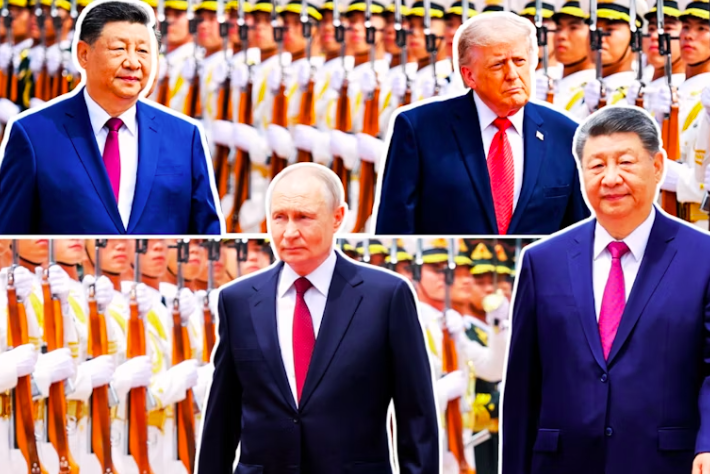
The contemporary geopolitical landscape has been marked by growing tensions among the United States, China and Russia, with the interactions increasingly influencing the contours of the global order. The second Trump administration arrived on January 2025, with the US President pursing a more transactional foreign policy, one which has been highlighted by its aggressive economic measures and disruption of established alliances. These developments have taken shape alongside the often described “no-limits” partnership between the Chinese President Xi Jinping and the Russian President Vladimir Putin, which has deepened in lieu of their long and historical relationship, their cycles of cooperation and the shifting balance of power.
Trump has started his second term, with the hopes of ‘un-uniting’ Beijing and Moscow and preventing the formation of a consolidated axis between the two major powers. But a combination of economic sanctions and geopolitical crises has ended up reinforcing the strategic coordination between the two. This includes but is not limited to increased trade volume with a rise of 23 per cent between the months of January and May 2026 and in energy exports that has rapidly climbed since the outbreak of the Ukraine war along with the proposal of new infrastructure projects such as the Power of Siberia 2 pipeline to further deepen bilateral integration. This however should not be interpreted as an unconditional alignment, as China has continued to be cautious about an overdependence on Russian energy and it reflects a broader priority of avoiding reliance on any single partner. Most importantly, Beijing remains far more integrated with the global economy and continues to safeguard its ties with major markets while avoiding any costly secondary sanctions. Russia for its part is also approaching the limits of what this partnership can deliver and remains wary of the asymmetry: its economy becoming increasingly reliant on a single major buyer with the leverage to set terms. Therefore, the interaction shaping their engagement cannot be clearly defined through clear choices or stable alignments, but as part of a great power interaction, that is at once interdependent, with coordination where their interests converge and through hedging where they diverge, thereby creating a more fragile and strained international order.
A Broken Triangle
The origin of this triangular configuration can be better understood by tracing the longer history of how these powers have positioned themselves against one another over successive decades. Beginning with Nixon, in the backdrop of the Sino-Soviet split in the 1970s that has been the result of a deepening ideological and territorial dispute, Washington found an opportunity to exploit the rift by isolating Moscow while enhancing its own strategic ties. This strategy worked as Beijing found itself economically isolated with limited diplomatic reach and was seeking greater strategic autonomy from Soviet influence. This allowed the US to maintain a relatively better position with both powers, with a greater diplomatic leverage rather than being constrained by a unified bloc.
The dissolution of the Soviet Union and a post-Cold War in unipolar order reduced the need for triangular balancing, as the shift in strategic conditions meant that the US was less likely to confront similar tensions that could constrain its choices. These conditions however no longer exist and under Trump there is an attempt to replicate this logic in reverse, by warming up to Moscow and trying to isolate Beijing. This perception has been echoed in the US policy cycles including the Secretary of State Marco Rubio, who has long argued that the US should avoid Russia becoming a long-term junior partner to China. In a strategy dubbed the “reverse Nixon”,Trump’s approach has been to ease Western sanctions on Russia and reassure the concerns that are there on NATO expansion to encourage Moscow to distance itself from China. Analysts however argue that Trump’s concessions on issue like Ukraine would not be a strong incentive for Moscow to burn a long-time relationship with China, for an administration that could leave office by 2028.
Conversely, China and Russia are not formal allies, but their partnerships are grounded in economic interdependence and converging interests in limiting the US influence. Moreover, Russia and China are part of multilateral organizations such as the Shanghai Cooperation Organization (SCO) and the BRICS+, and both have across successive US administrations from Obama to Biden have deepened their cooperation in energy, finance, trade and technology. The assumption therefore that Kremlin can be easily incentivized to decouple from Beijing might be naive. For Moscow, the successive rounds of sanctions have shown the uncertainty that any potential reintegration into the SWIFT system, even if the access is given can be withdrawn at any time.
For Beijing and Moscow thus, the partnership has continued to deepen, and has been enhanced by Putin’s May 2026 visit, which coincided with the 25th anniversary of the Russia-China Treaty of Good-Neighborliness and Friendly Cooperation. Moreover, with around 40 bilateral agreements covering trade and logistics to nuclear energy, both countries have also advocated for a ‘multipolar world and a new type of international relations. The timing itself was strategic as the Putin-Xi talks came less than a week after Trump’s own summit in Beijing. What the two summits, read together revealed is a structural reality, that the strategy of ‘reverse Nixon’ has not weakened the axis to the extent it targeted. At the same time, the present US policy has been characterized as being transactional and assertive, with economic pressures, selective engagement and readiness to revisit established alignments. The result has been not only the failure to pull either of the rival powers closer but also the creation of conditions that continue to strain the broader international environment.
A Decentralised World
The escalating great power tension has the ability to push the world closer to a potential instability. This was highlighted by the Bulletin of Atomic Scientists, when they set the Doomsday Clock at 89 seconds to midnight as 2025 opened, the closest it has ever been to a symbolic catastrophe, a result of the compounding risks from arms control, disruptive technologies such as AI and nuclear threats. Moreover, the New START treaty has expired, without a successor that could act as a nuclear arms control agreement between the US and Russia. Thereby, the last mechanism by which the two powers can exchange data on nuclear deployments, conduct inspections and maintain a level of strategic transparency has been removed, increasing the chances of a miscalculation in times of a crisis.
For the Global South, these consequences have been severe, especially through the disruptions caused by the US-China trade war, whose long terms effects deeply affect the economy of those developing countries that have integrated themselves into the supply chains of both the powers. Countries especially in South and Southeast Asia that has benefited from the “China + 1” strategy such as Vietnam, Bangladesh, Indonesia are now also encountering policy contradiction as US trade policies shift their focus from “Made in China” to “Made by China” and try to stop rerouting of Chinese goods through third countries. As a result, these developing economies find themselves caught in the same trade pressures they were trying to avoid.
Beyond trade, the shift in the security landscape has been equally consequential with military alliances by the US being treated as of cost-sharing nature rather than permanent strategic commitments. The approach has placed growing pressure on allies in both Europe and the Indo-Pacific to raise their defence spending significantly, thereby straining alliance partnerships and the reliability of US security guarantees. Moreover when the frequency of cross border crises are rising from pandemics, supply chain disruptions to climate shocks, the US decision to withdraw from 66 international organizations, including several entities within the UN system, has also raised serious concern about the weakening of the multilateral order.
These developments have direct effects on the rules-based order itself. The fragile nature of the international order has created space for middle powers such as Brazil, India, Indonesia to expand their strategic autonomy, by diversifying their economic and security partnerships and engaging in issue-based coalitions as global governance becomes more decentralized. However, this middle power activism is not uniform, and their motivations or objectives also differ and therefore they should not be treated as a cohesive bloc with shared interests. But it does reflect a growing tendency among states to pursue issue specific cooperation, whether in minilateral groupings or through selective engagements in multilateral forums where their interests converge.
Their success, however, will ultimately depend not only on the degree of trust and common purpose they share, but their efforts which will also play an important role in sustaining international cooperation in the backdrop of a more contested global order.
What Lies Ahead?
Moving forward, a number of trajectories can present itself on how future developments will unfold. The first one is a managed coexistence, where the three powers will continue to compete with occasional instances of cooperation as the international order fragments into overlapping blocs. However ongoing tensions such as from Ukraine to the Taiwan Strait also means that the leadership in these countries must be able absorb the pressures without gravitating towards confrontation.
Second, would be a genuine diplomatic breakthrough where through successful dialogue a conclusion of the pressing issues and settlement of differences can take place. This trajectory cannot be ruled out as the transactional nature of the world order means that there is still room for agreements. But at the same time, these issues, such as a successor to replace the New START treaty, would require a sustained level of diplomatic investment to bring about any meaningful result.
The third trajectory, which cannot be ignored, is a gradual escalation on multiple fronts ranging from nuclear signaling to economic shocks creating instability, that can result in a confrontation among the major powers.
Therefore, it is ultimately not a breakdown of order that we have, but rather a transformation into a looser more fragmented system. As major powers increasingly interpret or bypass rules based on their immediate interests, the system begins to function less as a shared framework and more as a tool of competition. In such a setting, stability will not come from the strength of the rules, but instead the willingness by the states to exercise restraint. It is this shift, from that of a rule bound to one of a negotiated uncertainty that defines the present moment.



