
By : Glory Saikia, Research Analyst, GSDN
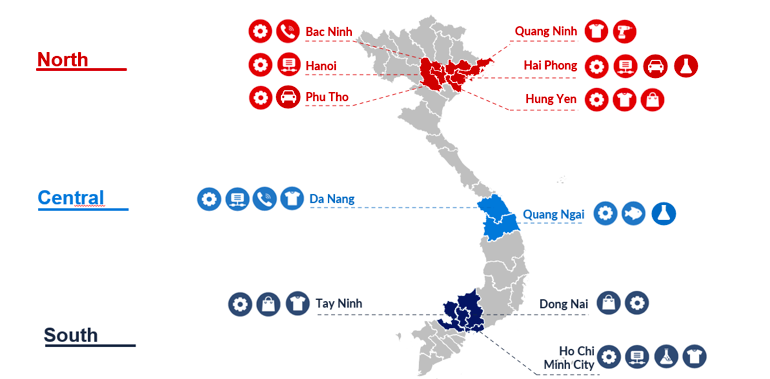
Samsung hires an average of 2,000 people a week for its production facilities in Vietnam. The diversification of the global supply chain has created opportunities for Vietnam for industrial transformation. It is no longer seen only as a low-cost manufacturing country, as it is among the top three most promising manufacturing hubs in Asia, according to the Asia Manufacturing Index 2026. In recent years, the country has attracted more investment in electronics, semiconductors, and high-tech industries. Samsung now produces a large share of its smartphones in Vietnam, while other technology companies are increasing investments in AI, chips, and electronic equipment. This shows how it is slowly transforming from a “cheap factory destination” into a higher-value manufacturing and technology hub.
Vietnam has emerged as one of the most attractive destinations for manufacturing. Its rise is driven by cost-effective labor, expanding trade architecture, a favorable investment climate, regulatory reforms, and better access to global markets through major trade agreements. The roots of this emergence can be traced back to the Doi-moi reforms of 1986 that marked a significant shift towards a market-oriented economy. These reforms opened Vietnam to foreign investment while simultaneously retaining one-party control.
The remarkable rise of Vietnam also raises an important question on how the country emerged as a destination of manufacturing, the structural challenges it is facing, the geopolitical implications of it rise and what reform policies are necessary to continue its growth.
China+1 Strategy Driving its Integration in the Global Production Hub
The most important driver is the China+1 strategy, where firms diversify their production beyond China to reduce risk and dependency. Nearly one-third of the supply chain leaders moved out of China or were planning to do so due to rising labour costs, trade war tariffs, and supply chain concentration risk. Vietnam’s geographic proximity to southern China reduced the complexities related to logistics. It emerged as a critical destination for sourcing operations in Asia as part of this strategy, making significant changes in its legal framework and infrastructure investments. These efforts have succeeded in attracting telecommunications companies, including Samsung, to relocate to Vietnam. Vietnam’s real GDP grew with the average rate of 7.4% between 1991-2009. Its productivity increases under the condition of international trade as it focuses on the production of the good with its absolute advantage.
Another central driver is foreign direct investment. There are several reasons for which Vietnam has been able to attract a large amount of Foreign Direct Investment: its strategic location in a fast-growing region, a stable political and economic environment, abundant natural mineral resources, a young and relatively well-educated labour force, a large and growing domestic market, its potential as an export platform for EU and US markets, and a liberal investment framework backed by the government’s consistent commitment to economic reform.
Many global firms like Samsung, LG, Panasonic, and Microsoft are active in Vietnam, with Samsung being one of the largest foreign investors in the country, with $9 billion invested, and an additional $3 billion smartphone factory under development. It employs over 5,000 production workers and software engineers. Vietnam is the second-largest employment base for Microsoft after the United States. Additionally, LG and Panasonic have set up production facilities in the north to manufacture white goods (for example, refrigerators, washing machines, and air conditioners).
Vietnam has signed a broad network of trade agreements that have amplified foreign investments. These agreements have opened market access and reduced tariffs, making Vietnamese exports more competitive. Starting from its 1995 accession to ASEAN and the ASEAN Free Trade Agreement (AFTA), followed by the ASEAN+ agreements from 1997, Vietnam has laid the foundation for regional integration. Its bilateral trade agreement with the US in 2000 granted access to the world’s largest export market without discrimination. Consequently, agreements, such as the 2009 Economic Partnership Agreement (EPA) with Japan and the major trade deals around 2015, including the Trans-Pacific Partnership (TPP) and the EU-Vietnam Free Trade Agreement (EVFTA), also introduced high-standard trade frameworks covering diverse sectors.
Vietnam is integrated into global value chains, and it exports and imports through three key industries. The textile and garment sector grew after the 1986 reforms and received a boost after WTO accession in 2007. Vietnam ranks 4th among the world’s largest clothing exporters behind China, Bangladesh, and India. Moreover, it is the third largest exporter of shoes and handbags after China and Italy. The footwear industry, it employs around one million workers in around 600 companies. Bilateral trade between Vietnam and the United States reached US$123 billion in 2023, up from US$92 billion in 2021, making the U.S. Vietnam’s largest export market.
Vietnam has placed itself among the most open economies in the ASEAN region due to its high import-export turnover. It has earned its name in the global value chain, especially in sectors such as electronics, textiles, and agricultural products, which are globally popular under the tag “Made in Vietnam”. It is also gradually moving towards production stages that involve high technical standards. Relations between the USA and Vietnam are reaching new heights, as evidenced by their dynamic, with the USA remaining Vietnam’s largest and most important export market. The USA also ranks 11th among key foreign investors in Vietnam. Vietnam also has 266 investment projects in the US with a total registered capital of nearly US$ 1.4 billion.
Assembly Platform Trap
Several structural weaknesses accompany Vietnam’s rise as a production hub in the global supply chain. The biggest problem is that Vietnam mostly does the lowest-value work. It assembles finished products but does not design, brand, or innovate them. The World Bank describes Vietnam as an “assembly platform” that carries out the cheapest and least skilled steps of production. This implies that even though Vietnam exports a lot, the real value that is gained within Vietnam remains relatively low. The link between foreign companies and local businesses is another weakness. Much of Vietnam’s export success comes from foreign firms that are not fully connected to the domestic economy. For example, in 2011, only 37% of the value in exports came from the local suppliers, while 67% came from foreign firms. The Vietnamese companies also struggle to absorb new technologies, and over time, the productivity growth has slowed down. The infrastructure and human capital gaps add to these challenges, as transport and logistics systems also need serious upgrades to keep up with the growing trade. The economy has developed into a “two-track system,” where foreign firms do very well, but domestic firms struggle to compete or connect.
However, Vietnam should be cautioned that the shift in factories from China to Vietnam is just a “low-hanging fruit” strategy, as moving production out of China is extremely expensive, estimated at around $1 trillion for US and European companies. Another risk associated with this is that Vietnam might be seen just as a cheaper alternative to China rather than an independent economy. The success stories, like the PAN group, show that transformation is possible but rare. These companies benefit from the finances and support from the government, but without broader reforms, it will remain an exception. To move beyond the low-value assembly and become a high-value economy in the long run, Vietnam needs to strengthen its domestic industries, boost productivity, and build stronger institutions.
However, despite its success, Vietnam remains largely dependent on low-value assembly work, foreign firms, and export-led growth, with limited domestic technological spillovers. This reflects its dependency structure, as even though it has attracted significant Foreign Direct Investment (FDI), much of its profit and intellectual property remain centred in the Multinational Corporations based in the developed economies.
Geopolitical Implications of Vietnam’s Rise in the Global Supply Chain
The rise of Vietnam as a production hub in the global supply chain has implications well beyond the economic dimension, as it also leads to the restructuring of production networks driven by the rivalry between the US and China. It also reflects how middle powers can navigate this production competition and become beneficiaries. The political and economic interests of major economies in Vietnam may have a broader impact on its economic development and trade. If there arises tension between the major economies or when the global supply chain gets disrupted, it may lead to the development of new sectors. The shifting geopolitics have opened a door for Vietnam to step into the semiconductor industry that China has long dominated. It has been actively attracting foreign investment and high-tech industries, gradually securing a key role in the global chip supply chain.
The leading firms, including Boeing and SpaceX, also chose Vietnam as part of their broader supply chain diversification between 2020 and 2024. This pattern confirms that geopolitical friction, rather than purely economic logic, has become a primary force reshaping where production occurs globally. Vietnam’s government has responded to these dynamics with calculated pragmatism. Hanoi has pursued “bamboo diplomacy” that maintains flexible and non-confrontational relationships with all major powers, simultaneously boosting the economic prospects created by the geopolitical competition
However, the escalating geopolitical conflicts and trade disruptions can also negatively affect Vietnam since its economy remains highly dependent on global trade. Its future as a global production hub is filled with both opportunities and challenges. It must build stronger domestic supporting industries and generate genuine technology spillovers from the Foreign Direct Investments (FDI) to address the structural limitations. It must improve product quality, standardize the production process, and accelerate digital transformation. By making effective use of strategic partnerships while strengthening the internal capabilities of domestic enterprises, Vietnam can not only maintain its current role but also gradually move to a higher position in the global value chain.
In Vietnam’s motor vehicle industry, Tier 1 suppliers Yazaki, Sumi Hanel, and Sumidenso run various large operations. Robotics and Additive Manufacturing (AM) have opened up new jobs for engineers who can run programs and make robots. This leads to better-paying and high-skilled jobs which is good for Vietnam. It should start setting up training centers to provide them with Additive Manufacturing (AM) skills and use them in many industries.
Vietnam’s Bet on Reforms
The recent wave of optimism around Vietnam focuses on the new set of government reforms where Resolution 68 is the most important. It emphasizes the private sector as the most important driving force of the national economy. It also honors the entrepreneurs as the ‘new warriors on the economic front’ and aims to double the number of private firms to 2 million by 2030. It calls for building 20 globally competitive private companies. The government has also committed billions to physical infrastructure and greenlit a US$67 billion high-speed rail line connecting Hanoi and Ho Chi Minh City, shrinking a 30-hour journey to five. It also plans to spend $25 billion on its airports by 2030.
The Vietnam Economic Update report highlights that Vietnam’s reform agenda is progressing in the right direction. However, to turn these reforms into concrete outcomes, it requires various efforts to ensure that the investments are productive with sufficient financing. The level of implementation should match the level of ambition. These reforms can create a positive cycle of investor confidence and increased private investment, which in turn will create greater resilience, supporting Vietnam’s progress.
Logistics and connectivity infrastructure are essential for Vietnam to sustain economic growth across all sectors. Among the logistics service providers, healthy market competition is necessary to ensure domestic firm participation and linkages with regional and international market providers. If Vietnam balances domestic and foreign market participation, it will maximize spillover effects while ensuring equitable service provision. It must continue investments in logistics infrastructure from a macro perspective and give priority to investing in human resources development by providing necessary skills for all levels of authorities and enterprises.
Conclusion
Current and future trends of the global economy will shape the evolution of its export competitiveness. The trade agreements could allow Vietnam to continue its growth as an export platform in the global production hub. Vietnam’s government has implemented comprehensive policy measures to create a business-friendly environment. Its rise as a manufacturing hub is also linked to the convergence of forces such as the China+1 strategy and a reformed investment framework. However, there are several structural problems hindering its rise. It continues to function as an assembly platform while lagging in domestic value addition.
To ensure long-term development, it must strengthen its domestic economy and promote technology spillovers. Otherwise, it risks capturing only a small share of the value they generate.



