
By : Jaiwant Singh Jhala, Research Analyst, GSDN
Artificial Intelligence refers to computer systems capable of performing tasks that typically require human intelligence, including learning, reasoning, decision-making, and pattern recognition. In military affairs, AI is often described as a force multiplier because it can improve the speed, accuracy, and effectiveness of military operations. China’s military leadership believes that future wars will be characterized by ‘intelligence warfare’,where AI-driven systems will dominate the battlefield. This concept goes beyond the earlier notion of information warfare and focuses on the use of machine learning, big data analytics, autonomous systems, and advanced computing to achieve superiority in combat. The Chinese government’s New Generation Artificial Intelligence Development Plan (2017) identified AI as a national priority and emphasized its military applications. Since then, China has invested heavily in AI research and development, encouraging collaboration between technology companies, universities, and defence institutions. China’s rapid advancements in Artificial Intelligence (AI) are transforming not only its economy and society but also its military capabilities. Over the last decade, the Chinese government has identified AI as a strategic technology that can revolutionize warfare and enhance national security. Through substantial investments, military-civil fusion policies, and technological innovation, China is integrating AI into a wide range of weapon systems and military operations. The country’s objectiveis to build a ‘world-class military’ by the middle of the 21st century and to gain a competitive advantage in future conflicts. AI has become central to the modernization efforts of the Chinese military, the People’s Liberation Army (PLA), influencing everything from autonomous weapons and intelligence gathering to cyber warfare and command systems.
AI Strategy and MCF-
One of the key features of China’s AI development is the policy of Military-Civil Fusion (MCF). Under this strategy, civilian technological innovations are integrated into military modernization efforts. Leading Chinese technology firms such as Baidu, Alibaba, Tencent, Huawei, and SenseTime contribute to AI development that can potentially support defence applications. Military-Civil Fusion enables the PLA to access cutting-edgetechnologies developed in the commercial sector, including machine learning algorithms, computer vision, natural language processing, robotics, autonomous navigation systems and big data analytics. This approach reduces development costs and accelerates the deployment of advanced military technologies.
AI and Weapon Systems-
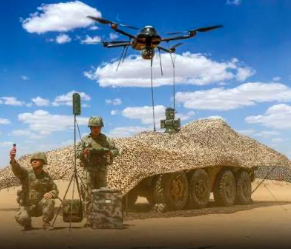
One of the most significant applications of AI in China’s military is the development of autonomous weapon systems. These systems can operate with minimal human intervention and make decisions based on data gathered from sensors and battlefield environments. China has become a major producer of military drones and is increasingly incorporating AI into their operations. AI-powered drones can identify targets automatically, navigate complex environments, coordinate with other drones, conduct surveillance missions, and carry out precision strikes. Chinese defence companies have demonstrated drone swarms capable of operating collectively using AI algorithms. Swarm technology allows hundreds of drones to communicate and cooperate, overwhelming enemy defences through coordinated attacks. Unlike traditional drones controlled by remote operators, AI-enabled drones can continue missions even when communication links are disrupted, making them more resilient in contested environments. China is also developing AI-enhanced loitering munitions, often referred to as ‘kamikaze drones. These weapons can search for targets independently and strike them once identified. AI improves target recognition and mission effectiveness while reducing the need for constant human control. AI is playing an increasingly important role in improving China’s missile capabilities. Modern missile systems require rapid identification and tracking of targets. AI algorithms help process sensor data from satellites, radar systems, and reconnaissance platforms to improve target acquisition. China has invested heavily in hypersonic missile technology. Hypersonic weapons travel at speeds exceeding Mach 5 and present significant challenges for missile defence systems. AI contributes to real-time navigation, flight-path optimization, target tracking, and evasion of defensive systems. By processing large amounts of data during flight, AI allows hypersonic weapons to adapt to changing battlefield conditions and improve their effectiveness. Modern warfare increasingly depends on the ability to process information rapidly and make timely decisions. China is integrating AI into command and control (C2) systems to improve battlefield management. AI systems analyze vast quantities of information from multiple sources, including satellites, radar systems, intelligence reports, drones, and communication systems. These systems can identify threats, recommend courses of action, and support commanders in making faster decisions. AI enhances situational awareness by combining data from different sensors into a comprehensive operational picture. This enables military leaders to respond quickly to emerging threats and coordinate forces efficiently. Chinese military strategists believe that decision superiority will be a critical factor in future wars, and AI provides a means of achieving this advantage.
Impact of AI on Navy-
China’s naval modernization program increasingly incorporates AI technologies. The PLA Navy is developing unmanned surface vessels (USVs) capable of performing reconnaissance, surveillance, anti-submarine warfare, and detection. AI enables these vessels to navigate independently, avoid obstacles, and coordinate with other naval assets. AI-powered underwater drones can conduct long-duration missions with limited human intervention. These systems support intelligence gathering, ocean surveillance, submarine tracking, and my countermeasures. Such capabilities are particularly important in strategically significant regions such as the South China Sea.
Impact of AI on Airforce-
China is actively integrating AI into its air force operations. AI assists pilots by processing sensor information, identifying threats, managing electronic warfare systems, and supporting tactical decisions. Future Chinese fighter aircraft may incorporate AI copilots capable of handling routine tasks and assisting in combat situations. China is exploring concepts like ‘loyal wingman’ drones. These AI-powered unmanned aircraft operatealongside manned fighters, extending combat capabilities while reducing risks to pilots. Their roles may include decoy operations and air-to-ground attacks.
Impact of AI on Cyber Warfare-
Cyber warfare represents another area where China is employing AI extensively. AI can identify network vulnerabilities, detect security weaknesses, automate cyberattacks, and adapt malware to changing defences. AI-driven cyber tools increase the speed and scale of offensive operations. At the same time, AI strengthens defensive capabilities. The combination of offensive and defensive cyber-AI enhances China’s overall cyber warfare posture. Electronic warfare also involves disrupting enemy communications, sensors, and command systems. China uses AI to analyse electromagnetic signals, jam enemy systems more effectively and adapt electronic attacks in real time. Machine learning algorithms can rapidly process large volumes of signal intelligence and identify opportunities for disruption that human operators might miss.
Challenges-
Despite significant progress, China faces several challenges in integrating AI into weapon systems. AI systems can suffer from data quality problems, algorithmic errors, vulnerability to deception, and reliability issues in complex environments. Battlefield conditions are often unpredictable, making autonomous decision-making difficult. The growing use of autonomous weapons raises important ethical questions. Concerns include accountability for AI decisions, civilian casualties, compliance with international humanitarian law, and risk of accidental escalation. Many countries are debating whether fully autonomous lethal weapons should be regulated or restricted. AI systems may themselves become targets of cyberattacks. Adversaries could attempt to manipulate data inputs, hack autonomous systems, disrupt communication networks, and exploit software vulnerabilities. Protecting AI-enabled weapon systems is therefore a major challenge.
China’s use of AI in weapon systems has significant implications for global security. AI may alter the military balance in the Indo-Pacific region by enhancing China’s operational capabilities. Neighboring countries and major powers are closely monitoring these developments. AI accelerates military competition among leading powers. The United States, China, and other nations are investing heavily in AI-driven military technologies, creating a new technological arms race. The increasing autonomy of weapon systems could shorten decision-making times during crises. While this may improve military effectiveness, it also raises the risk of miscalculation and unintended escalation. AI is also transforming the nature of warfare itself. Future conflicts may involve extensive use of autonomous systems, cyber operations, and machine-driven decision-making, reducing reliance on traditional military platforms.



