
By : Soumya Dutta, Research Analyst, GSDN
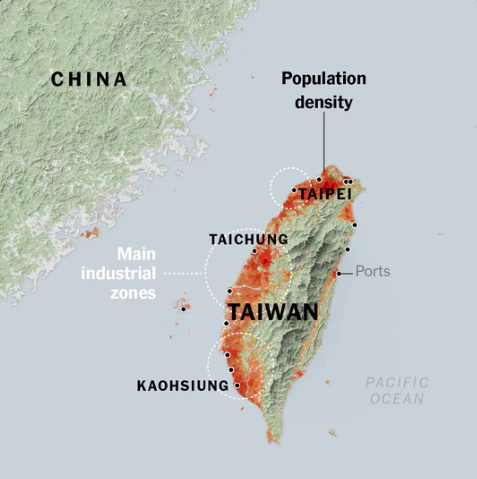
On July 20-21, 2026, a People’s Liberation Army (PLA) helicopter and an unmanned aerial vehicle (UAV) crossed into the Taiwan Strait median line, a significant boundary for escalation control between China and Taiwan and stayed for roughly 9.5 hours inside the Taiwan’s restricted R9 zone east of the line. It has not been the first publicly reported case of the PLA using its air assets and testing Taiwan’s response thresholds but they typically consisted of fighter jets that stayed for a few minutes and headed back, however using a helicopter that hover at a lower altitude and for such extended period sets a dangerous precedent. Combined with a reconnaissance UAV, it points to a more coordinated use of troops for a possible cross-Strait action.
These operations by China has been generally understood as strategic signaling, but these expanded efforts point towards a more ‘operational conditioning’, whereby these external actors are normalizing their presence in what Taiwan claims as its sovereign domain, rehearsing access corridors and incrementally changing the baseline for acceptable airspace behavior. These actions are far more consequential than what coercive messaging would have done, precisely as no codified law is being violated. The Air Defence Identification Zone (ADIZ) along with the median line do not carry any international legal status, so what is under attack is not a statute but the acceptable measures of restraint, whose erosion as Taipei fears may very well lead to a reunification as Beijing claims under its ‘One China’ policy.
Therefore, the legal distinction regarding the routine PLA operations around Taiwan is crucial to understanding the significance of these incursions. The clearest legal boundary for Taiwan is its 12 nautical-mile territorial airspace, where an entry by Chinese military aircraft would be considered a substantial violation of Taiwan’s sovereignty. This framework is grounded in international agreements, most notably the 1944 Chicago Convention on International Civil Aviation, which established the principle of state sovereignty over national airspace. Most PLA aircrafts, however, remain outside this boundary and within the ADIZ, which acts an early-warning and identification buffer along with the median line, which is an informal military demarcation established during the Cold War with US support to reduce the risk of military incidents, but neither China nor Taiwan has formally agreed to it. With room to manoeuvre, Beijing has gradually expanded the frequency and duration of its operations, normalizing a more persistent PLA military presence around Taiwan.
A Long-Arc of Taiwan Strait Crisis
These patterns that continued for over a decade have been marked by a few trigger points, most notably the 2022 visit by US House Speaker Nancy Pelosi which was perceived as a breach of the narrative, that Taiwan is an inalienable province of China, culminating into the Fourth Taiwan Strait Crisis. This prompted China to launch large-fire military exercises, conduct drone and maritime assault operations, thereby effectively rehearsing a blockade of the island. Similar Chinese military response has followed Taiwan President Tsai Ing-wen’s meeting with US Speaker Kevin McCarthy in 2023 and then Vice President Lai Ching-te’s layover in US, with Beijing conducting increasingly extensive exercises around the island. This pattern has thus continued through the Joint Sword series and Justice Mission-2025, which increasingly focus on encirclement, blockade, strikes on critical infrastructure and establishing anti-access/anti-denial (A2/AD) capabilities to constrain the ability of external actors to intervene directly.
Against this backdrop Taiwan Strait has remained a geopolitical flashpoint, with its narrow corridor placed at the centre of tensions between Taiwan and mainland China. The current phase of heightened tensions can be understood as a continuation of a recurring pattern of crises in the strait, dating back to the First Taiwan Strait Crisis in 1954-55. It began, when Beijing shelled the Taiwan-controlled offshore island of Kinmen and Matsu, bringing China and the United States close to direct military confrontation. Soon after, the Second Taiwan Strait Crisis followed in 1958, when China again bombarded the island, prompting US military intervention and raising fears of a wider conflict, including the possible use of nuclear weapons. The Third Taiwan Strait crisis in 1995-96, nearly four decades later saw Beijing conduct missile tests and military manoeuvres around Taiwan in an attempt to pressure Taipei ahead of its first presidential election. This escalation then prompted Washington to deploy two aircraft carrier groups to the region.
With each episode leaving behind a precedent that Beijing has turned into a new operational normal, this baseline has been reinforced by China’s equipping of all its five theatre commands with the J-20 fifth generation fighter jets and undertaking joint military exercises and normalizing a persistent air presence. What makes the recent development interesting, is also the deliberate shift in strategy, after the detected Chinese fighter sorties dropped to a three year low in the first half of 2026 to 1334 a result of the Trump-Xi Summit in Beijing earlier this year and perhaps since Beijing has already established the behavioral thresholds, which it can now maintain with lower operational costs and also reduce the international attention spikes arising from observers.
What Beijing Gains Now and Later
The question therefore arises on this apparent resurgence and what does China hope to achieve? In this context, these developments are not a renewed aggression but a validation of the precedent it has gained while slowly redefining the strait status quo. Moreover, Beijing aims to achieve certain short term as well as long term goals through this. Firstly, repeated ADIZ incursions result in a cumulative strain on Taiwan’s air defence system and erode its response efficiency and threshold. Secondly, this enables the PLA to rehearse its blockade and access-denial tactics in a peacetime setting. Third exceptional actions now tend to appear routine. In the longer term, rather than avoiding escalation Beijing is learning to author it. This has been a sequence however not unique to Taiwan, but visible in the South China Sea and in the East China Sea around the Senkaku Islands, administered by Japan. The aim of unification then carriers a more consequential effect than coercion itself.
A Red Line or not?
The response of the stakeholders therefore becomes important on how they interpret these developments. China has repeatedly asserted its territorial integrity and emphasized its commitments on achieving the ‘One China’ principle while blaming countries like the US for breaching its pledge to maintain ‘unofficial only’ relations with Taiwan, as highlighted by Pelosi’s visit and even releasing white papers on reunification. Taiwan’s Ministry of Foreign Affairs (MOFA) has described China’s actions as a violation of the “rules based international order” and “international norms,” even condemning similar airspace intrusions in regions like Japan while updating its engagement rules and declaring that any Chinese aircraft that enters its sovereign airspace of 12 nautical miles of the coasts, in contrast to median line (25 miles) will invite a military response.
These developments also coincide with the so-called Davidson Window which anticipates China’s militarily actions against Taiwan by 2027. However, Beijing has not articulated a specific public deadline for achieving reunification. Instead, the CPC has consistently framed it as part of its broader ambition of “national rejuvenation”, associated with the 2049 centenary of the PRC. What matters more is however the method, as Beijing is not preparing for a single decisive moment but incrementally redefining what counts as acceptable behavior in contested airspace, one uncontested incursion at a time. As key actors from Washington to Tokyo and Manila observe these developments, India too must pay closer attention to the implications of such incremental normalization for airspace management and crisis stability in contested theatres, particularly along its sensitive frontiers. The deeper risk therefore lies not simply in misreading Beijing’s signals, but in misjudging the baseline itself failing to notice when yesterday’s exception has quietly become today’s norm.



